Responsible Workforce Technology: Better Information Without Losing Employee Trust

Workforce technology gives organisations unprecedented visibility over working time, attendance, access, absence and operational performance. Used correctly, it can improve payroll accuracy, reduce administration, control labour costs and help protect employees. Used without clear safeguards, however, the same technology can create legitimate concerns about privacy, fairness and excessive monitoring.

Responsible workforce technology is not about collecting as much employee information as possible. It is about using the right information, for a clearly defined business purpose, with appropriate security, transparency and human oversight.

This distinction is becoming increasingly important. The UK Government is currently considering how workplace-monitoring technologies should be managed, with a particular focus on clarity, transparency, employee voice and responsible implementation. This is a consultation rather than final legislation, but it gives employers a clear indication of the direction in which expectations are moving. Read the Government’s workplace-monitoring consultation.

Workforce technology should have a clear purpose

Every workforce system should begin with a legitimate operational requirement.

An employer may need to record attendance so employees are paid accurately, manage access to restricted areas, confirm who is present during an emergency, monitor working-time compliance or understand the labour used on a particular job or production process.

These are valid business purposes. Problems arise when information collected for one reason is subsequently used for an unrelated purpose without proper consideration, communication or justification.

Before introducing any workforce technology, an organisation should therefore be able to explain:

  • What information will be collected.
  • Why that information is required.
  • How it will be used.
  • Who will be able to access it.
  • How long it will be retained.
  • Whether it will contribute to any automated decisions.
  • What choices or alternatives are available to employees.

Transparency creates confidence

Employees should not have to guess how workplace technology affects them.

Clear communication helps employees understand that a time-and-attendance system is there to create accurate records, that access control protects people and premises, or that operational data is being used to improve production rather than simply scrutinise individuals.

Where appropriate, employers should consult employees and their representatives before new technology is introduced. This provides an opportunity to explain the business requirement, answer questions and identify legitimate concerns before implementation.

Transparency is particularly important where technology involves location data, biometrics or detailed operational information.

Biometric technology requires additional care

Facial recognition can provide fast, contact-free and highly accurate employee identification. It can reduce forgotten credentials, discourage “buddy clocking” and support secure access control.

However, biometric information used to identify a person is special-category personal data. The Information Commissioner’s Office states that organisations must complete a Data Protection Impact Assessment before processing biometric data to identify workers.

Employers must also establish an appropriate lawful basis, demonstrate that the proposed use is necessary and proportionate, and consider whether a less intrusive alternative could achieve the same objective.

Where consent is being relied upon, employees must have a genuine choice. The ICO gives the example of providing a swipe-card alternative without disadvantaging employees who do not wish to use biometrics. Read the ICO’s guidance on biometric time and access control.

This does not mean that facial recognition cannot be used responsibly. It means that the organisation introducing it must make a considered and properly documented decision.

Collect only what is needed

A responsible system should allow organisations to configure technology around their actual requirements rather than forcing them to collect unnecessary information.

For example, a mobile employee may need to confirm that they have arrived at an authorised work location. That does not automatically mean their movements need to be continuously tracked throughout the working day.

Similarly, operational technology may need to record which employee completed a job or production operation, but this should not become unrestricted personal surveillance.

The principle is straightforward: collect the information needed to achieve the defined purpose—and no more.

Important decisions should remain subject to human oversight

Workforce systems can identify exceptions, highlight patterns and provide managers with better information. They should not remove appropriate management judgement.

An attendance pattern may require investigation, but the system will not necessarily understand the personal or operational circumstances behind it. A productivity variance may identify a problem, but it may have been caused by machine downtime, material shortages, training requirements or an unrealistic production target.

Technology should support fair, consistent and informed decisions. Managers should remain able to review the underlying information, correct errors and consider the wider context before action is taken.

Security must be designed into the solution

Workforce information must be protected throughout its lifecycle.

This includes appropriate access controls, encryption, secure communications, clearly defined administrative permissions, retention policies, audit trails and reliable deletion processes. Remote access should also be controlled, authorised and restricted to the systems and time periods genuinely required.

The organisation using the system remains the data controller and is responsible for determining why and how employee information is processed. The technology provider should support that responsibility through secure design, clear documentation and configurable controls.

The Ceequel® approach

Ceequel® brings together Time & Attendance, HR, Employee Self Service, Access Control, Visitor Management, mobile clocking and Operational Intelligence within one configurable software suite.

This allows organisations to establish consistent controls across workforce processes while maintaining clear distinctions between different types of information and their intended purposes.

Depending on the organisation’s requirements, Ceequel can support:

  • Facial recognition or non-biometric proximity credentials.
  • Defined user roles and administrative permissions.
  • Accurate time, attendance, absence and working-hours records.
  • GPS and geofenced mobile clocking for authorised locations.
  • Controlled access to buildings and restricted areas.
  • Interactive fire and evacuation information.
  • Job, operation, output, downtime and labour-cost analysis.
  • Audit trails supporting management and compliance requirements.
  • Integration with payroll, HR and wider business systems.

The communications software used within Ceequel clocking devices is designed and coded by ELF Productivity Ltd, providing secure, encrypted communication between hardware and the Ceequel software environment.

Crucially, Ceequel provides information to authorised managers; it does not replace their responsibility to make fair, proportionate and properly informed decisions.

Better control and responsible use belong together

Organisations do not have to choose between operational visibility and employee trust.

A well-designed workforce-management system can help employers control labour costs, improve payroll accuracy, manage compliance and make better decisions while still respecting privacy, proportionality and individual rights.

The strongest workforce technology is not simply the technology that collects the most information. It is the technology that gives an organisation the information it genuinely needs, protects that information properly and enables it to be used openly, fairly and responsibly.

To discuss how Ceequel® can support responsible workforce management across your organisation, contact ELF Productivity Ltd or request a demonstration.
Why ERP Shop Floor Data Collection Falls Short of Continuous Improvement

Many ERP systems now include some form of Shop Floor Data Collection (SFDC). On the surface, this appears to give manufacturers everything they need: production quantities, labour time, machine status, scrap levels and completed works orders.

However, collecting production transactions is not the same as providing the insight required for continuous improvement.

ERP systems are designed primarily to manage business processes. They are excellent at controlling works orders, inventory, purchasing, scheduling, costing and financial reporting. Their shop-floor functionality is generally designed to feed these processes with accurate production data.

Continuous improvement requires something different.

ERP Records What Happened

Most ERP-based SFDC systems concentrate on recording key transactions, such as:

  • When a works order started and finished
  • How many units were produced
  • The quantity of scrap recorded
  • The labour hours allocated to the job
  • Whether the order was completed
  • What materials were consumed

This information is important, but it usually provides a high-level summary rather than explaining what happened throughout the production process.

A works order may have taken two hours longer than planned, but why?

Was it caused by a machine stoppage, a shortage of material, an extended changeover, a quality problem, an unavailable operator or repeated short interruptions?

The ERP system may show the variance, but it rarely captures the operational detail needed to understand and eliminate its cause.

Continuous Improvement Needs Greater Detail

Continuous improvement depends upon identifying patterns, losses and recurring problems. This requires detailed, accurate and timely information from the shop floor.

Manufacturers need to understand:

  • Why machines and production lines stopped
  • How often short, unplanned stoppages occurred
  • Whether delays were caused by machines, materials, methods or labour
  • How actual cycle times compared with expected performance
  • Where bottlenecks developed
  • Why output varied between shifts, teams or products
  • What caused scrap, rework or quality failures
  • How long changeovers actually took
  • Whether corrective actions delivered a measurable improvement

Without this level of information, improvement teams are often forced to rely on spreadsheets, handwritten records, supervisor feedback and employee recollection.

By the time the information is reviewed, much of the context has already been lost.

The Problem with High-Level Downtime Codes

Some ERP platforms allow operators to select downtime or loss codes. However, these are often too broad to support meaningful root-cause analysis.

Recording “machine breakdown” does not explain which component failed, what symptoms were observed, whether the same fault has occurred previously or what action was taken to resolve it.

Likewise, “material shortage” does not identify whether the material was unavailable, delivered late, incorrectly located, rejected for quality reasons or supplied in the wrong quantity.

Continuous improvement requires structured data that allows organisations to move beyond identifying the category of a problem and begin understanding its underlying cause.

Small Losses Create a Big Problem

ERP systems are generally designed around significant production events. Yet many of the greatest opportunities for improvement are hidden within smaller, repeated losses.

A production line may suffer dozens of two or three-minute stoppages during a shift. Individually, these interruptions may not appear important enough to record. Collectively, however, they can account for hours of lost production every week.

If these micro-stoppages are not captured, categorised and analysed, they remain invisible. The ERP system may simply show that the works order took longer than expected, without revealing the repeated events responsible for the lost time.

Reporting Is Not the Same as Analysis

ERP reporting typically answers business questions such as:

  • Was the order completed?
  • How much did it cost?
  • Was the required quantity produced?
  • How much material was consumed?
  • What was the labour variance?

Continuous-improvement teams need to ask different questions:

  • Where are we losing productive time?
  • Which problems occur most frequently?
  • Which issues have the greatest impact?
  • Are the same faults recurring?
  • Which shift or product experiences the most variation?
  • Did the corrective action work?
  • What should we improve next?

Answering these questions requires data to be explored by machine, production line, product, shift, employee, reason, duration and frequency. It also needs to be presented in a way that helps managers recognise trends and prioritise action.

A standard ERP report may present the numbers, but it does not necessarily turn them into actionable operational intelligence.

Real-Time Visibility Matters

ERP information is often reviewed after a shift, production run or reporting period has ended. This is suitable for costing and historical reporting, but improvement opportunities frequently require a much faster response.

Supervisors need to see when performance begins to fall, when downtime is increasing or when a production line is operating below its expected rate. The earlier a problem is identified, the sooner action can be taken.

Real-time operational visibility helps manufacturers prevent a minor issue from becoming an entire shift of lost production.

The ERP Still Has an Important Role

This does not mean replacing the ERP system.

The ERP should remain the central platform for managing orders, materials, stock, schedules and financial information. What it needs is a dedicated operational-intelligence layer capable of collecting and analysing the detailed information that conventional ERP transactions cannot provide.

An effective solution should combine data collected directly from machinery and PLCs with information entered by employees on the shop floor. This creates a more complete picture by capturing both what happened and the operational reason behind it.

The resulting information can then be used to support OEE, downtime analysis, root-cause investigation, DMAIC, Six Sigma and other structured improvement programmes.

From Shop Floor Data to Operational Intelligence

Ceequel® Operational Intelligence goes beyond traditional Shop Floor Data Collection. It provides manufacturers with the detailed, real-time information needed to understand production losses, investigate their causes and measure the results of improvement activity.

Rather than competing with the ERP system, it complements it. Production orders and relevant business data can be shared between the two platforms, while Ceequel® captures the deeper shop-floor detail required by production managers and continuous-improvement teams.

Because collecting more data is not the objective.

The real objective is to provide the right people with clear, reliable information that helps them reduce waste, improve performance and make better operational decisions.

An ERP system can tell you what was produced and what it cost.

Ceequel® Operational Intelligence helps explain why performance varied—and what you can do to improve it.

Replacing Mitrefinch TMS: A Practical Guide for UK Employers

As workforce management requirements continue to evolve, many organisations are reviewing whether their existing Time & Attendance solution remains aligned with their operational, payroll, compliance, and workforce management objectives.

If your organisation currently uses Mitrefinch TMS and is considering its future options, this guide provides a practical framework for assessing whether your current solution continues to meet your needs and, if not, what should be considered when evaluating alternative platforms.

This article is intended as an impartial guide to help employers make informed decisions based on their own business requirements.

Why Organisations Review Their Time & Attendance System

Time & Attendance systems are a critical component of workforce management. As organisations grow, diversify, or modernise their operations, requirements often change.

Common reasons for reviewing an existing solution include:

  • Increasing payroll administration and manual intervention.
  • Expansion across multiple sites or locations.
  • Greater use of remote, mobile, or field-based employees.
  • A requirement to integrate Time & Attendance with HR, Payroll, ERP, Access Control, or Visitor Management systems.
  • The need for improved management visibility and reporting.
  • Changes in working practices, legislation, or compliance requirements.
  • Hardware refresh programmes or software renewal cycles.
  • Business acquisitions, mergers, or organisational restructuring.

A system review does not necessarily mean a replacement is required. However, it provides an opportunity to assess whether the current solution continues to deliver the functionality, efficiency, and return on investment expected by the business.

What a Modern Workforce Management Solution Should Deliver

A Time & Attendance solution should do more than simply record employee attendance. It should provide accurate workforce data that supports operational decision-making, payroll accuracy, compliance, and employee engagement.

When evaluating any solution, organisations should expect:

Accurate Workforce Data

  • Real-time attendance monitoring.
  • Automated calculation of working hours.
  • Accurate overtime and absence management.
  • Reduction in manual payroll adjustments.

Improved Management Visibility

  • Real-time workforce dashboards.
  • Exception reporting.
  • Attendance trend analysis.
  • Labour cost visibility.

Streamlined Payroll Processing

  • Automated payroll preparation.
  • Clear audit trails.
  • Reduced payroll queries.
  • Reliable integration with payroll systems.

Workforce Compliance

  • Working Time Regulations monitoring.
  • Absence tracking.
  • Audit and reporting capabilities.
  • Accurate records for compliance purposes.

Enhanced Employee and Manager Self-Service

  • Electronic holiday requests.
  • Manager approvals.
  • Employee access to attendance records.
  • Mobile workforce capabilities where required.

Key Questions to Ask During a System Review

Whether reviewing your current supplier or considering alternative providers, consistency is essential. Every supplier should be evaluated against the same criteria.

Payroll Management

  • How are exceptions and anomalies identified and managed?
  • How are audit trails maintained?
  • How does the system reduce payroll administration?

Business Rules

  • Can the solution accommodate existing working rules and agreements?
  • How flexible is the configuration?
  • Can future changes be implemented without development work?

Hardware and Data Collection

  • What clocking methods are available?
  • Can existing hardware be retained?
  • What options exist for mobile or remote workers?

Integration

  • What integrations are available with Payroll, HR, ERP, Access Control, and Visitor Management systems?
  • Are integrations proven and supported?

Security and Hosting (for cloud based systems)

  • Where is data hosted?
  • What security standards are maintained?
  • What service levels and support arrangements are provided?

Implementation

  • What does the migration process involve?
  • How is data transferred and validated?
  • What support is available during and after implementation?

Commercial Considerations

  • What are the initial implementation costs?
  • What ongoing support and maintenance costs apply?
  • Are there any additional licensing or usage-based charges?

The Importance of a Structured Migration Process

For most organisations, the greatest risk during a replacement project is not the installation of new software. The primary challenge is ensuring that existing workforce rules, pay calculations, attendance policies, and operational processes are accurately replicated or improved.

A successful migration project should include:

  • Detailed Scope of Works.
  • Documentation of existing rules and processes.
  • Configuration review and approval.
  • Data migration planning – if available.
  • Payroll validation and parallel testing.
  • User and manager training.
  • Post-implementation support.

Organisations should seek clear documentation outlining how each stage of the migration will be managed.

Evaluating Long-Term Value

While software functionality remains important, organisations should also consider the broader value delivered by a workforce management solution.

Areas worth evaluating include:

  • Reduction in payroll administration.
  • Removal of manual calculations.
  • Improved labour cost control.
  • Enhanced workforce visibility.
  • Reduced manual processes.
  • Improved compliance reporting.
  • Increased management efficiency.
  • Scalability for future growth.

A workforce management platform should support operational objectives not only today, but also as the organisation evolves over the coming years.

Making an Informed Decision

Every organisation’s requirements are unique. The most effective procurement decisions are based on clearly documented business objectives, operational requirements, implementation considerations, support arrangements, and long-term value (ROI).

A structured review process allows organisations to assess whether their existing solution remains the best fit or whether alternative platforms may offer additional benefits more aligned with future business goals.

By taking a measured and evidence-based approach, organisations can ensure that any investment in workforce management technology delivers meaningful improvements in productivity, efficiency, accuracy, and visibility.

About Ceequel®

Ceequel® is a UK-developed workforce management platform designed to help organisations manage attendance, absence, labour costs, employee self-service, manager approvals, access control, visitor management, and workforce reporting through a single integrated solution.

Supporting organisations across manufacturing, logistics, food production, distribution, healthcare, engineering, and other sectors, Ceequel® provides flexible deployment options and configurable workforce management capabilities designed to meet the operational requirements of modern UK employers.

For organisations reviewing their current Time & Attendance solution, a structured demonstration and discovery process can help determine whether Ceequel® is aligned with their operational and workforce management objectives.


This article is intended for informational purposes only and does not make any representations regarding the performance, functionality, support, commercial arrangements, or future direction of any third-party software product or supplier. Organisations should undertake their own evaluation based on their individual business requirements and procurement processes.

Replacing Legacy Kronos Systems: A Practical Guide for UK Employers

Many organisations have relied on Kronos workforce management solutions for years, benefiting from robust time recording, scheduling, and workforce management capabilities. However, as technology, workforce expectations, and business requirements evolve, many employers are taking the opportunity to review whether their existing system continues to meet their operational needs and future objectives.

If your organisation is currently using a legacy Kronos solution and is considering its long-term strategy, this guide outlines the key factors that should be considered when evaluating your existing platform and assessing potential alternatives.

This article is intended as an educational resource to support informed decision-making and procurement best practice.

Why Organisations Review Legacy Workforce Management Systems

Workforce management systems often remain in place for many years. During that time, businesses can undergo significant changes that place new demands on technology and operational processes.

Common reasons organisations review their existing workforce management platform include:

  • Changes to payroll processes and compliance requirements.
  • Business growth, acquisitions, or multi-site expansion.
  • Increasing use of mobile, remote, or hybrid working.
  • A desire to improve management visibility and workforce analytics.
  • The need for greater automation and reduced administration.
  • Wider digital transformation programmes.
  • ERP, HR, or payroll system replacement projects.
  • Hardware refresh cycles or infrastructure modernisation initiatives.
  • Evolving employee expectations around self-service and accessibility.

A system review provides an opportunity to assess whether the existing platform remains aligned with current business objectives and future workforce management requirements.

What Modern Workforce Management Should Deliver

Today’s workforce management systems are expected to do far more than simply record attendance.

A modern solution should support strategic decision-making while improving operational efficiency across the organisation.

Accurate Time Recording

Organisations should expect:

  • Real-time attendance visibility.
  • Automated working time calculations.
  • Accurate overtime management.
  • Comprehensive absence monitoring.
  • Clear audit trails for payroll processing.

Improved Operational Visibility

Managers should have access to:

  • Live workforce dashboards.
  • Attendance exception reporting.
  • Labour utilisation data.
  • Departmental and site-level analytics.
  • Real-time workforce status information.

Payroll Efficiency

Effective workforce management should help organisations:

  • Reduce manual payroll administration.
  • Minimise payroll queries and adjustments.
  • Improve payroll accuracy.
  • Streamline payroll preparation processes.
  • Provide clear reporting and audit capabilities.

Employee and Manager Self-Service

Modern solutions increasingly support:

  • Holiday and absence requests.
  • Electronic approvals.
  • Mobile workforce access.
  • Employee attendance visibility.
  • Manager workflow automation.

Workforce Compliance

Employers should be able to monitor and report on:

  • Working Time Regulations.
  • Attendance policies.
  • Absence management.
  • Audit requirements.
  • Workforce governance procedures.

Key Areas to Assess During a System Review

When reviewing any workforce management platform, organisations should evaluate suppliers using consistent criteria.

Workforce Management Functionality

Consider whether the solution supports:

  • Complex shift patterns.
  • Overtime rules.
  • Attendance management.
  • Absence management.
  • Flexible working arrangements.
  • Multi-site operations.

Payroll Integration

Questions to consider include:

  • How is payroll data prepared and transferred?
  • What validation processes exist?
  • How are exceptions managed?
  • What audit capabilities are available?

Data Collection Methods

Review the available options for:

  • Biometric clocking.
  • Facial recognition.
  • Proximity cards and fobs.
  • Mobile workforce applications.
  • Web-based attendance recording.

Integration Capabilities

Organisations should understand how the platform shares data with:

  • Payroll systems.
  • HR software.
  • ERP platforms.
  • Access Control systems.
  • Visitor Management solutions.
  • Business intelligence and reporting tools.

Security and Infrastructure

Areas to evaluate include:

  • Data hosting arrangements.
  • Security standards and certifications.
  • Business continuity provisions.
  • Support and service level agreements.
  • Disaster recovery procedures.

Scalability

A workforce management platform should support:

  • Organisational growth.
  • Additional sites.
  • New departments.
  • Future technology requirements.
  • Evolving workforce practices.

Planning a Successful Migration

Any workforce management replacement project should be approached as a business transformation initiative rather than simply a software installation.

Successful projects typically include:

Discovery and Analysis

  • Review of existing workforce rules.
  • Documentation of attendance policies.
  • Identification of payroll requirements.
  • Review of reporting needs.

Configuration and Validation

  • Comprehensive Scope of Works.
  • Operational validation.
  • Payroll validation.
  • Rule verification.

Data Migration

  • Historical data requirements.
  • Employee information transfer.
  • Validation procedures.

Training and Adoption

  • Manager training.
  • Employee communication.
  • User documentation.
  • Ongoing support arrangements.

Go-Live and Post-Implementation Support

  • Controlled deployment.
  • Parallel payroll testing where appropriate.
  • Dedicated support during transition.
  • Performance monitoring.

Looking Beyond Features

When reviewing any workforce management solution, organisations should consider the wider business outcomes it can deliver.

These may include:

  • Reduced labour administration.
  • Improved payroll accuracy – no payroll leakage.
  • Greater workforce visibility.
  • Better labour cost control.
  • Improved operational efficiency.
  • Enhanced compliance reporting.
  • Increased employee engagement.
  • Better management decision-making.

The objective should be to identify a solution that supports both immediate operational needs and long-term organisational goals.

Future-Proofing Workforce Management

As workforce management technology continues to evolve, organisations increasingly seek platforms that can support a wider range of operational requirements from a single environment.

Areas commonly considered during strategic reviews include:

Bringing these functions together can help reduce administration, improve data accuracy, and provide a more unified view of the workforce.

About Ceequel®

Ceequel® is a UK-developed workforce management platform designed to help organisations manage attendance, absence, labour costs, employee self-service, manager approvals, access control, visitor management, and workforce reporting through a single integrated solution.

Used across manufacturing, food production, logistics, engineering, healthcare, distribution, and other sectors, Ceequel® provides organisations with configurable workforce management capabilities that can be tailored to specific operational requirements.

For organisations reviewing legacy workforce management platforms, a structured discovery and demonstration process can help determine whether Ceequel® aligns with their current and future workforce management objectives.


This article is provided for informational purposes only and does not make any representations regarding the performance, functionality, support arrangements, commercial terms, product lifecycle, or future direction of any third-party software product or supplier. Organisations should undertake their own independent evaluation based on their specific operational requirements, procurement processes, and business objectives.

UK Manufacturing Is Data-Rich – Five Principles for Turning Manufacturing Data into Better Decisions

Part 2 of a 2 Part Series……….

Most manufacturers already hold a significant amount of operational information.

The challenge is converting that information into something managers can use to improve productivity, control cost and sustain Continuous Improvement.

A dashboard containing dozens of measures may look impressive. But if it does not help the organisation make a better decision, its commercial value is limited.

Manufacturers can improve the value of their operational data by applying five practical principles.

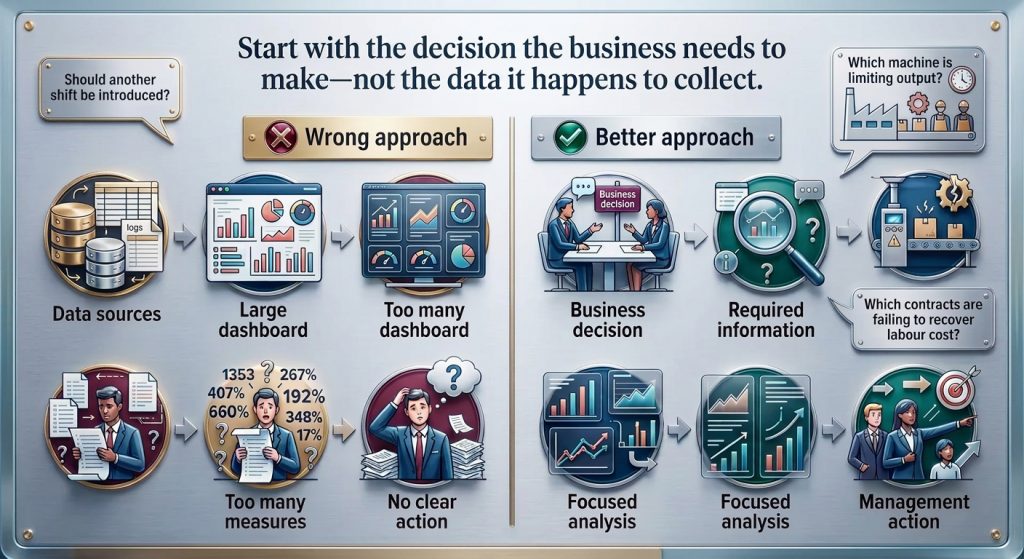
1. Begin with the decision, not the dashboard

A data project should not begin by asking:

What information can we collect?

It should begin by identifying the decisions the organisation needs to improve.

For example:

  • Should another shift be introduced?
  • Is a particular product commercially viable?
  • Which machine is creating the greatest constraint?
  • Why does one production line outperform another?
  • Is overtime increasing output or compensating for inefficiency?
  • Which contracts are failing to recover their true labour cost?

Once the decision is clear, the manufacturer can determine which information is required to support it.

This prevents the business from collecting data simply because it is available.

2. Connect planned performance with operational reality

Most manufacturers already hold production plans, estimates, standards and expected costs.

The difficulty lies in comparing them consistently with what actually happened.

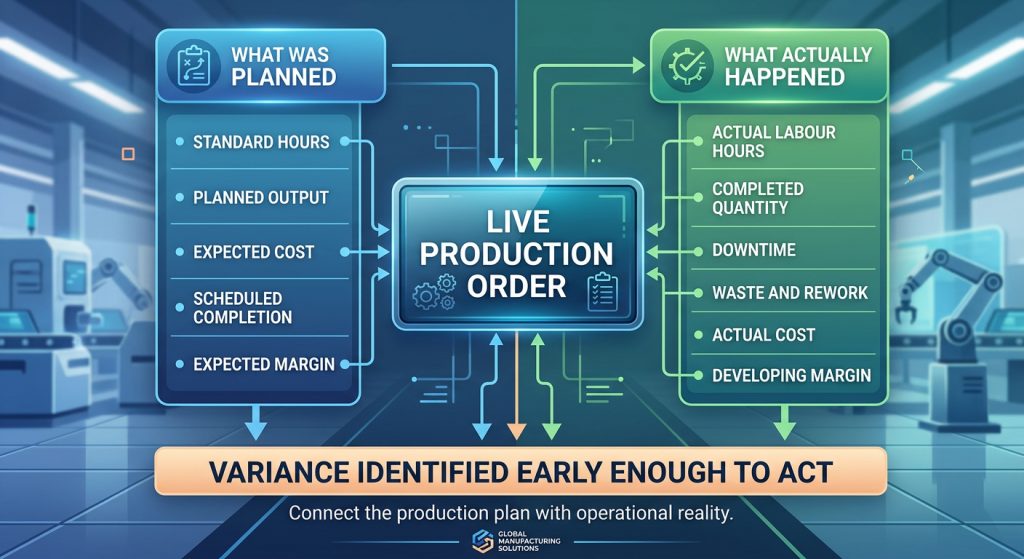
A production order should not remain an isolated record within an ERP system.

It should become a live operational entity against which the business can attribute:

  • Labour
  • Activities
  • Machine usage
  • Output
  • Downtime
  • Waste
  • Rework
  • Work in Progress

This enables the manufacturer to compare:

  • Estimated cost with actual cost
  • Standard hours with actual hours
  • Planned output with completed output
  • Expected margin with developing margin
  • Scheduled completion with likely completion

Planning information then becomes a tool for operational control rather than simply a record of what was expected.

3. Capture information where the activity takes place

Operational data becomes less reliable when it depends on memory or retrospective entry.

Employees may be asked at the end of a shift to remember when a job started, why it stopped or how long they spent on an unplanned activity.

Supervisors may reconstruct events from paper records, spreadsheets and conversations.

Information should instead be captured as close as possible to the activity.

This may involve:

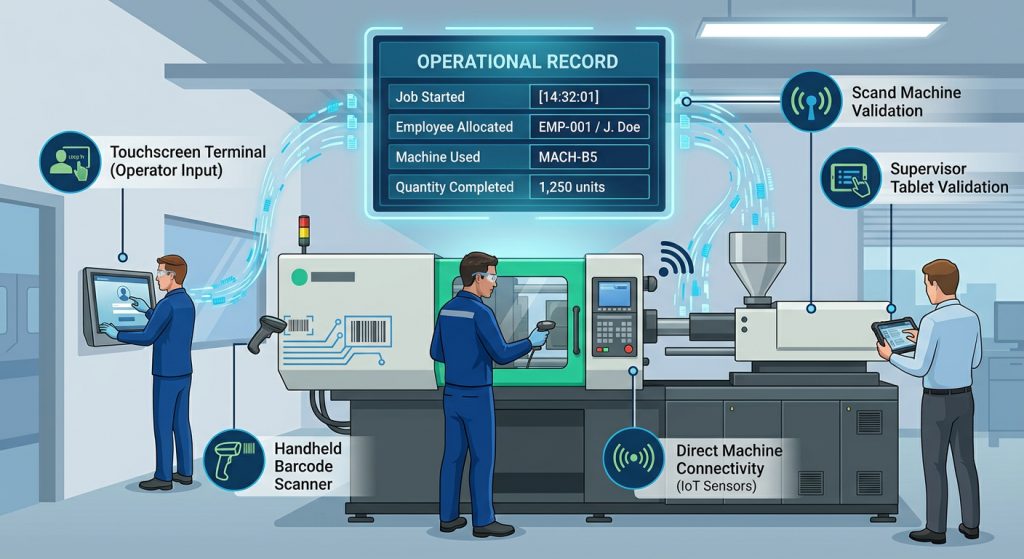
  • Shop-floor touchscreens
  • Barcode scanners
  • Mobile devices
  • Machine and PLC signals
  • Automated data feeds
  • Simple employee declarations
  • Supervisor validation

The objective should not be to create more administration.

It should be to make accurate data capture a natural part of completing the work.

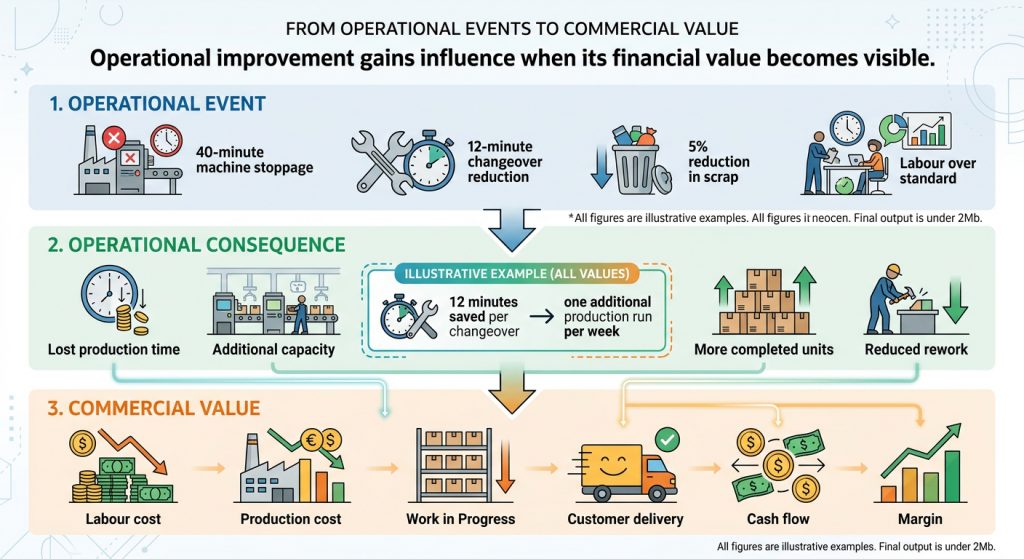
4. Translate operational variance into financial value

Operational measures become more influential when they are expressed commercially.

A reduction in downtime is positive.

An increase in recoverable production capacity creates a business case.

A shorter changeover is useful.

Demonstrating that the reduction creates an additional production run each week gives the improvement strategic relevance.

Manufacturers should therefore connect productivity, downtime, waste and efficiency measures with:

  • Labour cost
  • Production cost
  • Capacity
  • Work in Progress
  • Customer service
  • Cash flow
  • Margin

This creates a common language between operations, finance and senior management.

It also helps improvement teams demonstrate the real commercial value of their work.

5. Close the improvement loop

Continuous Improvement should operate as a complete cycle:

  1. Define the problem
  2. Measure current performance
  3. Identify the causes
  4. Implement the change
  5. Measure the result
  6. Control the improved process

Too many improvement projects reach the implementation stage without establishing how the result will be monitored and sustained.

Reliable operational information allows the manufacturer to determine:

  • What changed
  • Why it changed
  • Whether the improvement has continued
  • What commercial value has been created

This distinguishes a temporary improvement from a permanent change in performance.

Technology is only part of the answer

Advanced technology can support stronger manufacturing performance, but technology alone does not create a data-driven organisation.

Artificial intelligence, robotics and automation all depend on structured management, reliable information and clearly defined operational objectives.

AI cannot compensate for:

  • Inconsistent job codes
  • Unreliable standards
  • Disconnected systems
  • Poor labour attribution
  • Missing downtime reasons
  • Incomplete operational context

Before a manufacturer asks what AI could predict, it must first be able to explain accurately what has already happened.

The foundation of industrial AI is not the algorithm.

It is trusted operational data.

From data collection to operational intelligence

For many manufacturers, the answer is not to replace every existing system.

It is to create a connected operational layer between those systems, the workforce, machinery and the production environment.

That layer should be capable of:

  • Receiving orders, routings, standards and cost information
  • Presenting relevant instructions to employees
  • Capturing activity as work takes place
  • Combining employee, job, process and machine data
  • Applying operational and financial rules
  • Calculating performance at the required level of detail
  • Returning meaningful information to managers and authorised systems

Ceequel® Operational Intelligence has been designed around this principle.

It connects operational activity with information from existing business systems, machinery and the workforce.

The platform can convert job, employee, process and machine information into measures such as:

  • Labour productivity
  • Job cost
  • Work in Progress
  • Actual versus standard performance
  • Downtime
  • Overall Equipment Effectiveness
  • Cost variance
  • Margin performance

The purpose is not simply to produce more reports.

It is to create a consistent operational record that helps manufacturers understand what is happening, why it is happening and what it means commercially.

The next productivity improvement may not require another system producing another isolated set of figures.

It may begin by connecting the information the manufacturer already has—and using it to make better decisions.


We’ll be right back after this short break…..

After taking a short break……..Euro2020 is FINALLY under way!

The England campaign under Gareth Southgate’s quiet, gentle leadership is as steady as ever.

Since taking over the ‘Top Job’, he’s emerged as the ‘Big Brother’ of the squad and that’s not only apparent with his laid-back approach to the line-up but also with his backroom staff.

Has a Laissez-Faire style of management developed within the England camp?

Laissez-Faire, ah yes, the old ‘hands off ‘minimal micro-management, no daily meeting approach.

Apple’s Steve Jobs was a committed believer……apparently.

French for “leave alone” Laissez-Faire is to all intent and purposes the position to adopt for a ‘leave in peace’ method. It’s the most agreeable tactic to assume, so long as you’re happy giving your line-up the freedom to rock out and be C R E A T I V E.

But does this mean that traditional management styles are no longer essential for success, have they become an out-of-date, unnecessary waste of time?

Like the ‘Beautiful Game’, are managers switching tactics at half-time if their time-tested leadership method is failing, particularly on the next generation of workers who after the last year or so, have spent most of their time working from home?

Let’s look at the top 5 recognised management styles.

Coaching
A coach identifies strengths, weaknesses and is effective at setting goals for the team. They understand how everyone on their team ‘ticks’ and recognises that everybody has something different to bring to the table.

The Visionary
A visionary will drive and inspire others, will always be looking ahead and will be creative with fresh ideas and concepts. A manager who looks at the bigger picture and how notions can be transformed for the better whilst understanding that new ideas take time to be perfected. Focus is given to the end prize not the current position.

Servant
Servant leaders are people-minded and invest heavily in personal development. They are particularly good with employee well-being, morale and satisfaction. Amiable, caring and agreeable whilst seeing both sides of the argument.

Autocratic/Authoritarian
The dreaded military style leader is focused purely on results and efficiency and will make decisions solo or with a small principle group. Workers subjected to this type of austere leadership believe they are just ‘a number’ and therefore not recognised as an individual. The autocratic leader usually sees the cost to the company and not the person behind it.

Democratic
A democratic leader will always ask for input. A manager who not only recognises that others have voices and opinions worth listening to but who is open to constructive criticism and who welcomes a two-way street approach within meetings, which, as every leader worth their salt recognises, is valuable.

Whatever management style you choose to adopt for your ‘squad’ Ceequel® Biometric Time and Attendance Management software will help you deliver the results that you require for ALL your workforce.

ELF Productivity Ltd and Ceequel® software, reliable, steady, always developing and constantly improving.

For a closer look at Ceequel® software contact ELF Productivity Ltd today for a free, no obligation quotation and demonstration of Ceequel® software.

Alternatively, please feel free to download our brochure catalogue here.

Ceequel® Facial Recognition Announcement!

After leading the way in facial-recognition technology for the last 3 years, here at ELF Productivity Ltd we are delighted to announce that temperature detection is now encompassed into our latest Ceequel® offering!

After testing, testing and more testing, Ceequel® software suite now incorporates a fully functional and accurate temperature detection solution.

Included with facial-recognition is the option for non-contact palm recognition and temperature detection in the latest devices.

The hardware can be used for Clocking or controlling access to site via Ceequel® Access Control on entry systems such as doors and turnstiles, with full workflow notification when temperature readings are too high.

All individual clocking and access times are recorded to include a temperature check, with these actions being both reportable and fully auditable.

If you are interested in a Temperature Detection, Biometric Time and Attendance or Access Control system for your company, contact ELF Productivity Ltd for a free demonstration and quotation of Ceequel® software suite.

Alternatively, Ceequel® brochures can be downloaded here.

ELF Productivity Ltd and Ceequel® software, supporting, advising and maintaining all our clients during the ongoing Coronavirus outbreak.

There’s No Place Like Home

Education both remotely and at school is finally over until September and that means only one thing……summer is officially here!

Holidays can begin or as the UK travel industry have re-branded it, let the ‘staycation’ commence!

#Staycation. With holidays already reserved to spend via ‘Costa del Decking’ this summer, when was the last time any of us chose to take our annual leave in Blighty?

As we emerge from one of the most traumatic times in UK work history, a ‘staycation’ could just be what the doctor if not the Government ordered for UK workers. Coastal, countryside and city destinations all filled with businesses that need a helping hand at this time.

Not convinced and still prefer to jet off?

Given the current climate, is anyone particularly enamoured with the thought of sharing a tin can with 200 + strangers, on a flight loaded with masks and hand sanitiser, accompanied by the type of nervy eye-swivels that only appear when someone is brave enough to clear their throat?

Surely the option to holiday at home this year for that reason alone is more attractive.

Remember when you were a child and the only things that mattered on holiday were candy floss, building sandcastles on the beach and fish and chips, usually in that order. Children don’t particularly care where they holiday, as long as they get to have an adventure.

With UK hotels and hospitality still able to accommodate bookings, supporting local businesses is crucial at this stage of our recovery to provide the country with a much-needed economic boost and to help workers enjoy some welcome R&R time-off.

Perhaps you have always wanted to scale the dizzy heights of Ben Nevis – Bear Grylls style obviously! Maybe now is the time to accomplish that dream. Spending hours outdoors is a proven medicine for a good night’s sleep, as well as being beneficial for both mental health and physical wellbeing.

Given the current climate that’s something we could all profit from once we are back on the shop floor.

Great Britain is an amazing place so why not enjoy a ‘staycation’ this summer? Is holidaying in the UK really so bad?

After all, as Dorothy often reminds us “There’s no place like home.”

If you are interested in implementing a Human Resources Time and Attendance Management system to assist in planning your employees own summer #staycation, contact ELF Productivity Ltd today on 01257 256000 for a free, no obligation demonstration and quotation of Ceequel® software suite.

Or alternatively, our brochure catalogue can be downloaded here.

ELF Productivity Ltd and Ceequel® software, assisting, advising and supporting all our clients both remotely and office-based during the ongoing Coronavirus outbreak.

The Buffet Is Open….

With public transport still considered to be ‘persona non grata’ if you want to avoid people not up to speed on the ‘benefits’ of hand washing the added extra responsibility of commuting to work for those who don’t own or have access to a car is proving to be a challenge.

Use public transport if you REALLY have to but DON’T use public transport AT ALL if you can avoid it. If you can avoid it then do so, if you can’t then……. use it???

Anyone Confused.com?

As we navigate through the mixed messages that have come out of Dominic, sorry ‘Downing’ Street the Chancellor has thrown a lifeline at failing hospitality businesses…… #eatouttohelpout

The buffet is open, the buffet IS OPEN and it’s all on Rishi……for now.

In order to throw off the ‘outside bad, inside good’ mentality and to give the economy a kick where it hurts, we now get to enjoy the Covid version of that old faithful, better known as ‘BOGOF’ during August, with Rishi picking up the tab.

And if that’s not enough excitement, it comes with the added benefit that employers will receive a bonus to bring back furloughed staff and retain them until 2021.

But how do staff mentally prepare to return to their current employer after being locked down for three months, much less a new boss?

As the recession starts to bite, people who started the lockdown on furlough are now facing the very real prospect of having to begin all over again.

“What’s your name and where do you come from?” No, not the immortal words of Cilla but your potential new HR team leader.

Employers have a duty of care to employees both old and new, particularly those who will essentially have to travel on public transport and who will require support to even walk through the door.

HR must recognise that ALL aspects of recruiting and working have changed and more than ever, place importance on employees’ wellbeing and mental health both in AND out of the workplace.

With the UK now tentatively unlocking all its doors and with Facial Recognition units and Key Fob/Proximity cards available as standard options, at ELF Productivity Ltd we are confident that with Ceequel® Time and Attendance Human Resources software and Ceequel Access Control, we can assist in helping you to re-open your business this summer and navigate you through the challenging times ahead.

We are positive that whatever path you and your HR department embark on this year, ELF Productivity Ltd can be there to both guide and advise.

ELF Productivity Ltd and Ceequel®software, assisting, supporting and maintaining all our clients during the ongoing Coronavirus outbreak.

If you are interested in a Biometric Time and Attendance Management system for your business, please contact ELF Productivity Ltd today on 01257 256000.

Alternatively, our brochure catalogue can be downloaded here.

Recruitment…….The Covid Way

Without it sounding like just another soundbite but the world of HR has changed……. forever.

In the wake of the devastating tsunami damage that Covid-19 has brought to businesses across the UK, what does the future hold for Human Resources and recruitment?

When companies are once again ready and confident to commit to a recruitment drive, will there be Zoom and Team interviews until the ‘virtual ink’ is dry on the contract? Or will they be masked up, gowned up, latex gloves at the ready, face-to-face interviews?

If candidates ARE permitted within a 5 mile radius of your building, will it be smart casual dress for those face-to-face interviews or will it be replaced with ‘designer hazmat’ at Reception and worn until the candidate is a fully-fledged, temperature checked, cough and Covid-free member of your team?

Interestingly, will temperature checks become as compulsory as clocking in and making ‘The Boss’ a brew?

All joking aside and with the 1 metre pub (sorry PLUS) rule imminent the hoops and hurdles that Human Resources have had to jump through to get even this far have been challenging, never mind being “Open for Business” again.

As we all try and regain some degree of normality, recruiting after the lockdown is now another major hurdle to not only embrace but master.

E-Doc sign software for contracts was already in widespread use prior to the pandemic, however in the wake of the outbreak there has been a surge of interest in the software. Is this now the way forward, remote interviews, coupled with E signatures and then on to remote working?

As the country tentatively unlocks and if you have never contemplated or even considered a Biometric Time Management System for your employees before, now could be the right time for you to begin planning and implementing a system for your shop floor.

Whatever Human Resources has in store for its future, ELF Productivity Ltd is here to guide, assist and help you through the transitional minefield. With almost 40 years’ experience of Time and Attendance computer software, we guarantee that at least one of our many Ceequel® software modules will not only appeal TO you but work FOR you.

ELF Productivity Ltd and Ceequel® software, supporting, upholding and helping all our clients during the ongoing Coronavirus outbreak.

If you are interested in a Biometric Time Management system for your HR and Payroll department, contact ELF Productivity Ltd today on 01257 256000 for a free, no obligation demonstration and quotation of Ceequel® software suite.

Or, if you prefer, our brochure catalogue can be downloaded here.