Replacing Mitrefinch TMS: A Practical Guide for UK Employers

As workforce management requirements continue to evolve, many organisations are reviewing whether their existing Time & Attendance solution remains aligned with their operational, payroll, compliance, and workforce management objectives.

If your organisation currently uses Mitrefinch TMS and is considering its future options, this guide provides a practical framework for assessing whether your current solution continues to meet your needs and, if not, what should be considered when evaluating alternative platforms.

This article is intended as an impartial guide to help employers make informed decisions based on their own business requirements.

Why Organisations Review Their Time & Attendance System

Time & Attendance systems are a critical component of workforce management. As organisations grow, diversify, or modernise their operations, requirements often change.

Common reasons for reviewing an existing solution include:

  • Increasing payroll administration and manual intervention.
  • Expansion across multiple sites or locations.
  • Greater use of remote, mobile, or field-based employees.
  • A requirement to integrate Time & Attendance with HR, Payroll, ERP, Access Control, or Visitor Management systems.
  • The need for improved management visibility and reporting.
  • Changes in working practices, legislation, or compliance requirements.
  • Hardware refresh programmes or software renewal cycles.
  • Business acquisitions, mergers, or organisational restructuring.

A system review does not necessarily mean a replacement is required. However, it provides an opportunity to assess whether the current solution continues to deliver the functionality, efficiency, and return on investment expected by the business.

What a Modern Workforce Management Solution Should Deliver

A Time & Attendance solution should do more than simply record employee attendance. It should provide accurate workforce data that supports operational decision-making, payroll accuracy, compliance, and employee engagement.

When evaluating any solution, organisations should expect:

Accurate Workforce Data

  • Real-time attendance monitoring.
  • Automated calculation of working hours.
  • Accurate overtime and absence management.
  • Reduction in manual payroll adjustments.

Improved Management Visibility

  • Real-time workforce dashboards.
  • Exception reporting.
  • Attendance trend analysis.
  • Labour cost visibility.

Streamlined Payroll Processing

  • Automated payroll preparation.
  • Clear audit trails.
  • Reduced payroll queries.
  • Reliable integration with payroll systems.

Workforce Compliance

  • Working Time Regulations monitoring.
  • Absence tracking.
  • Audit and reporting capabilities.
  • Accurate records for compliance purposes.

Enhanced Employee and Manager Self-Service

  • Electronic holiday requests.
  • Manager approvals.
  • Employee access to attendance records.
  • Mobile workforce capabilities where required.

Key Questions to Ask During a System Review

Whether reviewing your current supplier or considering alternative providers, consistency is essential. Every supplier should be evaluated against the same criteria.

Payroll Management

  • How are exceptions and anomalies identified and managed?
  • How are audit trails maintained?
  • How does the system reduce payroll administration?

Business Rules

  • Can the solution accommodate existing working rules and agreements?
  • How flexible is the configuration?
  • Can future changes be implemented without development work?

Hardware and Data Collection

  • What clocking methods are available?
  • Can existing hardware be retained?
  • What options exist for mobile or remote workers?

Integration

  • What integrations are available with Payroll, HR, ERP, Access Control, and Visitor Management systems?
  • Are integrations proven and supported?

Security and Hosting (for cloud based systems)

  • Where is data hosted?
  • What security standards are maintained?
  • What service levels and support arrangements are provided?

Implementation

  • What does the migration process involve?
  • How is data transferred and validated?
  • What support is available during and after implementation?

Commercial Considerations

  • What are the initial implementation costs?
  • What ongoing support and maintenance costs apply?
  • Are there any additional licensing or usage-based charges?

The Importance of a Structured Migration Process

For most organisations, the greatest risk during a replacement project is not the installation of new software. The primary challenge is ensuring that existing workforce rules, pay calculations, attendance policies, and operational processes are accurately replicated or improved.

A successful migration project should include:

  • Detailed Scope of Works.
  • Documentation of existing rules and processes.
  • Configuration review and approval.
  • Data migration planning – if available.
  • Payroll validation and parallel testing.
  • User and manager training.
  • Post-implementation support.

Organisations should seek clear documentation outlining how each stage of the migration will be managed.

Evaluating Long-Term Value

While software functionality remains important, organisations should also consider the broader value delivered by a workforce management solution.

Areas worth evaluating include:

  • Reduction in payroll administration.
  • Removal of manual calculations.
  • Improved labour cost control.
  • Enhanced workforce visibility.
  • Reduced manual processes.
  • Improved compliance reporting.
  • Increased management efficiency.
  • Scalability for future growth.

A workforce management platform should support operational objectives not only today, but also as the organisation evolves over the coming years.

Making an Informed Decision

Every organisation’s requirements are unique. The most effective procurement decisions are based on clearly documented business objectives, operational requirements, implementation considerations, support arrangements, and long-term value (ROI).

A structured review process allows organisations to assess whether their existing solution remains the best fit or whether alternative platforms may offer additional benefits more aligned with future business goals.

By taking a measured and evidence-based approach, organisations can ensure that any investment in workforce management technology delivers meaningful improvements in productivity, efficiency, accuracy, and visibility.

About Ceequel®

Ceequel® is a UK-developed workforce management platform designed to help organisations manage attendance, absence, labour costs, employee self-service, manager approvals, access control, visitor management, and workforce reporting through a single integrated solution.

Supporting organisations across manufacturing, logistics, food production, distribution, healthcare, engineering, and other sectors, Ceequel® provides flexible deployment options and configurable workforce management capabilities designed to meet the operational requirements of modern UK employers.

For organisations reviewing their current Time & Attendance solution, a structured demonstration and discovery process can help determine whether Ceequel® is aligned with their operational and workforce management objectives.


This article is intended for informational purposes only and does not make any representations regarding the performance, functionality, support, commercial arrangements, or future direction of any third-party software product or supplier. Organisations should undertake their own evaluation based on their individual business requirements and procurement processes.

Replacing Legacy Kronos Systems: A Practical Guide for UK Employers

Many organisations have relied on Kronos workforce management solutions for years, benefiting from robust time recording, scheduling, and workforce management capabilities. However, as technology, workforce expectations, and business requirements evolve, many employers are taking the opportunity to review whether their existing system continues to meet their operational needs and future objectives.

If your organisation is currently using a legacy Kronos solution and is considering its long-term strategy, this guide outlines the key factors that should be considered when evaluating your existing platform and assessing potential alternatives.

This article is intended as an educational resource to support informed decision-making and procurement best practice.

Why Organisations Review Legacy Workforce Management Systems

Workforce management systems often remain in place for many years. During that time, businesses can undergo significant changes that place new demands on technology and operational processes.

Common reasons organisations review their existing workforce management platform include:

  • Changes to payroll processes and compliance requirements.
  • Business growth, acquisitions, or multi-site expansion.
  • Increasing use of mobile, remote, or hybrid working.
  • A desire to improve management visibility and workforce analytics.
  • The need for greater automation and reduced administration.
  • Wider digital transformation programmes.
  • ERP, HR, or payroll system replacement projects.
  • Hardware refresh cycles or infrastructure modernisation initiatives.
  • Evolving employee expectations around self-service and accessibility.

A system review provides an opportunity to assess whether the existing platform remains aligned with current business objectives and future workforce management requirements.

What Modern Workforce Management Should Deliver

Today’s workforce management systems are expected to do far more than simply record attendance.

A modern solution should support strategic decision-making while improving operational efficiency across the organisation.

Accurate Time Recording

Organisations should expect:

  • Real-time attendance visibility.
  • Automated working time calculations.
  • Accurate overtime management.
  • Comprehensive absence monitoring.
  • Clear audit trails for payroll processing.

Improved Operational Visibility

Managers should have access to:

  • Live workforce dashboards.
  • Attendance exception reporting.
  • Labour utilisation data.
  • Departmental and site-level analytics.
  • Real-time workforce status information.

Payroll Efficiency

Effective workforce management should help organisations:

  • Reduce manual payroll administration.
  • Minimise payroll queries and adjustments.
  • Improve payroll accuracy.
  • Streamline payroll preparation processes.
  • Provide clear reporting and audit capabilities.

Employee and Manager Self-Service

Modern solutions increasingly support:

  • Holiday and absence requests.
  • Electronic approvals.
  • Mobile workforce access.
  • Employee attendance visibility.
  • Manager workflow automation.

Workforce Compliance

Employers should be able to monitor and report on:

  • Working Time Regulations.
  • Attendance policies.
  • Absence management.
  • Audit requirements.
  • Workforce governance procedures.

Key Areas to Assess During a System Review

When reviewing any workforce management platform, organisations should evaluate suppliers using consistent criteria.

Workforce Management Functionality

Consider whether the solution supports:

  • Complex shift patterns.
  • Overtime rules.
  • Attendance management.
  • Absence management.
  • Flexible working arrangements.
  • Multi-site operations.

Payroll Integration

Questions to consider include:

  • How is payroll data prepared and transferred?
  • What validation processes exist?
  • How are exceptions managed?
  • What audit capabilities are available?

Data Collection Methods

Review the available options for:

  • Biometric clocking.
  • Facial recognition.
  • Proximity cards and fobs.
  • Mobile workforce applications.
  • Web-based attendance recording.

Integration Capabilities

Organisations should understand how the platform shares data with:

  • Payroll systems.
  • HR software.
  • ERP platforms.
  • Access Control systems.
  • Visitor Management solutions.
  • Business intelligence and reporting tools.

Security and Infrastructure

Areas to evaluate include:

  • Data hosting arrangements.
  • Security standards and certifications.
  • Business continuity provisions.
  • Support and service level agreements.
  • Disaster recovery procedures.

Scalability

A workforce management platform should support:

  • Organisational growth.
  • Additional sites.
  • New departments.
  • Future technology requirements.
  • Evolving workforce practices.

Planning a Successful Migration

Any workforce management replacement project should be approached as a business transformation initiative rather than simply a software installation.

Successful projects typically include:

Discovery and Analysis

  • Review of existing workforce rules.
  • Documentation of attendance policies.
  • Identification of payroll requirements.
  • Review of reporting needs.

Configuration and Validation

  • Comprehensive Scope of Works.
  • Operational validation.
  • Payroll validation.
  • Rule verification.

Data Migration

  • Historical data requirements.
  • Employee information transfer.
  • Validation procedures.

Training and Adoption

  • Manager training.
  • Employee communication.
  • User documentation.
  • Ongoing support arrangements.

Go-Live and Post-Implementation Support

  • Controlled deployment.
  • Parallel payroll testing where appropriate.
  • Dedicated support during transition.
  • Performance monitoring.

Looking Beyond Features

When reviewing any workforce management solution, organisations should consider the wider business outcomes it can deliver.

These may include:

  • Reduced labour administration.
  • Improved payroll accuracy – no payroll leakage.
  • Greater workforce visibility.
  • Better labour cost control.
  • Improved operational efficiency.
  • Enhanced compliance reporting.
  • Increased employee engagement.
  • Better management decision-making.

The objective should be to identify a solution that supports both immediate operational needs and long-term organisational goals.

Future-Proofing Workforce Management

As workforce management technology continues to evolve, organisations increasingly seek platforms that can support a wider range of operational requirements from a single environment.

Areas commonly considered during strategic reviews include:

Bringing these functions together can help reduce administration, improve data accuracy, and provide a more unified view of the workforce.

About Ceequel®

Ceequel® is a UK-developed workforce management platform designed to help organisations manage attendance, absence, labour costs, employee self-service, manager approvals, access control, visitor management, and workforce reporting through a single integrated solution.

Used across manufacturing, food production, logistics, engineering, healthcare, distribution, and other sectors, Ceequel® provides organisations with configurable workforce management capabilities that can be tailored to specific operational requirements.

For organisations reviewing legacy workforce management platforms, a structured discovery and demonstration process can help determine whether Ceequel® aligns with their current and future workforce management objectives.


This article is provided for informational purposes only and does not make any representations regarding the performance, functionality, support arrangements, commercial terms, product lifecycle, or future direction of any third-party software product or supplier. Organisations should undertake their own independent evaluation based on their specific operational requirements, procurement processes, and business objectives.

Why a Dedicated Time & Attendance Platform with Integrated HR Functionality Often Delivers Better Workforce Management Than an HR System with Embedded Time & Attendance

In recent years, many organisations have sought to consolidate software platforms wherever possible. As a result, numerous HR systems now include embedded Time & Attendance functionality as part of a broader Human Resources offering.

While the concept of managing everything from a single platform may appear attractive, organisations whose workforce management requirements extend beyond basic absence recording often discover that there is a significant difference between a system that was designed around workforce management and later enhanced with HR capabilities, and a system that was designed around HR administration and later expanded to include Time & Attendance features.

The distinction is important because the priorities, complexity, and operational demands of workforce management are fundamentally different from those of HR administration.

Time & Attendance Is an Operational System

At its core, Time & Attendance is not simply about recording when someone arrives at work.

A modern Time & Attendance platform is responsible for:

  • Capturing attendance data in real time.
  • Calculating working hours.
  • Applying overtime rules.
  • Managing shift patterns.
  • Monitoring absence.
  • Supporting payroll preparation.
  • Providing labour cost visibility – including shop floor data.
  • Managing workforce compliance.
  • Delivering real-time operational intelligence.

For many organisations, particularly those operating in manufacturing, logistics, food production, engineering, healthcare, retail, and distribution, workforce management is an operational function that directly impacts productivity, labour costs, and profitability every single day.

An error in attendance processing can affect payroll immediately.

An error allocating labour to the wrong job can affect productivity immediately.

An error in workforce visibility can affect operational decision-making immediately.

HR Systems Are Primarily Employee Administration Platforms

Human Resources systems are typically designed to manage employee information and HR processes.

Common areas of focus include:

  • Employee records.
  • Recruitment.
  • Onboarding.
  • Performance management.
  • Learning and development.
  • Disciplinary procedures.
  • Employee documentation.
  • Policy management.
  • Succession planning.

These are critical business functions, but they are generally administrative rather than operational.

Most HR systems are designed to answer questions such as:

  • Who works for us?
  • What qualifications do they hold?
  • What training have they completed?
  • What policies apply to them?

Time & Attendance systems, by contrast, answer questions such as:

  • Who is currently on site?
  • Who is absent?
  • Who is working overtime?
  • What are today’s labour costs?
  • What exceptions require attention before payroll is processed?

While both disciplines involve employees, they serve very different purposes.

Workforce Management Is Often More Complex Than HR

Many organisations underestimate the complexity involved in accurately managing attendance and payroll-related calculations.

Examples include:

  • Multiple shift patterns.
  • Continental shifts.
  • Rotating rosters.
  • Overtime premiums.
  • Call-out payments.
  • Bank holiday rules.
  • Flexitime arrangements.
  • Annualised Hours.
  • TOIL (Banked Hours)
  • Attendance bonuses.
  • Break deductions.
  • Union agreements.
  • Site-specific working practices.

A dedicated Time & Attendance platform is typically designed from the outset to accommodate these operational requirements, effortlessly.

In contrast, organisations should carefully assess whether an embedded Time & Attendance module can fully support the complexity of their workforce rules both now and in the future.

Payroll Accuracy Depends on Workforce Accuracy

For many organisations, payroll represents one of the largest costs within the business.

The quality of payroll output is heavily dependent on the quality of attendance data entering the process.

A dedicated Time & Attendance platform is often built around:

  • Automated Rules Management.
  • Exception management.
  • Payroll validation.
  • Audit trails.
  • Labour cost reporting.

These functions help ensure that attendance data is accurate before it reaches payroll.

This is why many organisations view Time & Attendance as a critical operational control rather than simply an extension of HR administration.

Real-Time Visibility Matters

Operational managers often need access to information throughout the day, not simply at payroll processing time.

Examples include:

  • Who has not arrived for work?
  • Which departments are understaffed?
  • Who is currently on site and in the fire register?
  • Who is approaching overtime thresholds?
  • Which agency workers are present today – and their cost?

Dedicated workforce management platforms are typically designed to provide this information in real time.

This operational visibility can support:

  • Resource planning.
  • Production management.
  • Shift management.
  • Health and safety procedures.
  • Labour cost control.

Workforce Management Extends Beyond HR

Modern Time & Attendance platforms increasingly support a broader workforce ecosystem.

This may include:

  • Employee Self-Service.
  • Manager Self-Service.
  • Access Control.
  • Visitor Management.
  • Contractor Management.
  • Fire Registers.
  • Labour Analytics.
  • Workforce Reporting – Shop Floor Data Capture

These functions often sit closer to operations, facilities, production, and payroll than they do to traditional HR administration.

As a result, many organisations prefer a workforce management platform that can integrate HR functionality rather than relying solely on an HR platform to manage operational workforce processes.

Flexibility for Operational Change

Businesses rarely remain static.

New sites open.

Departments expand.

Shift patterns change.

Acquisitions occur.

Working practices evolve.

A workforce management platform should be capable of adapting to operational change without requiring extensive redevelopment or manual workarounds.

When evaluating any solution, organisations should consider how easily workforce rules, attendance policies, and operational processes can be modified as business requirements evolve.

The Ideal Approach: Integrated, Not Compromised

The discussion should not be viewed as HR versus Time & Attendance.

Both are essential.

The real question is where the organisation’s primary operational requirements sit.

For many employers, the most effective approach is a dedicated workforce management platform that incorporates HR functionality while maintaining the specialist attendance, payroll, labour management, and operational capabilities required to manage the workforce effectively.

This allows organisations to benefit from:

  • Comprehensive workforce management.
  • Integrated HR processes.
  • Accurate payroll preparation.
  • Real-time operational visibility.
  • Reduced administration.
  • Improved workforce intelligence.

Conclusion

Every organisation has different requirements, and there is no single solution that is right for every business.

However, where workforce management, payroll accuracy, labour cost control, operational visibility, continuous improvement, and complex attendance rules are business-critical, organisations should carefully evaluate whether an embedded Time & Attendance module can provide the same depth of functionality as a platform designed specifically for workforce management.

The most successful workforce management projects are typically those that place operational requirements, payroll accuracy, and workforce visibility at the centre of the decision-making process, while ensuring that HR functionality remains fully integrated and readily accessible across the organisation.


This article is intended for informational purposes only. It does not make claims regarding the capabilities, performance, or suitability of any specific software product. Organisations should assess all solutions against their own operational, payroll, HR, compliance, and workforce management requirements before making a procurement decision.

UK Manufacturing Is Data-Rich—but Often Insight-Poor.

Part 1 of a 2 Part Series……….

UK manufacturing remains one of the country’s most strategically important industries.

The sector supports approximately 2.6 million jobs, accounts for a significant proportion of UK business research and development, and generates hundreds of billions of pounds in annual product sales.

Yet manufacturers continue to face considerable pressure from rising employment costs, energy prices, skills shortages, supply-chain disruption and international competition.

The next significant improvement in manufacturing productivity may not come solely from buying faster machinery, employing more people or installing additional automation.

It may come from making better use of the information already being generated inside the factory.

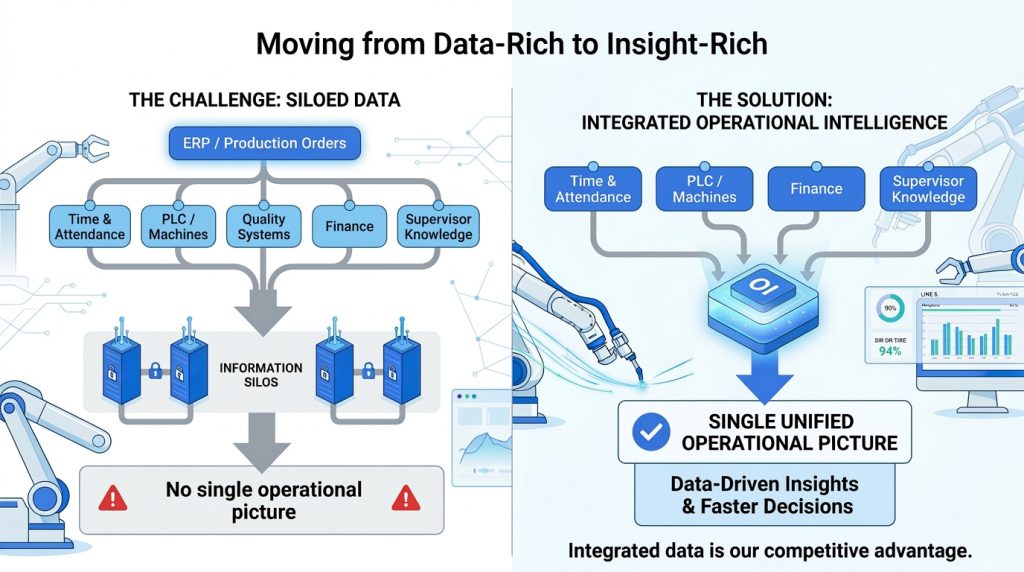
Manufacturers do not lack data

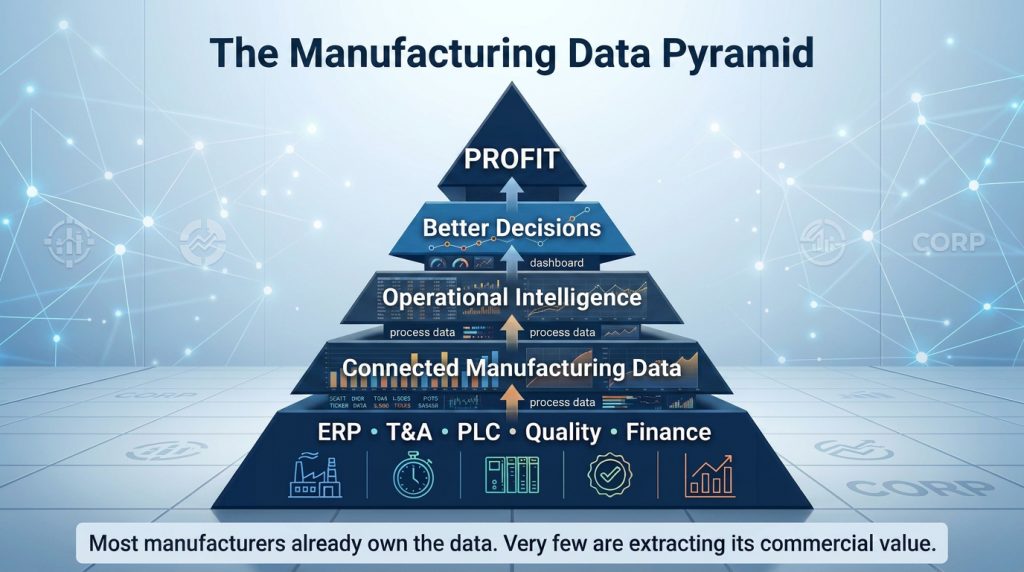
Every production environment creates large quantities of operational information.

ERP and MRP systems hold production orders, routings, standards, materials and planned quantities. Time and attendance systems contain working-time information. Machinery and PLCs produce performance signals. Quality systems record defects and rework. Finance departments maintain labour rates, overheads and costing data.

Employees and supervisors contribute another vital layer of information. They know why a job stopped, why a changeover took longer than expected, why materials were unavailable or why output fell below target.

The problem is rarely that this information does not exist.

The problem is that it is held across different systems, recorded at different levels of detail and made available at different times.

A manufacturer may know:

  • The total labour cost for the month
  • The number of employees who attended work
  • The total output achieved
  • The overall value of scrap
  • The level of overtime worked

But that does not necessarily reveal:

  • Which jobs absorbed the labour
  • Which operations exceeded their standard times
  • Where downtime occurred
  • Why production was delayed
  • Which products created the greatest rework
  • How Work in Progress changed during the day
  • Which customers, jobs or contracts delivered the expected margin

The business may possess all the individual pieces of information while still lacking a complete operational picture.

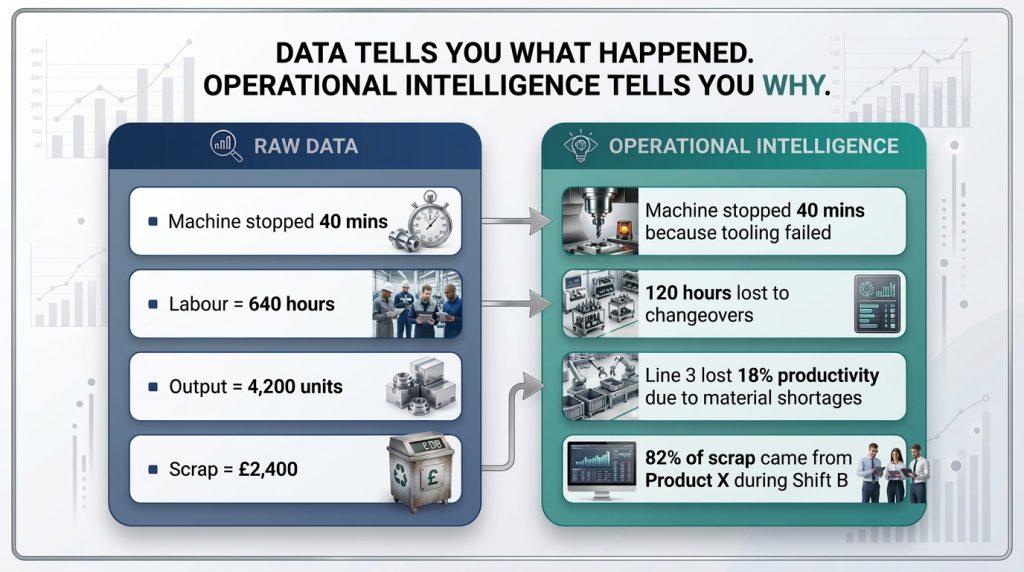
Data needs context

Knowing that a machine stopped for 40 minutes is useful.

Knowing that the stoppage delayed three jobs, created two hours of additional labour, affected a customer delivery and reduced the expected margin is far more valuable.

The same principle applies to workforce information.

Knowing that 80 employees worked an eight-hour shift confirms that 640 paid hours were available.

It does not explain how those hours were divided between:

  • Productive activity
  • Machine set-up
  • Changeovers
  • Maintenance
  • Waiting time
  • Rework
  • Training
  • Indirect work

Manufacturers therefore need to connect four essential dimensions.

What was planned

The order, routing, standard time, expected quantity, labour requirement, target cost and expected margin.

What actually happened

The employees involved, activities completed, hours consumed, quantities produced, machines used and interruptions encountered.

Why performance varied

Downtime, material shortages, quality failures, changeovers, resource constraints, skills issues or process inefficiencies.

What the variation meant financially

The impact on labour cost, production cost, Work in Progress, recovery, delivery performance and margin.

Until these dimensions are connected, management teams can spend more time debating whose figures are correct than deciding what action to take.

The limitations of lagging indicators

Traditional management reporting is largely based on lagging indicators.

These may include:

  • Monthly labour cost
  • Total production output
  • Scrap value
  • Overtime expenditure
  • Gross margin
  • Delivery performance

These measures remain important, but they usually show the final outcome after the opportunity to intervene has passed.

By the time a monthly report identifies a margin problem, the labour has already been paid, the material has already been consumed and the production delay has already occurred.

Operational intelligence provides the explanation behind the final result.

It can show:

  • Labour consumed by job and operation
  • Actual time compared with standard
  • Productive and non-productive activity
  • Machine interruptions
  • Changeover performance
  • Scrap and rework by product or process
  • Work in Progress
  • Output by employee, team, line or shift
  • The reasons behind operational variance

This changes the management question from:

Why was last month’s margin lower than expected?

to:

Which jobs are moving outside their expected labour and production cost today?

That is a fundamentally different management capability.

Better data supports better management

Continuous Improvement depends on measurement, analysis and response.

A manufacturer cannot consistently improve a process it cannot measure accurately.

Nor can it sustain an improvement if the information required to monitor the process arrives several weeks after the activity occurred.

When information is retrospective, improvement becomes reactive.

Managers investigate after the cost has been incurred, the production has been delayed and the margin has been reduced.

Operational data must therefore move at the speed of the operation.

The opportunity for UK manufacturing is not simply to collect more information.

It is to connect existing information more effectively, add the operational context behind it and use it before the opportunity to act has passed.

Because better performance does not begin with more data.

It begins with understanding what the data is really saying.

Ceequel® Facial Recognition

Did you know that ELF Productivity Ltd is still leading the way in facial recognition technology?

Ceequel® software continues to offer a fully functional and accurate temperature detection solution with options available for both non-contact palm recognition and temperature detection in all the latest units.

Hardware that can be utilised for clocking purposes and controlling access to site via Ceequel® Access Control with door and turnstile entry.

All individual clocking and access times are recorded to include a temperature check.  Actions that are both reportable, fully auditable and include workflow notifications and alerts for when temperature readings are high.

If you are interested in a Biometric Time and Attendance or Access Control system for your company, contact ELF Productivity Ltd today for a free, no obligation demonstration and quotation of Ceequel® software.

Alternatively, Ceequel® brochures can be downloaded here

Ceequel® Facial Recognition Announcement!

After leading the way in facial-recognition technology for the last 3 years, here at ELF Productivity Ltd we are delighted to announce that temperature detection is now encompassed into our latest Ceequel® offering!

After testing, testing and more testing, Ceequel® software suite now incorporates a fully functional and accurate temperature detection solution.

Included with facial-recognition is the option for non-contact palm recognition and temperature detection in the latest devices.

The hardware can be used for Clocking or controlling access to site via Ceequel® Access Control on entry systems such as doors and turnstiles, with full workflow notification when temperature readings are too high.

All individual clocking and access times are recorded to include a temperature check, with these actions being both reportable and fully auditable.

If you are interested in a Temperature Detection, Biometric Time and Attendance or Access Control system for your company, contact ELF Productivity Ltd for a free demonstration and quotation of Ceequel® software suite.

Alternatively, Ceequel® brochures can be downloaded here.

ELF Productivity Ltd and Ceequel® software, supporting, advising and maintaining all our clients during the ongoing Coronavirus outbreak.

There’s No Place Like Home

Education both remotely and at school is finally over until September and that means only one thing……summer is officially here!

Holidays can begin or as the UK travel industry have re-branded it, let the ‘staycation’ commence!

#Staycation. With holidays already reserved to spend via ‘Costa del Decking’ this summer, when was the last time any of us chose to take our annual leave in Blighty?

As we emerge from one of the most traumatic times in UK work history, a ‘staycation’ could just be what the doctor if not the Government ordered for UK workers. Coastal, countryside and city destinations all filled with businesses that need a helping hand at this time.

Not convinced and still prefer to jet off?

Given the current climate, is anyone particularly enamoured with the thought of sharing a tin can with 200 + strangers, on a flight loaded with masks and hand sanitiser, accompanied by the type of nervy eye-swivels that only appear when someone is brave enough to clear their throat?

Surely the option to holiday at home this year for that reason alone is more attractive.

Remember when you were a child and the only things that mattered on holiday were candy floss, building sandcastles on the beach and fish and chips, usually in that order. Children don’t particularly care where they holiday, as long as they get to have an adventure.

With UK hotels and hospitality still able to accommodate bookings, supporting local businesses is crucial at this stage of our recovery to provide the country with a much-needed economic boost and to help workers enjoy some welcome R&R time-off.

Perhaps you have always wanted to scale the dizzy heights of Ben Nevis – Bear Grylls style obviously! Maybe now is the time to accomplish that dream. Spending hours outdoors is a proven medicine for a good night’s sleep, as well as being beneficial for both mental health and physical wellbeing.

Given the current climate that’s something we could all profit from once we are back on the shop floor.

Great Britain is an amazing place so why not enjoy a ‘staycation’ this summer? Is holidaying in the UK really so bad?

After all, as Dorothy often reminds us “There’s no place like home.”

If you are interested in implementing a Human Resources Time and Attendance Management system to assist in planning your employees own summer #staycation, contact ELF Productivity Ltd today on 01257 256000 for a free, no obligation demonstration and quotation of Ceequel® software suite.

Or alternatively, our brochure catalogue can be downloaded here.

ELF Productivity Ltd and Ceequel® software, assisting, advising and supporting all our clients both remotely and office-based during the ongoing Coronavirus outbreak.

The Buffet Is Open….

With public transport still considered to be ‘persona non grata’ if you want to avoid people not up to speed on the ‘benefits’ of hand washing the added extra responsibility of commuting to work for those who don’t own or have access to a car is proving to be a challenge.

Use public transport if you REALLY have to but DON’T use public transport AT ALL if you can avoid it. If you can avoid it then do so, if you can’t then……. use it???

Anyone Confused.com?

As we navigate through the mixed messages that have come out of Dominic, sorry ‘Downing’ Street the Chancellor has thrown a lifeline at failing hospitality businesses…… #eatouttohelpout

The buffet is open, the buffet IS OPEN and it’s all on Rishi……for now.

In order to throw off the ‘outside bad, inside good’ mentality and to give the economy a kick where it hurts, we now get to enjoy the Covid version of that old faithful, better known as ‘BOGOF’ during August, with Rishi picking up the tab.

And if that’s not enough excitement, it comes with the added benefit that employers will receive a bonus to bring back furloughed staff and retain them until 2021.

But how do staff mentally prepare to return to their current employer after being locked down for three months, much less a new boss?

As the recession starts to bite, people who started the lockdown on furlough are now facing the very real prospect of having to begin all over again.

“What’s your name and where do you come from?” No, not the immortal words of Cilla but your potential new HR team leader.

Employers have a duty of care to employees both old and new, particularly those who will essentially have to travel on public transport and who will require support to even walk through the door.

HR must recognise that ALL aspects of recruiting and working have changed and more than ever, place importance on employees’ wellbeing and mental health both in AND out of the workplace.

With the UK now tentatively unlocking all its doors and with Facial Recognition units and Key Fob/Proximity cards available as standard options, at ELF Productivity Ltd we are confident that with Ceequel® Time and Attendance Human Resources software and Ceequel Access Control, we can assist in helping you to re-open your business this summer and navigate you through the challenging times ahead.

We are positive that whatever path you and your HR department embark on this year, ELF Productivity Ltd can be there to both guide and advise.

ELF Productivity Ltd and Ceequel®software, assisting, supporting and maintaining all our clients during the ongoing Coronavirus outbreak.

If you are interested in a Biometric Time and Attendance Management system for your business, please contact ELF Productivity Ltd today on 01257 256000.

Alternatively, our brochure catalogue can be downloaded here.

Recruitment…….The Covid Way

Without it sounding like just another soundbite but the world of HR has changed……. forever.

In the wake of the devastating tsunami damage that Covid-19 has brought to businesses across the UK, what does the future hold for Human Resources and recruitment?

When companies are once again ready and confident to commit to a recruitment drive, will there be Zoom and Team interviews until the ‘virtual ink’ is dry on the contract? Or will they be masked up, gowned up, latex gloves at the ready, face-to-face interviews?

If candidates ARE permitted within a 5 mile radius of your building, will it be smart casual dress for those face-to-face interviews or will it be replaced with ‘designer hazmat’ at Reception and worn until the candidate is a fully-fledged, temperature checked, cough and Covid-free member of your team?

Interestingly, will temperature checks become as compulsory as clocking in and making ‘The Boss’ a brew?

All joking aside and with the 1 metre pub (sorry PLUS) rule imminent the hoops and hurdles that Human Resources have had to jump through to get even this far have been challenging, never mind being “Open for Business” again.

As we all try and regain some degree of normality, recruiting after the lockdown is now another major hurdle to not only embrace but master.

E-Doc sign software for contracts was already in widespread use prior to the pandemic, however in the wake of the outbreak there has been a surge of interest in the software. Is this now the way forward, remote interviews, coupled with E signatures and then on to remote working?

As the country tentatively unlocks and if you have never contemplated or even considered a Biometric Time Management System for your employees before, now could be the right time for you to begin planning and implementing a system for your shop floor.

Whatever Human Resources has in store for its future, ELF Productivity Ltd is here to guide, assist and help you through the transitional minefield. With almost 40 years’ experience of Time and Attendance computer software, we guarantee that at least one of our many Ceequel® software modules will not only appeal TO you but work FOR you.

ELF Productivity Ltd and Ceequel® software, supporting, upholding and helping all our clients during the ongoing Coronavirus outbreak.

If you are interested in a Biometric Time Management system for your HR and Payroll department, contact ELF Productivity Ltd today on 01257 256000 for a free, no obligation demonstration and quotation of Ceequel® software suite.

Or, if you prefer, our brochure catalogue can be downloaded here.

The Return From Costa Del Home

With the biggest paid leave in UK work history slowly coming to an end and with a phased return to work AND school now in the pipeline, Human Resource departments up and down the land are poised to step-up and prepare for the mass return from ‘Costa del Home.’

With the phased return to school now scheduled to begin later in the year the nation’s children have been the ones to not only accept the current status quo but acclimatise to it.

When the mercury started to rise as quickly as the panic, they were the ones that grasped the long, hot lockdown with both hands.

With the added extra curriculum courtesy of the ‘School of Mum and Dad’ they adjusted to remote learning, helped said Mum/Dad deploy Zoom, Houseparty and explained how to Facetime grumpy gramps so actual faces could be viewed as opposed to the usual wall/ceiling/ear!

They created rainbows for their homes, baked banana bread for ’Isolating Nan’ all the time working out to daily gym sessions with Body Coach Joe.

As adults, when do we stop having that easy acceptance and tolerance? When do we stop being curious and open to exploring new concepts or ideas and new ways of doing things?

Mental Health Awareness is now more prevalent than ever, particularly within the workplace. The motto adopted for the recent Mental Health Awareness week is ‘be kind.’ As we all embark on the long road to recovery, what ‘kindness’ awaits employees on the shop floor?

At a time when we have all had to lean on someone either physically, mentally or spiritually, perhaps looking and learning from our children is the answer.

When the shop floors and offices are active once more and the idea of working remotely permanently loses its appeal, will HR uphold what it has learned during this unique time?

When the sounds of children playing in their school playgrounds fill the air again, will we look at them and realise that they played an integral part of helping and supporting US through the crisis; more importantly will we be humble and modest enough to learn from them?

Because after all, they are not only the Britons of this time but the future.

If you are interested in a Biometric Time and Attendance Management system for your own phased return to work, contact ELF Productivity Ltd today on 01257 256000 for a free, no obligation quotation and demonstration of Ceequel® software suite.

Or alternatively, our brochure catalogue can be downloaded here.

ELF Productivity Ltd and Ceequel® software, sustaining, supporting and maintaining all our clients during the ongoing Corona-virus outbreak.