Replacing Mitrefinch TMS: A Practical Guide for UK Employers

As workforce management requirements continue to evolve, many organisations are reviewing whether their existing Time & Attendance solution remains aligned with their operational, payroll, compliance, and workforce management objectives.

If your organisation currently uses Mitrefinch TMS and is considering its future options, this guide provides a practical framework for assessing whether your current solution continues to meet your needs and, if not, what should be considered when evaluating alternative platforms.

This article is intended as an impartial guide to help employers make informed decisions based on their own business requirements.

Why Organisations Review Their Time & Attendance System

Time & Attendance systems are a critical component of workforce management. As organisations grow, diversify, or modernise their operations, requirements often change.

Common reasons for reviewing an existing solution include:

  • Increasing payroll administration and manual intervention.
  • Expansion across multiple sites or locations.
  • Greater use of remote, mobile, or field-based employees.
  • A requirement to integrate Time & Attendance with HR, Payroll, ERP, Access Control, or Visitor Management systems.
  • The need for improved management visibility and reporting.
  • Changes in working practices, legislation, or compliance requirements.
  • Hardware refresh programmes or software renewal cycles.
  • Business acquisitions, mergers, or organisational restructuring.

A system review does not necessarily mean a replacement is required. However, it provides an opportunity to assess whether the current solution continues to deliver the functionality, efficiency, and return on investment expected by the business.

What a Modern Workforce Management Solution Should Deliver

A Time & Attendance solution should do more than simply record employee attendance. It should provide accurate workforce data that supports operational decision-making, payroll accuracy, compliance, and employee engagement.

When evaluating any solution, organisations should expect:

Accurate Workforce Data

  • Real-time attendance monitoring.
  • Automated calculation of working hours.
  • Accurate overtime and absence management.
  • Reduction in manual payroll adjustments.

Improved Management Visibility

  • Real-time workforce dashboards.
  • Exception reporting.
  • Attendance trend analysis.
  • Labour cost visibility.

Streamlined Payroll Processing

  • Automated payroll preparation.
  • Clear audit trails.
  • Reduced payroll queries.
  • Reliable integration with payroll systems.

Workforce Compliance

  • Working Time Regulations monitoring.
  • Absence tracking.
  • Audit and reporting capabilities.
  • Accurate records for compliance purposes.

Enhanced Employee and Manager Self-Service

  • Electronic holiday requests.
  • Manager approvals.
  • Employee access to attendance records.
  • Mobile workforce capabilities where required.

Key Questions to Ask During a System Review

Whether reviewing your current supplier or considering alternative providers, consistency is essential. Every supplier should be evaluated against the same criteria.

Payroll Management

  • How are exceptions and anomalies identified and managed?
  • How are audit trails maintained?
  • How does the system reduce payroll administration?

Business Rules

  • Can the solution accommodate existing working rules and agreements?
  • How flexible is the configuration?
  • Can future changes be implemented without development work?

Hardware and Data Collection

  • What clocking methods are available?
  • Can existing hardware be retained?
  • What options exist for mobile or remote workers?

Integration

  • What integrations are available with Payroll, HR, ERP, Access Control, and Visitor Management systems?
  • Are integrations proven and supported?

Security and Hosting (for cloud based systems)

  • Where is data hosted?
  • What security standards are maintained?
  • What service levels and support arrangements are provided?

Implementation

  • What does the migration process involve?
  • How is data transferred and validated?
  • What support is available during and after implementation?

Commercial Considerations

  • What are the initial implementation costs?
  • What ongoing support and maintenance costs apply?
  • Are there any additional licensing or usage-based charges?

The Importance of a Structured Migration Process

For most organisations, the greatest risk during a replacement project is not the installation of new software. The primary challenge is ensuring that existing workforce rules, pay calculations, attendance policies, and operational processes are accurately replicated or improved.

A successful migration project should include:

  • Detailed Scope of Works.
  • Documentation of existing rules and processes.
  • Configuration review and approval.
  • Data migration planning – if available.
  • Payroll validation and parallel testing.
  • User and manager training.
  • Post-implementation support.

Organisations should seek clear documentation outlining how each stage of the migration will be managed.

Evaluating Long-Term Value

While software functionality remains important, organisations should also consider the broader value delivered by a workforce management solution.

Areas worth evaluating include:

  • Reduction in payroll administration.
  • Removal of manual calculations.
  • Improved labour cost control.
  • Enhanced workforce visibility.
  • Reduced manual processes.
  • Improved compliance reporting.
  • Increased management efficiency.
  • Scalability for future growth.

A workforce management platform should support operational objectives not only today, but also as the organisation evolves over the coming years.

Making an Informed Decision

Every organisation’s requirements are unique. The most effective procurement decisions are based on clearly documented business objectives, operational requirements, implementation considerations, support arrangements, and long-term value (ROI).

A structured review process allows organisations to assess whether their existing solution remains the best fit or whether alternative platforms may offer additional benefits more aligned with future business goals.

By taking a measured and evidence-based approach, organisations can ensure that any investment in workforce management technology delivers meaningful improvements in productivity, efficiency, accuracy, and visibility.

About Ceequel®

Ceequel® is a UK-developed workforce management platform designed to help organisations manage attendance, absence, labour costs, employee self-service, manager approvals, access control, visitor management, and workforce reporting through a single integrated solution.

Supporting organisations across manufacturing, logistics, food production, distribution, healthcare, engineering, and other sectors, Ceequel® provides flexible deployment options and configurable workforce management capabilities designed to meet the operational requirements of modern UK employers.

For organisations reviewing their current Time & Attendance solution, a structured demonstration and discovery process can help determine whether Ceequel® is aligned with their operational and workforce management objectives.


This article is intended for informational purposes only and does not make any representations regarding the performance, functionality, support, commercial arrangements, or future direction of any third-party software product or supplier. Organisations should undertake their own evaluation based on their individual business requirements and procurement processes.

UK Manufacturing Is Data-Rich – Five Principles for Turning Manufacturing Data into Better Decisions

Part 2 of a 2 Part Series……….

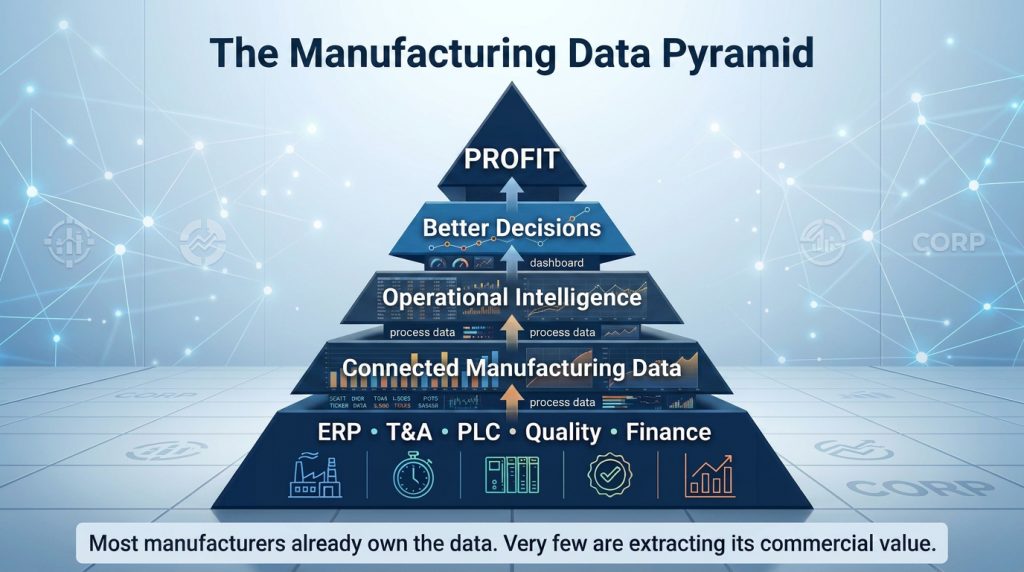
Most manufacturers already hold a significant amount of operational information.

The challenge is converting that information into something managers can use to improve productivity, control cost and sustain Continuous Improvement.

A dashboard containing dozens of measures may look impressive. But if it does not help the organisation make a better decision, its commercial value is limited.

Manufacturers can improve the value of their operational data by applying five practical principles.

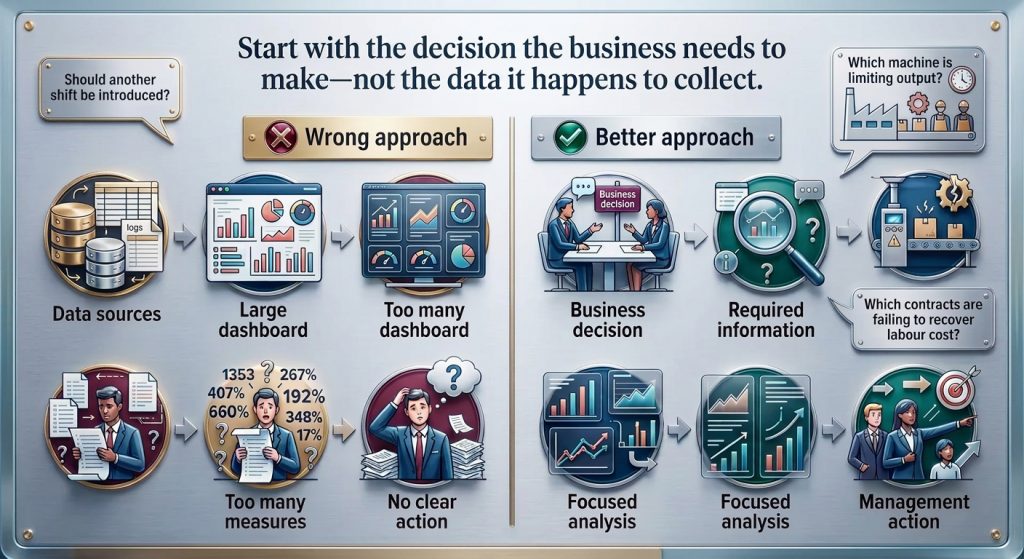
1. Begin with the decision, not the dashboard

A data project should not begin by asking:

What information can we collect?

It should begin by identifying the decisions the organisation needs to improve.

For example:

  • Should another shift be introduced?
  • Is a particular product commercially viable?
  • Which machine is creating the greatest constraint?
  • Why does one production line outperform another?
  • Is overtime increasing output or compensating for inefficiency?
  • Which contracts are failing to recover their true labour cost?

Once the decision is clear, the manufacturer can determine which information is required to support it.

This prevents the business from collecting data simply because it is available.

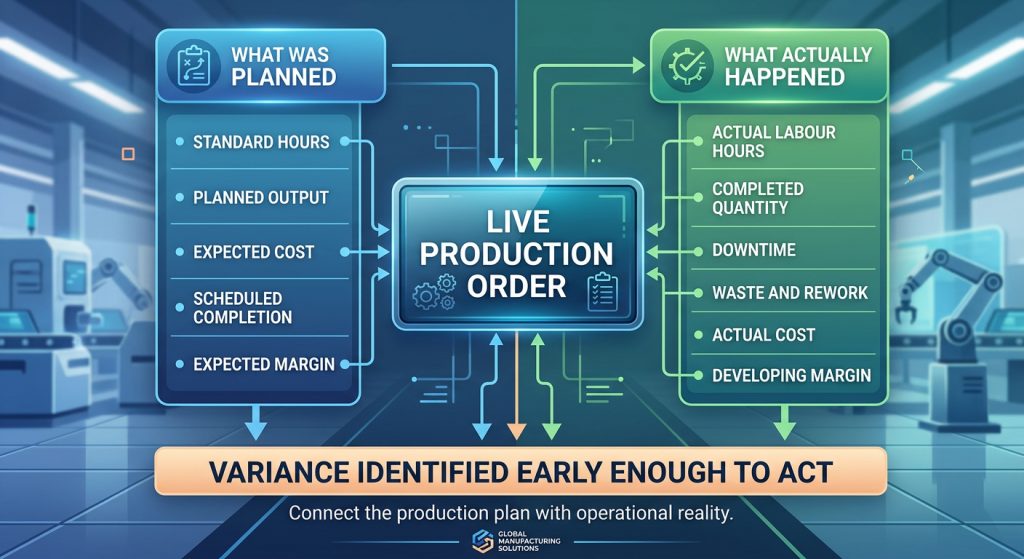
2. Connect planned performance with operational reality

Most manufacturers already hold production plans, estimates, standards and expected costs.

The difficulty lies in comparing them consistently with what actually happened.

A production order should not remain an isolated record within an ERP system.

It should become a live operational entity against which the business can attribute:

  • Labour
  • Activities
  • Machine usage
  • Output
  • Downtime
  • Waste
  • Rework
  • Work in Progress

This enables the manufacturer to compare:

  • Estimated cost with actual cost
  • Standard hours with actual hours
  • Planned output with completed output
  • Expected margin with developing margin
  • Scheduled completion with likely completion

Planning information then becomes a tool for operational control rather than simply a record of what was expected.

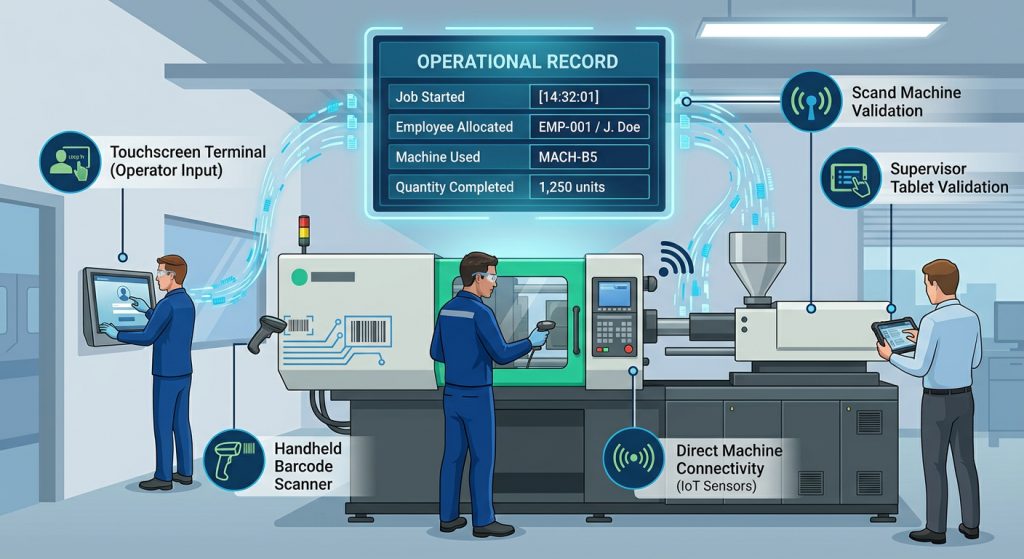
3. Capture information where the activity takes place

Operational data becomes less reliable when it depends on memory or retrospective entry.

Employees may be asked at the end of a shift to remember when a job started, why it stopped or how long they spent on an unplanned activity.

Supervisors may reconstruct events from paper records, spreadsheets and conversations.

Information should instead be captured as close as possible to the activity.

This may involve:

  • Shop-floor touchscreens
  • Barcode scanners
  • Mobile devices
  • Machine and PLC signals
  • Automated data feeds
  • Simple employee declarations
  • Supervisor validation

The objective should not be to create more administration.

It should be to make accurate data capture a natural part of completing the work.

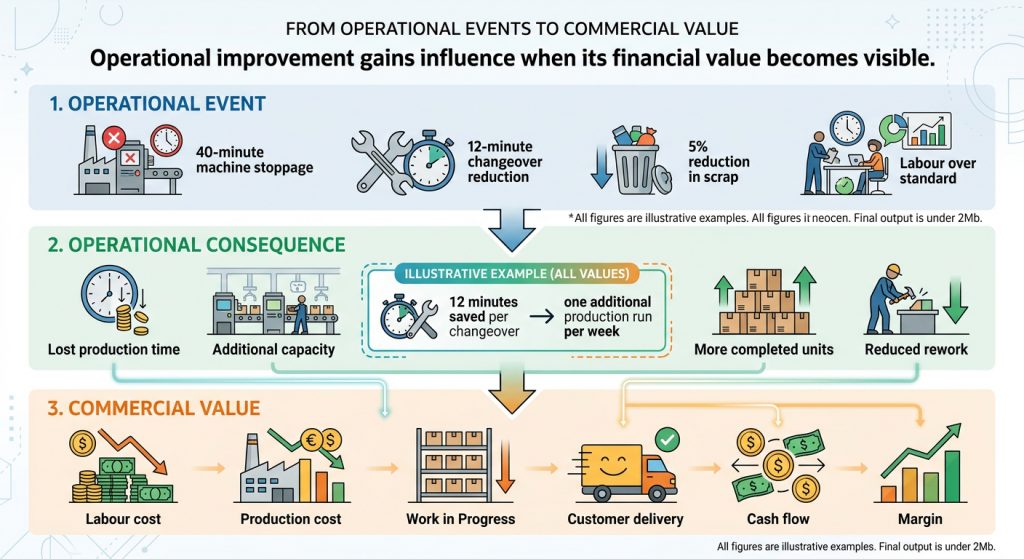
4. Translate operational variance into financial value

Operational measures become more influential when they are expressed commercially.

A reduction in downtime is positive.

An increase in recoverable production capacity creates a business case.

A shorter changeover is useful.

Demonstrating that the reduction creates an additional production run each week gives the improvement strategic relevance.

Manufacturers should therefore connect productivity, downtime, waste and efficiency measures with:

  • Labour cost
  • Production cost
  • Capacity
  • Work in Progress
  • Customer service
  • Cash flow
  • Margin

This creates a common language between operations, finance and senior management.

It also helps improvement teams demonstrate the real commercial value of their work.

5. Close the improvement loop

Continuous Improvement should operate as a complete cycle:

  1. Define the problem
  2. Measure current performance
  3. Identify the causes
  4. Implement the change
  5. Measure the result
  6. Control the improved process

Too many improvement projects reach the implementation stage without establishing how the result will be monitored and sustained.

Reliable operational information allows the manufacturer to determine:

  • What changed
  • Why it changed
  • Whether the improvement has continued
  • What commercial value has been created

This distinguishes a temporary improvement from a permanent change in performance.

Technology is only part of the answer

Advanced technology can support stronger manufacturing performance, but technology alone does not create a data-driven organisation.

Artificial intelligence, robotics and automation all depend on structured management, reliable information and clearly defined operational objectives.

AI cannot compensate for:

  • Inconsistent job codes
  • Unreliable standards
  • Disconnected systems
  • Poor labour attribution
  • Missing downtime reasons
  • Incomplete operational context

Before a manufacturer asks what AI could predict, it must first be able to explain accurately what has already happened.

The foundation of industrial AI is not the algorithm.

It is trusted operational data.

From data collection to operational intelligence

For many manufacturers, the answer is not to replace every existing system.

It is to create a connected operational layer between those systems, the workforce, machinery and the production environment.

That layer should be capable of:

  • Receiving orders, routings, standards and cost information
  • Presenting relevant instructions to employees
  • Capturing activity as work takes place
  • Combining employee, job, process and machine data
  • Applying operational and financial rules
  • Calculating performance at the required level of detail
  • Returning meaningful information to managers and authorised systems

Ceequel® Operational Intelligence has been designed around this principle.

It connects operational activity with information from existing business systems, machinery and the workforce.

The platform can convert job, employee, process and machine information into measures such as:

  • Labour productivity
  • Job cost
  • Work in Progress
  • Actual versus standard performance
  • Downtime
  • Overall Equipment Effectiveness
  • Cost variance
  • Margin performance

The purpose is not simply to produce more reports.

It is to create a consistent operational record that helps manufacturers understand what is happening, why it is happening and what it means commercially.

The next productivity improvement may not require another system producing another isolated set of figures.

It may begin by connecting the information the manufacturer already has—and using it to make better decisions.


UK Manufacturing Is Data-Rich—but Often Insight-Poor.

Part 1 of a 2 Part Series……….

UK manufacturing remains one of the country’s most strategically important industries.

The sector supports approximately 2.6 million jobs, accounts for a significant proportion of UK business research and development, and generates hundreds of billions of pounds in annual product sales.

Yet manufacturers continue to face considerable pressure from rising employment costs, energy prices, skills shortages, supply-chain disruption and international competition.

The next significant improvement in manufacturing productivity may not come solely from buying faster machinery, employing more people or installing additional automation.

It may come from making better use of the information already being generated inside the factory.

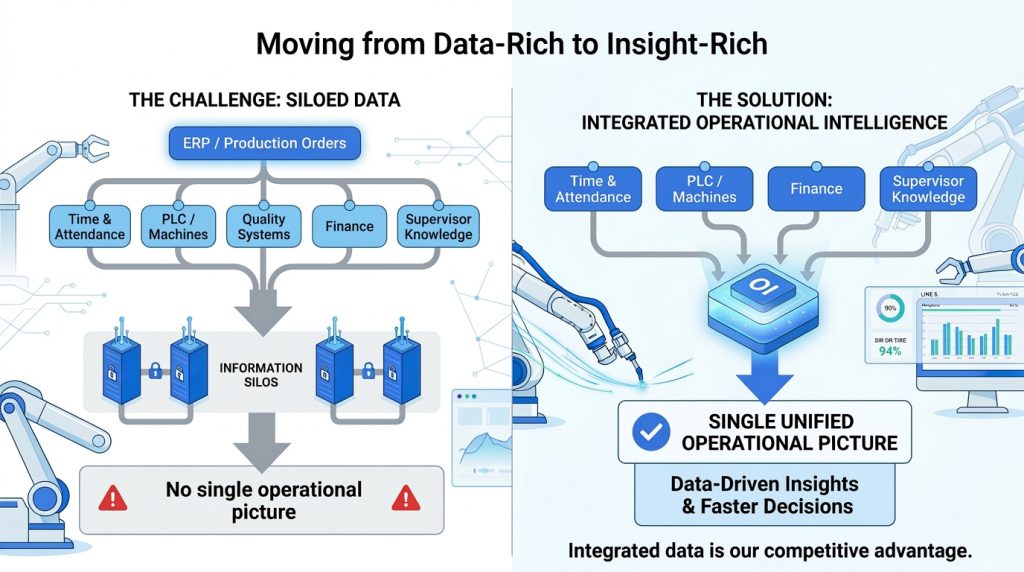
Manufacturers do not lack data

Every production environment creates large quantities of operational information.

ERP and MRP systems hold production orders, routings, standards, materials and planned quantities. Time and attendance systems contain working-time information. Machinery and PLCs produce performance signals. Quality systems record defects and rework. Finance departments maintain labour rates, overheads and costing data.

Employees and supervisors contribute another vital layer of information. They know why a job stopped, why a changeover took longer than expected, why materials were unavailable or why output fell below target.

The problem is rarely that this information does not exist.

The problem is that it is held across different systems, recorded at different levels of detail and made available at different times.

A manufacturer may know:

  • The total labour cost for the month
  • The number of employees who attended work
  • The total output achieved
  • The overall value of scrap
  • The level of overtime worked

But that does not necessarily reveal:

  • Which jobs absorbed the labour
  • Which operations exceeded their standard times
  • Where downtime occurred
  • Why production was delayed
  • Which products created the greatest rework
  • How Work in Progress changed during the day
  • Which customers, jobs or contracts delivered the expected margin

The business may possess all the individual pieces of information while still lacking a complete operational picture.

Data needs context

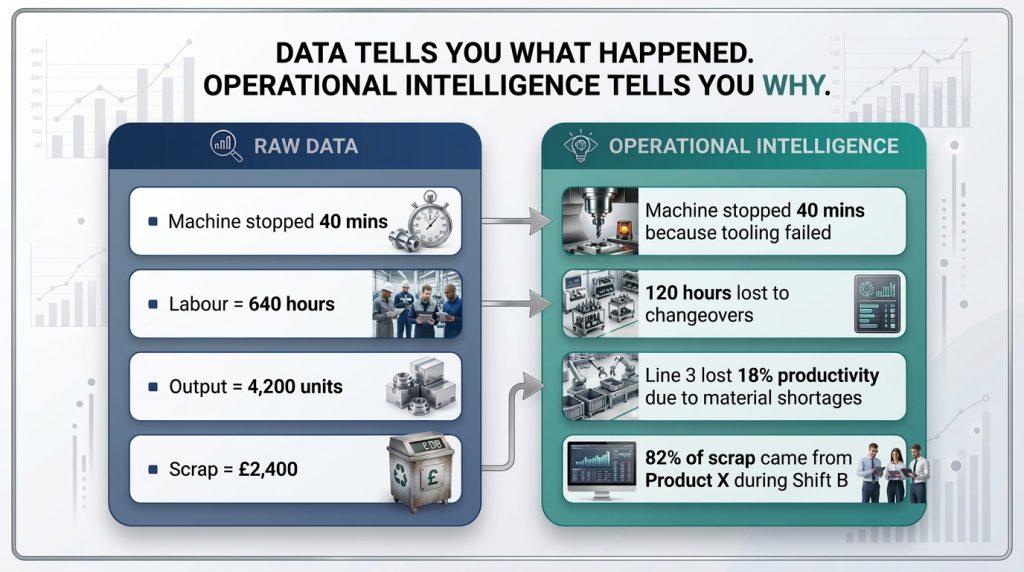
Knowing that a machine stopped for 40 minutes is useful.

Knowing that the stoppage delayed three jobs, created two hours of additional labour, affected a customer delivery and reduced the expected margin is far more valuable.

The same principle applies to workforce information.

Knowing that 80 employees worked an eight-hour shift confirms that 640 paid hours were available.

It does not explain how those hours were divided between:

  • Productive activity
  • Machine set-up
  • Changeovers
  • Maintenance
  • Waiting time
  • Rework
  • Training
  • Indirect work

Manufacturers therefore need to connect four essential dimensions.

What was planned

The order, routing, standard time, expected quantity, labour requirement, target cost and expected margin.

What actually happened

The employees involved, activities completed, hours consumed, quantities produced, machines used and interruptions encountered.

Why performance varied

Downtime, material shortages, quality failures, changeovers, resource constraints, skills issues or process inefficiencies.

What the variation meant financially

The impact on labour cost, production cost, Work in Progress, recovery, delivery performance and margin.

Until these dimensions are connected, management teams can spend more time debating whose figures are correct than deciding what action to take.

The limitations of lagging indicators

Traditional management reporting is largely based on lagging indicators.

These may include:

  • Monthly labour cost
  • Total production output
  • Scrap value
  • Overtime expenditure
  • Gross margin
  • Delivery performance

These measures remain important, but they usually show the final outcome after the opportunity to intervene has passed.

By the time a monthly report identifies a margin problem, the labour has already been paid, the material has already been consumed and the production delay has already occurred.

Operational intelligence provides the explanation behind the final result.

It can show:

  • Labour consumed by job and operation
  • Actual time compared with standard
  • Productive and non-productive activity
  • Machine interruptions
  • Changeover performance
  • Scrap and rework by product or process
  • Work in Progress
  • Output by employee, team, line or shift
  • The reasons behind operational variance

This changes the management question from:

Why was last month’s margin lower than expected?

to:

Which jobs are moving outside their expected labour and production cost today?

That is a fundamentally different management capability.

Better data supports better management

Continuous Improvement depends on measurement, analysis and response.

A manufacturer cannot consistently improve a process it cannot measure accurately.

Nor can it sustain an improvement if the information required to monitor the process arrives several weeks after the activity occurred.

When information is retrospective, improvement becomes reactive.

Managers investigate after the cost has been incurred, the production has been delayed and the margin has been reduced.

Operational data must therefore move at the speed of the operation.

The opportunity for UK manufacturing is not simply to collect more information.

It is to connect existing information more effectively, add the operational context behind it and use it before the opportunity to act has passed.

Because better performance does not begin with more data.

It begins with understanding what the data is really saying.

What’s In A Name?

“Say my name, say my name” Have a read of our latest blog post on recruiting and retaining the best staff for your workforce.

“So, your name is Molly, why?”

Taken aback by that question? Struggling to think of a suitable answer? In fact, what sort of a reply can you possibly give or be expected to give when faced with that question?

Reported recently by a leading HR magazine, that question was actually put to a potential employee during the interview process.

But it doesn’t end there.

Another question was asked, this time to a different candidate;

“What space phenomenon do you relate to?”

This time around however, the quick witted candidate was faster off the mark and fired back with the response;

“A black hole, because I suck all the energy out of the room”

Very clever!

Let’s be honest, we have all experienced the odd interview/interviewee and here at ELF Productivity we are not immune to it.

Several years ago, we experienced what can only be described as a severe case of emotional attachment and/or trust issues, which involved “the girlfriend” wanting and actually attempting to sit in and attend “the boyfriend’s” interview!

All joking apart, let’s be honest, over the years both employees and Human Resource departments have seen it all during the recruitment process, for further clarification, please refer to our previous blog post; “A Horse Fell On Me – Timewasters vs the Real Deal”

With Brexit now on the horizon and as the country manoeuvres and weaves its way through this complex transitional time, the recruitment process is now no longer about candidates fighting for that key placement. As we inch ever closer to leaving our grouchy European cousins behind, a skills shortage is now emerging as a real possibility.

Candidates leaving the UK for the foreseeable future, have left the door wide open for others to step in and reap the opportunities that are now on offer. Training, flexible/remote working, study support/leave and attractive remuneration packages are now dangled enticingly under potential employees noses.

Where once a replacement could easily be found, companies now need to re-think their whole recruitment strategy and offer flexible working and in-house training as standard options. Throw into the mix the ever increasing retirement age, advancements in digital development, employees having to work until they “drop”; that was a joke by the way, companies have little option but to market their particular brand with a lot more skill, knack and aptitude in what is now, a very competitive market.

But how would you make a good impression? What options would you need to offer, what changes would you have to make with regards to your own processes and procedures, in order to have the best workforce possible?

Let’s go back to the original question, “What’s in a name?”

Say the name ELF Productivity Limited or to its software peers, CEEQUEL® and you have an instantly recognisable brand.

That’s because CEEQUEL® is a name that you can trust.

ELF Productivity Limited has been at the forefront of Biometric Time and Attendance Management systems since 1982.

Where others have failed, CEEQUEL® has prevailed.

Without wishing to sound arrogant, you have to hold a very good deck of cards in your hands to put your head above the parapet and be able to withstand the competition in the Time and Attendance market for over 35 years.

As we progress into another new phase of development, ELF Productivity Ltd remains at the cutting edge, not only in terms of in-house talent but in the sheer vast knowledge of Biometric Time Management solutions that comes only from experience.

With an all-encompassing, fully integrated software solution such as Human Resource Management, your entire workforce can be managed from one central kiosk. This fully integrated CEEQUEL® module can co-exist on the same Time Attendance database or as a standalone HR Management solution.

Employee Self Service,Web-Manager and Shop Floor Data Capture; all come under ELF’s very impressive belt. CEEQUEL® mobile apps for Android, Apple and Windows devices are an added benefit for those employees that prefer to be a little more remote and flexible.

Biometric Access Control with fingerprint and facial recognition will help you monitor and track your entire workforce; whilst Shop Floor Data Capture will help you convert operator performance into performance related pay and bonuses.

CEEQUEL® Time and Attendance software suite has it all.

So what are you waiting for, isn’t it time you became acquainted with a name you can depend on, a Time and Attendance Management solution that continues to live up to its name, time and time again?

If you would like to learn more about the incomparable software suite that is CEEQUEL® Contact ELF Productivity Ltd today today for a free demonstration and no obligation quotation.

For a closer look at CEEQUEL®, our range of brochures can be downloaded here here

ELF Productivity Limited and CEEQUEL® names you can rely on, names you can trust.

Grease Is The Word

“I got chills, they’re multiplying”! Have a read of our latest blog post and discover how the original is ALWAYS the best.

Movie

This year sees the 40th Anniversary of that timeless classic movie of 1950’s teenage angst….. GREASE!

That’s right, the all singing, all dancing, hand-jiving ageless flick which turned Olivia Newton John and John Travolta into overnight stars, has reached the BIG 40!

To understand how Grease became THE movie of 1978 – if not all time, Vince Fontaine probably sums it up the best with his understated line “It doesn’t matter if you win or lose; it’s what you do with your dancin’ shoes”

Admit it; you really didn’t think that 40 years had passed by since you were singing “Summer Nights” and declaring “Sandy! You just can’t walk out of a drive-in”!

Time, unfortunately for everyone, really does have a habit of ticking by.

Even though 1978 still seems like yesterday for some of you; long hot summers, Spangles and Marathon bars (ask your Mum) does anyone remember or even realise that there was actually a sequel to Grease in the 1980’s?

Even though there were some great films in the ‘80’s, Grease 2 sadly isn’t one of them.

Released with great hype and expectation, the film has the same style of characters but without any of the original “chemistry “or endearing quality that everyone felt with The Pink Ladies and the T-Birds. By trying to recreate the original and as we all know you can’t improve on the genuine article, they produced a big fat dud! Ultimately, that familiar sense of “this is not what I was expecting” kicked in. The cinema paying public definitely weren’t “Hopelessly Devoted” to THIS sequel and gave it a big thumbs down!

To be fair, how can you improve on something that was so imaginative, so creative, that even now 40 years later, is still adored?

Sadly, this is what it can feel like with Time & Attendance Management systems. On the surface they may look and sound alike but not all Time & Attendance software is the same.

Here at ELF Productivity Limited, authors of the original CEEQUEL® software suite, we have been at the forefront of Biometric Time & Attendance and Human Resource Management since 1982. Other Time & Attendance systems may give the impression that they are comparable to ELF but CEEQUEL® is distinctive.

What sets ELF Productivity apart from all other systems is that our understanding and proficiency is incomparable. CEEQUEL® software is constantly evolving and as we advance into another new phase of development, we remain the definitive enterprise in Time & Attendance procedures – in other words the “Real McCoy”.

Software that works harder and deployed the way you want it, either via your existing IT infrastructure or via the cloud. CEEQUEL® Apps for iPhone, Android and Windows, provides your workforce with worldwide connectivity.

CEEQUEL® Employee Self Service and E-Manager modules will equip you with all the tools necessary, to enable you to manage not only your HR obligations but your remote and flexible workforce, whilst Access Control and Shop Floor Data Capture will come alongside and help you monitor and keep track of your entire workforce.

So, with all that information in mind, is CEEQUEL® software suite “The One That You Want” for your company this year? Do you need a Biometric Time & Attendance system that will “Go Together” with your existing workforce?

If so, choose the number 1 in Time & Attendance Management, choose the original CEEQUEL®

If you would like to know more about the advanced and revolutionary software suite that is CEEQUEL® our index of brochures can be found here.

Contact ELF Productivity Ltd today today for a free no obligation quotation and demonstration of CEEQUEL® software

And remember, keep dancin’!

Are You Allowing A Toxic Culture Into Your Workplace?

“Don’t you know that you’re toxic”. Have a read of our latest blog post here, on the best way to highlight that toxic employee.

Conflict

Let’s be honest, we have all experienced a difficult co-worker or manager at some time in our working lives. This is nothing new in the workplace but sadly, as a recent Harvard Business Study uncovered, bullying and incivility is not something that your company can afford to ignore.

The business study, which was undertaken by 60,000 employees, highlighted the true financial cost to businesses on the shop floor that employed people with a partiality to, but not exclusively, the following :-

• Vulgarity
• Lack of respect
• Lack of manners
• Discourteousness
• Coarseness
• Impoliteness
• Rudeness

The study also highlighted that by allowing such individuals to remain in the company over a long period of time, had a detrimental effect on the retention of other key members of staff.

The statistics below make for grim reading, as staff retention is crucial to any forward thinking company.

• 38% Intentionally decreased their work output
• 25% Took their frustrations out on their clients
• 12% Left their jobs altogether

The hiring process doesn’t always come easy for management, especially if they are lacking in the people-skills department themselves. Managers may be good at running a business or a department in terms of work, but from time to time they can fail to pick up on certain attributes that a person displays during the recruitment process. By missing these characteristics, individuals can and often do, “slip through the net”.

And as we all know, everyone can look good on paper!

Let’s take a look at the 5 main prime antagonists that may rear their “ugly heads” in the workplace as uncovered by the business study.

1. The Slacker
2. The Bully
3. The Gossip
4. The Lone Wolf
5. The Know it All

As you will see from the list, Human Resource Departments can do without the burden of this particular type of employee – in any situation.

So what can be done to highlight and more so bring to task this certain individual? What can management and in particular Human Resource Departments do, to end this negative cycle within the workplace?

ELF Productivity Limited’s CEEQUEL® software is the essential Time Management suite that you need.

ELF’s Time and Attendance system will allow you to uncover the real reason behind the downturn in productivity. Whether you need to supervise “The Slacker” on the shop floor or call time on “The Gossip” in the office, CEEQUEL® and our Shop Floor Data Capture and Human Resources modules will provide everything you require and necessitate for your workforce.

Shop Floor Data Capture

Shop Floor Data Capture does exactly what it says on the tin, it is employee tracking at its very best. A component of the CEEQUEL® Time and Attendance software suite, Shop Floor Data Capture not only calculates employees working hours, it also tracks activities and jobs over a specified time; thus highlighting that “shirker” and “gossip-monger” on the shop floor. Another benefit this module provides is the Incentive Scheme Calculation. This calculation is particularly popular within the manufacturing sector as it converts operator performance into performance related pay.

Human Resource Management

CEEQUEL® Human Resource Management solution is an all-encompassing, fully comprehensive HR module that will completely transform your personnel requirements. With views such as appraisals, discipline and grievance procedures, it provides the necessary instruments needed to deal with your day to day management workload. This module provides you with the software to not only supervise every individual employee but it will also highlight your hardworking employees; thus enabling you to reward and promote the right staff.

Another added benefit to CEEQUEL® Human Resource Management module is that it can co-exist on the same Time and Attendance database or as a standalone HR Management solution.

Does your company need a dynamic Time Management system that will not only stop a toxic culture from springing up in your workplace but allows your company to run more efficiently and smoothly?

Is it time for you to take a closer look at your workforce?

CEEQUEL® Time and Attendance software suite is all you need to monitor and keep track of your ENTIRE workforce.

If you would like to know more about the unrivalled CEEQUEL® Software Suite, including our leading Time and Attendance modules; the downloadable catalogue of brochures can be found here.

Contact ELF Productivity today for a free no obligation quotation and demonstration of CEEQUEL® software.

Love is in the Air and on the Shop Floor

Love is all around, check out our Valentine’s Day blog on keeping an attentive eye on your workforce.

“Love is in the Air” as John Paul Young once sang – for those of you old enough to remember and for those not old enough – it was 1977 to be precise!

February 14th is once again with us and for all you cynical people out there, Valentine’s Day is not something that can be avoided, especially as there are romantic reminders everywhere you turn. Valentine’s Day, particularly within a company, is one of those places. It has become a prime opportunity for people to make their anonymous move on that one special person who has caught their eye.

Embarking on a romance within an enterprise can turn out to be the best thing ever, or the worst, depending on the outcome and the company’s view. So what is your position as a business with regards to the wooing process or “courting” as they used to say, amongst your employees?

Where do you stand with your staff gazing at each other across the office and meeting at the photocopier? Are you happy seeing flowers, chocolates and a cuddly toy sent by a lovesick Romeo in pursuit of their Juliet? And are you content with the endless company gossip about the latest lovebirds?

Or are you, like a lot of employers out there, concerned about the lack of focus, downturn in productivity and even worse having to deal with a potential harassment claim?

Every company wants to cut their employees a little “slack” at certain times during their working day. No employer wants to be known as a tyrant in the office, especially when team building and morale is an integral part of any company’s mission statement. Unfortunately, as companies usually find out, there is a fine line between boosting staff morale and seeing your productivity output decline. As some employers call it “a very unproductive day”.

When does team building, and joviality (romantic or not) within the workplace stop and non-productive, timewasting and un-focused employees begin?

You may be asking “What’s Love Got To Do With It”? What can you do if your current Time and Attendance processes are not up to the task of monitoring your very own “Part-Time Lovers”, especially at this most romantic time of year? And what if “You’ve Lost That Loving Feeling” surrounding your manual, outdated and unreliable data capture system.

Here at ELF Productivity Ltd, authors of Ceequel® Time and Attendance software, we can ensure that “You’ve Got That Loving Feeling”. A module that will become your very own “Dreamlover”.

ELF Productivity’s Shop Floor Data Capture capture module is your own corporate cupid. It entwines management processes and employee tracking together. It has key features within, including, Actuals v Standard-times, Productive v Non-Productive Hours, Wages to Gross, Machine Monitoring and Incentive Scheme Calculations.

Employee Tracking is another key element within Shop Floor Data Capture. This will not only calculate the total number of hours worked by a particular employee but it will also provide details on how many hours the employee has worked on either a particular task or within a certain sector/department of the company. With fast accurate monitoring 24 hours day, transparency and clarity ensures you stay fully informed.

Here at ELF Productivity Ltd we have been at the forefront of Time and Attendance since 1982, so we are well positioned to understand that people spend a considerable amount of time in the workplace. Relationships which begin on the shop floor are more likely to end in marriage than ones that began in a pub or club. This is why we are best placed to understand the true requirements of Human Resource Management and Payroll Departments. Because of this our modules are being constantly developed to make use of any new ideas and new ways of making Time and Attendance processes, simpler, faster and more automated.

Do you want a new “Vision of Love? Is ELF Productivity Ltd and Ceequel® Time and Attendance software “The One That You Want” this Valentine’s Day?

If so, we know that “Love Takes Time” so Contact ELF Productivity today for a free no obligation quotation and demonstration of Ceequel® software.

If you would like to learn more about the unrivalled functionality of Ceequel® Software Suite, including our flagship Time and Attendance offering; a range of downloadable brochures can be found here.

Could you be more productive?

Managing your time on a day to day basis is often a daunting tasks to most people. Understanding just how much time you need to set aside for each task is often hard when you have no way of measuring how long each task takes. Implementing the below seven tips can help you to effectively manage your time and could even provide you with extra time to finish off tasks that may take longer than expected.

Time Management

Effectively managing your time is a daunting task for any employee. Although we would all like to believe we do it well the realisation is you probably spend over 50% of your time completing mundane tasks and unproductive processes.  Spending your time more effectively on more important tasks is likely to stop you from missing deadlines and having to complete tasks outside of work.

7 Tips to Help You Maximise Your Time

Using the 7 tips below will help you maximise your time making it easier for you to complete tasks on time and to the best of your ability.

1. Tracking

Keeping track of how long it takes you to complete each individual task is the easiest way to grasp a hold on which tasks require more time.  Knowing which projects take the most time allows you to effectively manage your weeks as you can allocate the right number of hours needed to complete each project and schedule tasks that take less time in around them.

2. Breaking up projects.

Breaking up bigger projects into smaller tasks allows you to manage your time more effectively. Knowing how long each part of a project takes makes it easier for you to recognise where you fall behind. This information allows you to allocate your time better the next time around, meaning you will hit your deadlines every time.

3. Kill unnecessary meetings

Meetings take up time and time is precious when it comes to the completion of everyday tasks. Attending a meeting that could have possibly been avoided on a day when you have an important project due is unnecessary and time consuming.

When planning a meeting you need to determine if one is really needed or can what you are going to be discussing be done over the phone or via email. You also need to decide if you really need so many of your staff or colleague to attend, if the meeting needs to go ahead and could it be completed by yourself and do you really need to take a colleague with you.

Scheduling short 10 to 15 minute meeting instead of the automated half an hour provided by your calendar is the most effective way to get meeting’s done but without the needing to waste any unnecessary time.  Although the idea of using a timer in a meeting can often be seen as disrespectful it is the easiest way to make sure you stay on top of your day to day schedule. Meeting’s that drag on longer than expected often leave you scrambling to finish tasks before the end of the day with many having to be pushed to the following morning.

4. Multitasking is a waste of time

Completing multiple tasks at once seems like the quickest way to get things done however it’s actually the least productive thing you could do.  A human has an average attention span of about 8 seconds meaning it tasks around 26 minutes to properly refocus on each task you’re completing meaning the work your producing in this time is actually not to the best of your ability.

Rather than completing all your tasks at once you should focus on one task at a time and reward yourself with breaks inbetween new projects.

5. Prioritise

There’s nothing worse than coming into work to see a list of past tasks on your desk that need amending. The easiest way to deal with this is to complete the most important task first. Schedule a block of time for this project and try to complete it within the allocated time. Make sure to take a note if the project takes longer than expected as this information will help you effectively manage your time next time you have to complete a similar project.

6. Distractions

Employees are their own worst enemy when it comes to avoiding distractions. We’ve all gotten caught up in checking and responding to our emails before so much so that a considerable period of time has gone by and we’ve still to make a start on that important project.  Realistically most of the emails you receive can wait, after all you don’t get paid for checking your emails your value is based on how productive you are at completing the essential tasks you are given. Giving yourself a selected period of time each day in order to check and respond to your emails is the easiest way to achieve the most from your day.

7. The 45/15 rule

We’re not designed to work on tasks for endless hours and after about 45 minutes we actually begin to lose focus. Allowing yourself to spend 45 solid minutes working on each individual task followed by a 15 minute break to focus on a distraction of your choice is the best way to achieve the highest levels of productivity.  Making sure you only take a bathroom break or check on any desktop or phone notifications whilst in your designated non-working time stops you from wasting productive minutes.

While employees can take note of the above seven tips to improve their productivity, without a time and attendance solution linked to employee tracking it is impossible to see which of your workforce are the most productive.

For more information on how you can track your employee’s productivity contact us today!