Replacing Mitrefinch TMS: A Practical Guide for UK Employers

As workforce management requirements continue to evolve, many organisations are reviewing whether their existing Time & Attendance solution remains aligned with their operational, payroll, compliance, and workforce management objectives.

If your organisation currently uses Mitrefinch TMS and is considering its future options, this guide provides a practical framework for assessing whether your current solution continues to meet your needs and, if not, what should be considered when evaluating alternative platforms.

This article is intended as an impartial guide to help employers make informed decisions based on their own business requirements.

Why Organisations Review Their Time & Attendance System

Time & Attendance systems are a critical component of workforce management. As organisations grow, diversify, or modernise their operations, requirements often change.

Common reasons for reviewing an existing solution include:

  • Increasing payroll administration and manual intervention.
  • Expansion across multiple sites or locations.
  • Greater use of remote, mobile, or field-based employees.
  • A requirement to integrate Time & Attendance with HR, Payroll, ERP, Access Control, or Visitor Management systems.
  • The need for improved management visibility and reporting.
  • Changes in working practices, legislation, or compliance requirements.
  • Hardware refresh programmes or software renewal cycles.
  • Business acquisitions, mergers, or organisational restructuring.

A system review does not necessarily mean a replacement is required. However, it provides an opportunity to assess whether the current solution continues to deliver the functionality, efficiency, and return on investment expected by the business.

What a Modern Workforce Management Solution Should Deliver

A Time & Attendance solution should do more than simply record employee attendance. It should provide accurate workforce data that supports operational decision-making, payroll accuracy, compliance, and employee engagement.

When evaluating any solution, organisations should expect:

Accurate Workforce Data

  • Real-time attendance monitoring.
  • Automated calculation of working hours.
  • Accurate overtime and absence management.
  • Reduction in manual payroll adjustments.

Improved Management Visibility

  • Real-time workforce dashboards.
  • Exception reporting.
  • Attendance trend analysis.
  • Labour cost visibility.

Streamlined Payroll Processing

  • Automated payroll preparation.
  • Clear audit trails.
  • Reduced payroll queries.
  • Reliable integration with payroll systems.

Workforce Compliance

  • Working Time Regulations monitoring.
  • Absence tracking.
  • Audit and reporting capabilities.
  • Accurate records for compliance purposes.

Enhanced Employee and Manager Self-Service

  • Electronic holiday requests.
  • Manager approvals.
  • Employee access to attendance records.
  • Mobile workforce capabilities where required.

Key Questions to Ask During a System Review

Whether reviewing your current supplier or considering alternative providers, consistency is essential. Every supplier should be evaluated against the same criteria.

Payroll Management

  • How are exceptions and anomalies identified and managed?
  • How are audit trails maintained?
  • How does the system reduce payroll administration?

Business Rules

  • Can the solution accommodate existing working rules and agreements?
  • How flexible is the configuration?
  • Can future changes be implemented without development work?

Hardware and Data Collection

  • What clocking methods are available?
  • Can existing hardware be retained?
  • What options exist for mobile or remote workers?

Integration

  • What integrations are available with Payroll, HR, ERP, Access Control, and Visitor Management systems?
  • Are integrations proven and supported?

Security and Hosting (for cloud based systems)

  • Where is data hosted?
  • What security standards are maintained?
  • What service levels and support arrangements are provided?

Implementation

  • What does the migration process involve?
  • How is data transferred and validated?
  • What support is available during and after implementation?

Commercial Considerations

  • What are the initial implementation costs?
  • What ongoing support and maintenance costs apply?
  • Are there any additional licensing or usage-based charges?

The Importance of a Structured Migration Process

For most organisations, the greatest risk during a replacement project is not the installation of new software. The primary challenge is ensuring that existing workforce rules, pay calculations, attendance policies, and operational processes are accurately replicated or improved.

A successful migration project should include:

  • Detailed Scope of Works.
  • Documentation of existing rules and processes.
  • Configuration review and approval.
  • Data migration planning – if available.
  • Payroll validation and parallel testing.
  • User and manager training.
  • Post-implementation support.

Organisations should seek clear documentation outlining how each stage of the migration will be managed.

Evaluating Long-Term Value

While software functionality remains important, organisations should also consider the broader value delivered by a workforce management solution.

Areas worth evaluating include:

  • Reduction in payroll administration.
  • Removal of manual calculations.
  • Improved labour cost control.
  • Enhanced workforce visibility.
  • Reduced manual processes.
  • Improved compliance reporting.
  • Increased management efficiency.
  • Scalability for future growth.

A workforce management platform should support operational objectives not only today, but also as the organisation evolves over the coming years.

Making an Informed Decision

Every organisation’s requirements are unique. The most effective procurement decisions are based on clearly documented business objectives, operational requirements, implementation considerations, support arrangements, and long-term value (ROI).

A structured review process allows organisations to assess whether their existing solution remains the best fit or whether alternative platforms may offer additional benefits more aligned with future business goals.

By taking a measured and evidence-based approach, organisations can ensure that any investment in workforce management technology delivers meaningful improvements in productivity, efficiency, accuracy, and visibility.

About Ceequel®

Ceequel® is a UK-developed workforce management platform designed to help organisations manage attendance, absence, labour costs, employee self-service, manager approvals, access control, visitor management, and workforce reporting through a single integrated solution.

Supporting organisations across manufacturing, logistics, food production, distribution, healthcare, engineering, and other sectors, Ceequel® provides flexible deployment options and configurable workforce management capabilities designed to meet the operational requirements of modern UK employers.

For organisations reviewing their current Time & Attendance solution, a structured demonstration and discovery process can help determine whether Ceequel® is aligned with their operational and workforce management objectives.


This article is intended for informational purposes only and does not make any representations regarding the performance, functionality, support, commercial arrangements, or future direction of any third-party software product or supplier. Organisations should undertake their own evaluation based on their individual business requirements and procurement processes.

Replacing Legacy Kronos Systems: A Practical Guide for UK Employers

Many organisations have relied on Kronos workforce management solutions for years, benefiting from robust time recording, scheduling, and workforce management capabilities. However, as technology, workforce expectations, and business requirements evolve, many employers are taking the opportunity to review whether their existing system continues to meet their operational needs and future objectives.

If your organisation is currently using a legacy Kronos solution and is considering its long-term strategy, this guide outlines the key factors that should be considered when evaluating your existing platform and assessing potential alternatives.

This article is intended as an educational resource to support informed decision-making and procurement best practice.

Why Organisations Review Legacy Workforce Management Systems

Workforce management systems often remain in place for many years. During that time, businesses can undergo significant changes that place new demands on technology and operational processes.

Common reasons organisations review their existing workforce management platform include:

  • Changes to payroll processes and compliance requirements.
  • Business growth, acquisitions, or multi-site expansion.
  • Increasing use of mobile, remote, or hybrid working.
  • A desire to improve management visibility and workforce analytics.
  • The need for greater automation and reduced administration.
  • Wider digital transformation programmes.
  • ERP, HR, or payroll system replacement projects.
  • Hardware refresh cycles or infrastructure modernisation initiatives.
  • Evolving employee expectations around self-service and accessibility.

A system review provides an opportunity to assess whether the existing platform remains aligned with current business objectives and future workforce management requirements.

What Modern Workforce Management Should Deliver

Today’s workforce management systems are expected to do far more than simply record attendance.

A modern solution should support strategic decision-making while improving operational efficiency across the organisation.

Accurate Time Recording

Organisations should expect:

  • Real-time attendance visibility.
  • Automated working time calculations.
  • Accurate overtime management.
  • Comprehensive absence monitoring.
  • Clear audit trails for payroll processing.

Improved Operational Visibility

Managers should have access to:

  • Live workforce dashboards.
  • Attendance exception reporting.
  • Labour utilisation data.
  • Departmental and site-level analytics.
  • Real-time workforce status information.

Payroll Efficiency

Effective workforce management should help organisations:

  • Reduce manual payroll administration.
  • Minimise payroll queries and adjustments.
  • Improve payroll accuracy.
  • Streamline payroll preparation processes.
  • Provide clear reporting and audit capabilities.

Employee and Manager Self-Service

Modern solutions increasingly support:

  • Holiday and absence requests.
  • Electronic approvals.
  • Mobile workforce access.
  • Employee attendance visibility.
  • Manager workflow automation.

Workforce Compliance

Employers should be able to monitor and report on:

  • Working Time Regulations.
  • Attendance policies.
  • Absence management.
  • Audit requirements.
  • Workforce governance procedures.

Key Areas to Assess During a System Review

When reviewing any workforce management platform, organisations should evaluate suppliers using consistent criteria.

Workforce Management Functionality

Consider whether the solution supports:

  • Complex shift patterns.
  • Overtime rules.
  • Attendance management.
  • Absence management.
  • Flexible working arrangements.
  • Multi-site operations.

Payroll Integration

Questions to consider include:

  • How is payroll data prepared and transferred?
  • What validation processes exist?
  • How are exceptions managed?
  • What audit capabilities are available?

Data Collection Methods

Review the available options for:

  • Biometric clocking.
  • Facial recognition.
  • Proximity cards and fobs.
  • Mobile workforce applications.
  • Web-based attendance recording.

Integration Capabilities

Organisations should understand how the platform shares data with:

  • Payroll systems.
  • HR software.
  • ERP platforms.
  • Access Control systems.
  • Visitor Management solutions.
  • Business intelligence and reporting tools.

Security and Infrastructure

Areas to evaluate include:

  • Data hosting arrangements.
  • Security standards and certifications.
  • Business continuity provisions.
  • Support and service level agreements.
  • Disaster recovery procedures.

Scalability

A workforce management platform should support:

  • Organisational growth.
  • Additional sites.
  • New departments.
  • Future technology requirements.
  • Evolving workforce practices.

Planning a Successful Migration

Any workforce management replacement project should be approached as a business transformation initiative rather than simply a software installation.

Successful projects typically include:

Discovery and Analysis

  • Review of existing workforce rules.
  • Documentation of attendance policies.
  • Identification of payroll requirements.
  • Review of reporting needs.

Configuration and Validation

  • Comprehensive Scope of Works.
  • Operational validation.
  • Payroll validation.
  • Rule verification.

Data Migration

  • Historical data requirements.
  • Employee information transfer.
  • Validation procedures.

Training and Adoption

  • Manager training.
  • Employee communication.
  • User documentation.
  • Ongoing support arrangements.

Go-Live and Post-Implementation Support

  • Controlled deployment.
  • Parallel payroll testing where appropriate.
  • Dedicated support during transition.
  • Performance monitoring.

Looking Beyond Features

When reviewing any workforce management solution, organisations should consider the wider business outcomes it can deliver.

These may include:

  • Reduced labour administration.
  • Improved payroll accuracy – no payroll leakage.
  • Greater workforce visibility.
  • Better labour cost control.
  • Improved operational efficiency.
  • Enhanced compliance reporting.
  • Increased employee engagement.
  • Better management decision-making.

The objective should be to identify a solution that supports both immediate operational needs and long-term organisational goals.

Future-Proofing Workforce Management

As workforce management technology continues to evolve, organisations increasingly seek platforms that can support a wider range of operational requirements from a single environment.

Areas commonly considered during strategic reviews include:

Bringing these functions together can help reduce administration, improve data accuracy, and provide a more unified view of the workforce.

About Ceequel®

Ceequel® is a UK-developed workforce management platform designed to help organisations manage attendance, absence, labour costs, employee self-service, manager approvals, access control, visitor management, and workforce reporting through a single integrated solution.

Used across manufacturing, food production, logistics, engineering, healthcare, distribution, and other sectors, Ceequel® provides organisations with configurable workforce management capabilities that can be tailored to specific operational requirements.

For organisations reviewing legacy workforce management platforms, a structured discovery and demonstration process can help determine whether Ceequel® aligns with their current and future workforce management objectives.


This article is provided for informational purposes only and does not make any representations regarding the performance, functionality, support arrangements, commercial terms, product lifecycle, or future direction of any third-party software product or supplier. Organisations should undertake their own independent evaluation based on their specific operational requirements, procurement processes, and business objectives.

UK Manufacturing Is Data-Rich – Five Principles for Turning Manufacturing Data into Better Decisions

Part 2 of a 2 Part Series……….

Most manufacturers already hold a significant amount of operational information.

The challenge is converting that information into something managers can use to improve productivity, control cost and sustain Continuous Improvement.

A dashboard containing dozens of measures may look impressive. But if it does not help the organisation make a better decision, its commercial value is limited.

Manufacturers can improve the value of their operational data by applying five practical principles.

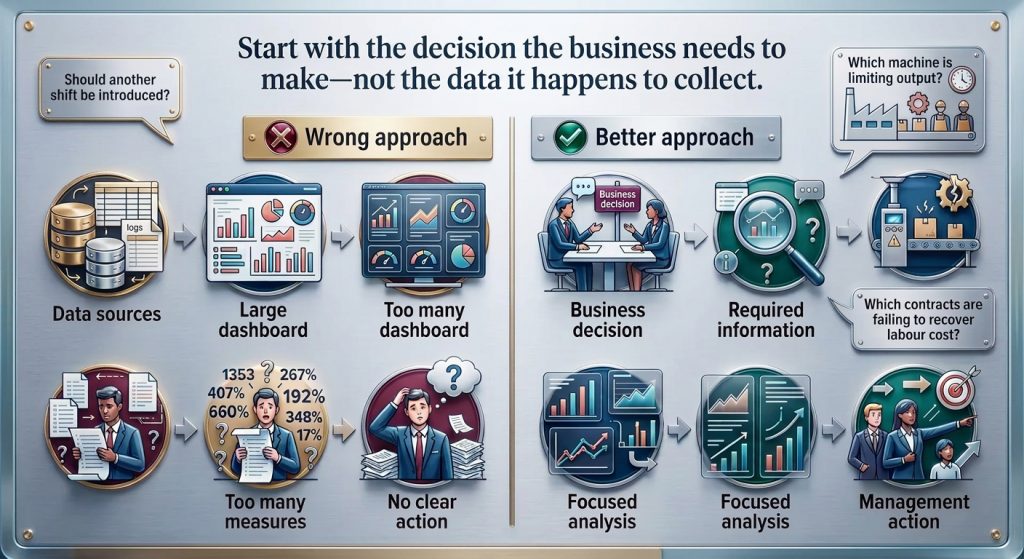
1. Begin with the decision, not the dashboard

A data project should not begin by asking:

What information can we collect?

It should begin by identifying the decisions the organisation needs to improve.

For example:

  • Should another shift be introduced?
  • Is a particular product commercially viable?
  • Which machine is creating the greatest constraint?
  • Why does one production line outperform another?
  • Is overtime increasing output or compensating for inefficiency?
  • Which contracts are failing to recover their true labour cost?

Once the decision is clear, the manufacturer can determine which information is required to support it.

This prevents the business from collecting data simply because it is available.

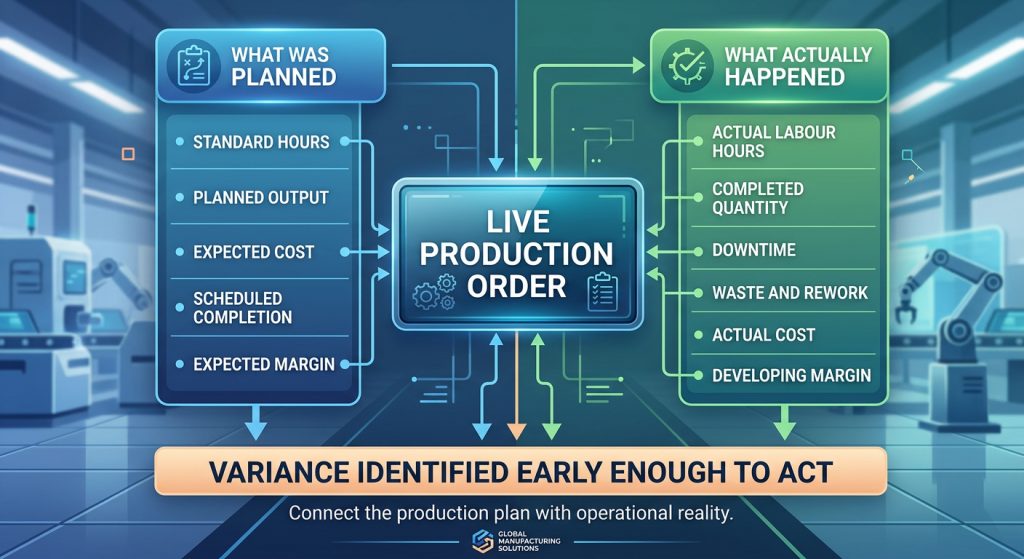
2. Connect planned performance with operational reality

Most manufacturers already hold production plans, estimates, standards and expected costs.

The difficulty lies in comparing them consistently with what actually happened.

A production order should not remain an isolated record within an ERP system.

It should become a live operational entity against which the business can attribute:

  • Labour
  • Activities
  • Machine usage
  • Output
  • Downtime
  • Waste
  • Rework
  • Work in Progress

This enables the manufacturer to compare:

  • Estimated cost with actual cost
  • Standard hours with actual hours
  • Planned output with completed output
  • Expected margin with developing margin
  • Scheduled completion with likely completion

Planning information then becomes a tool for operational control rather than simply a record of what was expected.

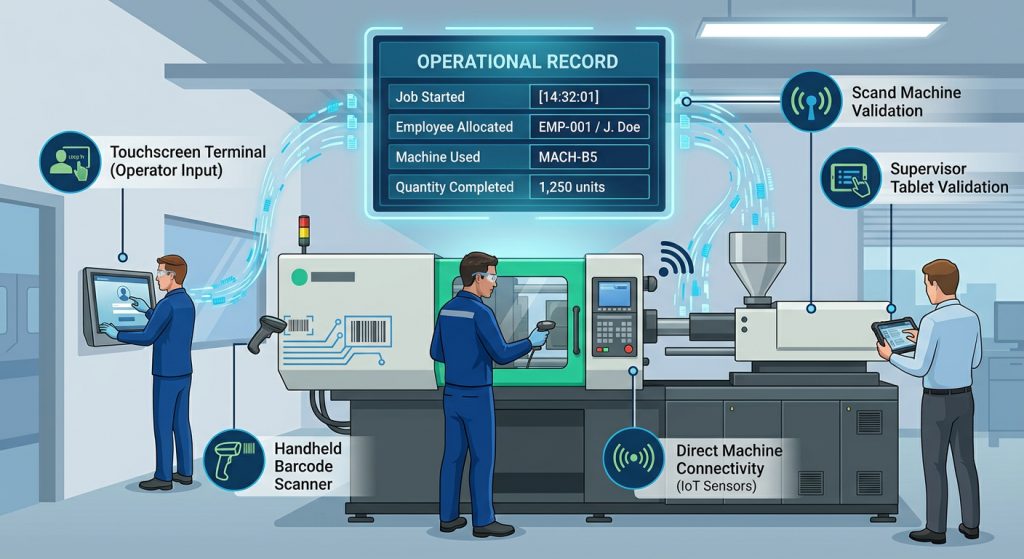
3. Capture information where the activity takes place

Operational data becomes less reliable when it depends on memory or retrospective entry.

Employees may be asked at the end of a shift to remember when a job started, why it stopped or how long they spent on an unplanned activity.

Supervisors may reconstruct events from paper records, spreadsheets and conversations.

Information should instead be captured as close as possible to the activity.

This may involve:

  • Shop-floor touchscreens
  • Barcode scanners
  • Mobile devices
  • Machine and PLC signals
  • Automated data feeds
  • Simple employee declarations
  • Supervisor validation

The objective should not be to create more administration.

It should be to make accurate data capture a natural part of completing the work.

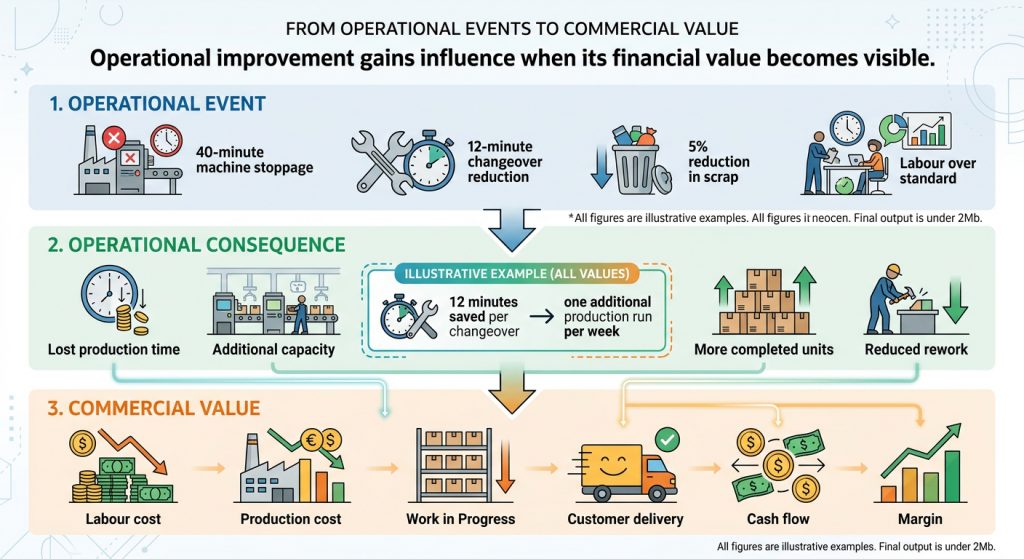
4. Translate operational variance into financial value

Operational measures become more influential when they are expressed commercially.

A reduction in downtime is positive.

An increase in recoverable production capacity creates a business case.

A shorter changeover is useful.

Demonstrating that the reduction creates an additional production run each week gives the improvement strategic relevance.

Manufacturers should therefore connect productivity, downtime, waste and efficiency measures with:

  • Labour cost
  • Production cost
  • Capacity
  • Work in Progress
  • Customer service
  • Cash flow
  • Margin

This creates a common language between operations, finance and senior management.

It also helps improvement teams demonstrate the real commercial value of their work.

5. Close the improvement loop

Continuous Improvement should operate as a complete cycle:

  1. Define the problem
  2. Measure current performance
  3. Identify the causes
  4. Implement the change
  5. Measure the result
  6. Control the improved process

Too many improvement projects reach the implementation stage without establishing how the result will be monitored and sustained.

Reliable operational information allows the manufacturer to determine:

  • What changed
  • Why it changed
  • Whether the improvement has continued
  • What commercial value has been created

This distinguishes a temporary improvement from a permanent change in performance.

Technology is only part of the answer

Advanced technology can support stronger manufacturing performance, but technology alone does not create a data-driven organisation.

Artificial intelligence, robotics and automation all depend on structured management, reliable information and clearly defined operational objectives.

AI cannot compensate for:

  • Inconsistent job codes
  • Unreliable standards
  • Disconnected systems
  • Poor labour attribution
  • Missing downtime reasons
  • Incomplete operational context

Before a manufacturer asks what AI could predict, it must first be able to explain accurately what has already happened.

The foundation of industrial AI is not the algorithm.

It is trusted operational data.

From data collection to operational intelligence

For many manufacturers, the answer is not to replace every existing system.

It is to create a connected operational layer between those systems, the workforce, machinery and the production environment.

That layer should be capable of:

  • Receiving orders, routings, standards and cost information
  • Presenting relevant instructions to employees
  • Capturing activity as work takes place
  • Combining employee, job, process and machine data
  • Applying operational and financial rules
  • Calculating performance at the required level of detail
  • Returning meaningful information to managers and authorised systems

Ceequel® Operational Intelligence has been designed around this principle.

It connects operational activity with information from existing business systems, machinery and the workforce.

The platform can convert job, employee, process and machine information into measures such as:

  • Labour productivity
  • Job cost
  • Work in Progress
  • Actual versus standard performance
  • Downtime
  • Overall Equipment Effectiveness
  • Cost variance
  • Margin performance

The purpose is not simply to produce more reports.

It is to create a consistent operational record that helps manufacturers understand what is happening, why it is happening and what it means commercially.

The next productivity improvement may not require another system producing another isolated set of figures.

It may begin by connecting the information the manufacturer already has—and using it to make better decisions.


How Can I Love You More?

L.O.V.E that little ‘Four Letter Word’ that is out in force around the middle of Feb and thanks to clever advertisers, very much in your face!

Now we know that being the romantic lot that you are, you wouldn’t have forgotten but just in case you have, here’s a gentle reminder; Valentine’s Day is just around the corner……

The most amorous time of the year brings out the romantic in many of us, especially the ‘Starry-Eyed’ personnel on the shop floor.

It must be said that the build up to February 14th can for some, be a distracting time on the production line. Amused anticipation is on open display, as your very own ‘Tim and Dawn’ are observed blushing their way around ‘The Office’.

But with all the ‘Endless Love’ flowing, what of the ‘bemused’ boss that not only has to manage his or her ‘Hopelessly Devoted’ team members but plan and schedule their last-minute ‘Love Rendezvous’?

It’s widely accepted that the most popular place to meet your ‘significant other’ is in the workplace. You spend more time there than anywhere else, so it makes ‘Perfect’ sense that ‘Love Is All Around’ doesn’t it?

Whilst opportunities present themselves more easily on the shop floor and when the time is right, ‘L.O.V.E’ is not always a surprise but after the first flush of romance, what happens when ‘Tim and Dawn’ request the inevitable time off together?

Planning staff holidays for any manager can be a headache, if not a vast military exercise; nothing works, nothing gels, nothing fits! Throw in an eleventh hour mini-break request from ‘John’ in sales and ‘Kayleigh’ in accounts and you get the idea. Two employees who not only work on the same team but the same project.

Here at ELF, we understand the situation completely when ‘You’ve Lost That Lovin’ Feeling’ with your current processes but be assured, with the right software in place, not only will Ceequel® become ‘the one that you want’ this Valentine’s Day but it will render everything ‘Perfect’ for both you AND your team.

Staff planning a last-minute get-away? Forget Booking.com as nothing books or confirms a holiday request faster than Ceequel® Employee Self Service.

Deployed on a kiosk or via an employee’s PC, smart phone or tablet, Employee Self Service completely removes the paper trail and gives total administration control to employees. Staff can immediately establish who on their team has already been granted a leave of absence.

So, with that in mind and apart from ‘The One’ make Ceequel® software the additional ‘significant other’ that you #Love this Valentine’s Day.

If you are interested in a Biometric Time and Attendance system to work with your Human Resources department, contact ELF Productivity Ltd today for a free no obligation quotation and demonstration of Ceequel® software.

Alternatively, our brochure catalogue can be downloaded here.

Creating an Effective Human Resources Strategy

Creating a successful Human Recourse strategy that pleases all of your employees can be an impossible task for many organisations. In order for your strategy to work, all stages need to piece together and each section requires thorough planning. A Human Resource strategy should always consist of four stages.

Are you struggling to implement a successful Human Resource strategy that keeps all your employees happy? Follow these simple guidelines to create a flexible strategy that works in many situations.

Human resource strategy encompasses four different stages: focus, flow, maturity, and execution. The focus of a human resources strategy concerns its goals and end result. For example, you may want to create a reward system for successful employees to improve morale. That can be your strategy’s “focus”.

Then, you need to worry about “flow”, or the process of implementing this focus. Let’s say you want to give your employees £50 restaurant gift cards if they work overtime to finish a project. Flow helps you decide what cards to get, how to pay for them, and how they will be distributed.

Maturity is the stage where you have to deal with any changes, good or bad, that affect your original strategy. Let’s say that a workplace poll reveals that almost none of your employees like the particular restaurant you’ve chosen. During the “maturity” stage, you deal with problems like these and solve them. Most of the difficult work will be accomplished in this stage, especially if you continue to run into problems.

Once your strategy concept has matured, you can move to execution. Sticking with the gift card idea, this stage might consist of purchasing the gift cards, deciding who gets them, and distributing them. While this stage can have its own problems, in a well-planned strategy, it’s often the easiest.

If you have any more information about human resource strategy, please contact us today.

The Latest Advancement in Keeping Time and Attendance

For many years Employers have been trying to find a way in which they can accurately record and track their employees time and attendance data. Old fashion methods such as mechanical punch cards were often time consuming and resulted in the loss of money for many organisations. Modern day technology has revitalised the way in which companies can now track and record their employees time and attendance data.

Ever since hourly wage was invented, employers have been looking for a reliable, tamper-free way to keep track of what hours each employee worked. Originally, there were simple write-in time cards, and in time those were replaced by mechanical punch cards. These cards made it impossible to simply alter your time, but they also take valuable minutes off of workers’ productivity as one shift lines up to clock out, and the other lines up to clock in. The bigger the crowd, the more minutes are wasted on time clock rigmarole. While technology has advanced, and many businesses have adopted ID cards with swipe-in features, those cards are little more than a computerised version of the punch clock.

Elf Productivity Ltd. has decided to offer businesses a different option, one that’s simple, effective, and which eliminates the shift change bottleneck that older methods create.

Time and Attendance Software

The way our time and attendance software works is that employees log in to your business’ network, and sign in from their own devices. This means that any connection capable device, from a workstation to a smartphone, will allow an employee to clock in. There’s no wasted time standing around a clock, and even better, there’s no need to buy a peripheral device for employees to “clock in” with at all. Not only that, but this software makes it possible for employees to work from home or in the field without losing track of how many hours they’ve been on the clock.

It’s simple, straightforward, and best of all, it’s only one of dozens of features that will help streamline your business’ network. If you’d like to know more about the features we offer, simply contact us today!

Is it Time for your Business to seek additional help for its Human Resource Operations?

In this day and age many businesses outsource at least a few of their business processes, the most common being their human resource functions. This is often because businesses feel that the outsourced company can provide them with a higher level of expertise.

When you are evaluating which business functions should be outsourced, you should ask yourself if you can get the same results when you hire someone internally to do the job. If you do not think you can get the same level of expertise, you may want to consider outsourcing. Today, you will find that many businesses outsource at least a few of their human resources functions. Even the companies who have a department filled with quality HR professionals are likely to outsource at least one of their human resources functions.

Every company will give you different reasons on how they knew when to seek help with their human resource operations. However, you will find that many of their answers will have common explanations.

Lower Costs

Businesses are always looking for ways to cut down on expenses. One of the largest expenses that a business can have is the salaries of the staff, but as expensive as this may be, if there are no employees, then the business cannot operate. Businesses want to find solutions that are affordable, but still allow their business to continue flowing smoothly; one of the best solutions is to outsource human resources.

Minimising Mistakes

UK Labour Law enforces many regulations, these regulations have an impact on millions of employers and employees every single day. When you combine those regulations with other laws and regulations, it can definitely cause plenty of headaches for professionals to ensure the company is following all the rules. By outsourcing your HR functions, you will have help in understanding the laws and regulations that must be followed.

It does not matter if your business is looking for a complete solution or if you just need a solution that will supplement the processes you already have, outsourcing your human resources functions will be sure to lower your expenses, minimise the mistakes, and improve your business’ overall production.

If you want to take better care of your business and your employees, contact us for additional information.

Access Control should be your Number One Priority

Access Control is a vital part of any organisation. If a business doesn’t have an access control system in place then potentially your property and sensitive information is at risk. Securing your sensitive data decreases this risk and also protects your employees and visitors.

Access control is one of the biggest buzz words in business right now, and for good reason. Why, you ask? Well, you wouldn’t give the brand new cashier the combination to the CEO’s personal safe, would you? Of course not, because the cashier doesn’t need that kind of access to do his or her job. The reality, though, is that when your business runs on an unsecured network where there aren’t enough safety measures taken there is nothing to stop employees on the shop floor from getting access to information they don’t need, and probably shouldn’t have. Performance reviews, personal information, company meeting minutes, client information, and so on, are all at risk.

The fewer people who have access to sensitive data, the smaller the chances are that someone may mess it up. And if something does happen, there’s a very small pool to draw from regarding who is responsible for it.

Access Control For The Modern Business

Just because you’re not a computer wizard, that doesn’t mean you can’t put reasonable, simple controls on your business’ network. Elf Productivity Ltd. has designed a simple software suite that lets anyone maintain their controls, keeping sensitive information in a place where only those who need it can get to it. In addition to access control features, though, this software also comes with a built-in time clock, employee self-service features, and it’s user-friendly. It’s meant to work with any business at any level, so regardless of whether you’re a sprawling multi-national corporation, or just a local store hoping to expand, this software will help you achieve your goals.

If you’d like more information on how Elf Productivity Ltd. can help your business achieve more, then simply contact us to find out about all the options we offer you.

Employee Self-Service puts the Power back in your Employees’ hands

For many years now the updating of employee data has been a task for your human recourse department. Modern day software such as employee self-service now makes it possible for your employees to manage and update their own personal data. It’s simplistic to use and works by providing each individual employee with their own web based profile that they can sign into.

The more people you employ, the harder it is to keep track of everyone; even a mid-sized enterprise of a hundred people or so is going to experience constant change as people get married, divorced, change banks, move to new addresses, and make a thousand other little adjustments from one year to the next. In the past, keeping up on all these changes was the Human Resources department’s job. Thanks to advances in software, though, you can implement employee self-service.

What is Employee Self-Service?

Employee self-service is when you put the responsibility of tracking employee information back in the hands of your employees. Rather than filling out forms, handing those forms to Human Resources, and then having them input the changes, why not cut out the middle man and let your employees fix their own details?

It sounds like a revolutionary idea, but in a world where Facebook is old hat, and social media has altered the way software works forever, it’s actually quite simple. Every employee has his or her own company profile, and when that information is changed it goes right into the system. There’s no need to fill out any paperwork, and no need to waste time by stacking a task onto someone else’s shoulders (especially a task that can be completed in minutes).

Employee self-service does more than save time and money, though. It lets employees take control of their own information, and it gives them the ability to do tasks for themselves. This simplifies your infrastructure, and it means that more people can spend more energy on the job at hand instead of on making sure you have their updated direct deposit, married name, new address, or any other details.

For more information on how we can help your business, simply contact us today!

Shop Floor Data Capture gives you Instant Access to Data you need

Making sure your company constantly hits its production targets is crucial if you want to remain in business. That’s why the implementation of a shop floor data capture system is imperative. Having accurate information to hand on production numbers during every part of the process allows you to identify where and when you’ve fallen short.

Numbers make the world go round, and they can be a matter of life or death for your business. If you need to fill orders, but find out too late that you haven’t completed enough of the product, then you’re in serious trouble. That’s why it’s important to get regular updates on your numbers by using shop floor data capture to keep tabs.

What is Shop Floor Data Capture?

The simple answer is that shop floor data capture is when you use sensors and computers to keep track of your production numbers. Say you were making lengths of pipe, under normal circumstances your machinery can produce 100 lengths in an hour, but due to a worn-out gasket that needs to be replaced you only produce 95 an hour. That isn’t a problem in the short-run, but over days and weeks that means you’re producing a lot fewer pieces of pipe than you thought. Shop floor data capture would notify you of the slower production, and you’d be able to fix the problem in time to keep your orders filled.

Shop floor data capture gives you instant updates on your numbers, making sure that if there’s a discrepancy between what you think you’re producing, and what you’re actually producing, then you can catch it quickly enough to fix the problem. Shop floor data capture keeps you up to date, and it ensures that you know exactly where you are in minutes rather than in hours or days.

For more information on how shop floor data capture can help your business succeed, simply contact us today!