Replacing Mitrefinch TMS: A Practical Guide for UK Employers

As workforce management requirements continue to evolve, many organisations are reviewing whether their existing Time & Attendance solution remains aligned with their operational, payroll, compliance, and workforce management objectives.

If your organisation currently uses Mitrefinch TMS and is considering its future options, this guide provides a practical framework for assessing whether your current solution continues to meet your needs and, if not, what should be considered when evaluating alternative platforms.

This article is intended as an impartial guide to help employers make informed decisions based on their own business requirements.

Why Organisations Review Their Time & Attendance System

Time & Attendance systems are a critical component of workforce management. As organisations grow, diversify, or modernise their operations, requirements often change.

Common reasons for reviewing an existing solution include:

  • Increasing payroll administration and manual intervention.
  • Expansion across multiple sites or locations.
  • Greater use of remote, mobile, or field-based employees.
  • A requirement to integrate Time & Attendance with HR, Payroll, ERP, Access Control, or Visitor Management systems.
  • The need for improved management visibility and reporting.
  • Changes in working practices, legislation, or compliance requirements.
  • Hardware refresh programmes or software renewal cycles.
  • Business acquisitions, mergers, or organisational restructuring.

A system review does not necessarily mean a replacement is required. However, it provides an opportunity to assess whether the current solution continues to deliver the functionality, efficiency, and return on investment expected by the business.

What a Modern Workforce Management Solution Should Deliver

A Time & Attendance solution should do more than simply record employee attendance. It should provide accurate workforce data that supports operational decision-making, payroll accuracy, compliance, and employee engagement.

When evaluating any solution, organisations should expect:

Accurate Workforce Data

  • Real-time attendance monitoring.
  • Automated calculation of working hours.
  • Accurate overtime and absence management.
  • Reduction in manual payroll adjustments.

Improved Management Visibility

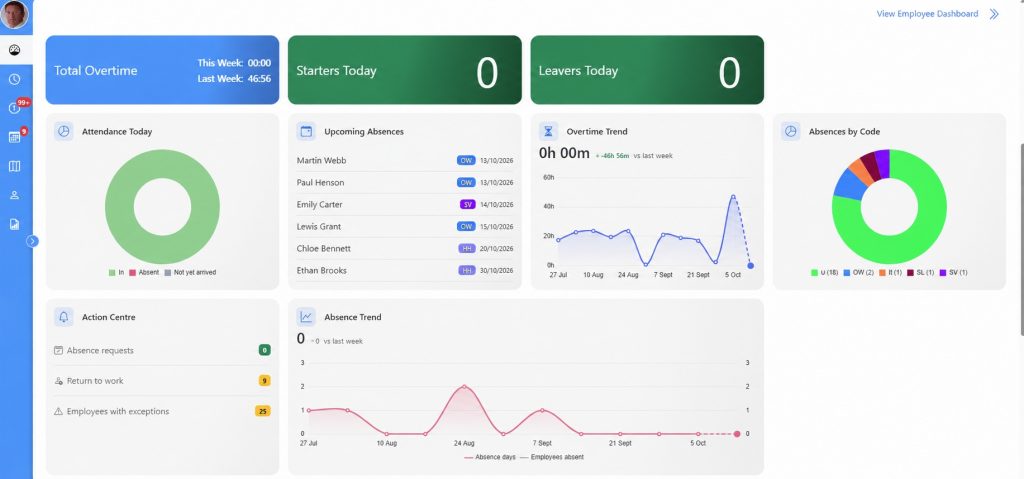
  • Real-time workforce dashboards.
  • Exception reporting.
  • Attendance trend analysis.
  • Labour cost visibility.

Streamlined Payroll Processing

  • Automated payroll preparation.
  • Clear audit trails.
  • Reduced payroll queries.
  • Reliable integration with payroll systems.

Workforce Compliance

  • Working Time Regulations monitoring.
  • Absence tracking.
  • Audit and reporting capabilities.
  • Accurate records for compliance purposes.

Enhanced Employee and Manager Self-Service

  • Electronic holiday requests.
  • Manager approvals.
  • Employee access to attendance records.
  • Mobile workforce capabilities where required.

Key Questions to Ask During a System Review

Whether reviewing your current supplier or considering alternative providers, consistency is essential. Every supplier should be evaluated against the same criteria.

Payroll Management

  • How are exceptions and anomalies identified and managed?
  • How are audit trails maintained?
  • How does the system reduce payroll administration?

Business Rules

  • Can the solution accommodate existing working rules and agreements?
  • How flexible is the configuration?
  • Can future changes be implemented without development work?

Hardware and Data Collection

  • What clocking methods are available?
  • Can existing hardware be retained?
  • What options exist for mobile or remote workers?

Integration

  • What integrations are available with Payroll, HR, ERP, Access Control, and Visitor Management systems?
  • Are integrations proven and supported?

Security and Hosting (for cloud based systems)

  • Where is data hosted?
  • What security standards are maintained?
  • What service levels and support arrangements are provided?

Implementation

  • What does the migration process involve?
  • How is data transferred and validated?
  • What support is available during and after implementation?

Commercial Considerations

  • What are the initial implementation costs?
  • What ongoing support and maintenance costs apply?
  • Are there any additional licensing or usage-based charges?

The Importance of a Structured Migration Process

For most organisations, the greatest risk during a replacement project is not the installation of new software. The primary challenge is ensuring that existing workforce rules, pay calculations, attendance policies, and operational processes are accurately replicated or improved.

A successful migration project should include:

  • Detailed Scope of Works.
  • Documentation of existing rules and processes.
  • Configuration review and approval.
  • Data migration planning – if available.
  • Payroll validation and parallel testing.
  • User and manager training.
  • Post-implementation support.

Organisations should seek clear documentation outlining how each stage of the migration will be managed.

Evaluating Long-Term Value

While software functionality remains important, organisations should also consider the broader value delivered by a workforce management solution.

Areas worth evaluating include:

  • Reduction in payroll administration.
  • Removal of manual calculations.
  • Improved labour cost control.
  • Enhanced workforce visibility.
  • Reduced manual processes.
  • Improved compliance reporting.
  • Increased management efficiency.
  • Scalability for future growth.

A workforce management platform should support operational objectives not only today, but also as the organisation evolves over the coming years.

Making an Informed Decision

Every organisation’s requirements are unique. The most effective procurement decisions are based on clearly documented business objectives, operational requirements, implementation considerations, support arrangements, and long-term value (ROI).

A structured review process allows organisations to assess whether their existing solution remains the best fit or whether alternative platforms may offer additional benefits more aligned with future business goals.

By taking a measured and evidence-based approach, organisations can ensure that any investment in workforce management technology delivers meaningful improvements in productivity, efficiency, accuracy, and visibility.

About Ceequel®

Ceequel® is a UK-developed workforce management platform designed to help organisations manage attendance, absence, labour costs, employee self-service, manager approvals, access control, visitor management, and workforce reporting through a single integrated solution.

Supporting organisations across manufacturing, logistics, food production, distribution, healthcare, engineering, and other sectors, Ceequel® provides flexible deployment options and configurable workforce management capabilities designed to meet the operational requirements of modern UK employers.

For organisations reviewing their current Time & Attendance solution, a structured demonstration and discovery process can help determine whether Ceequel® is aligned with their operational and workforce management objectives.


This article is intended for informational purposes only and does not make any representations regarding the performance, functionality, support, commercial arrangements, or future direction of any third-party software product or supplier. Organisations should undertake their own evaluation based on their individual business requirements and procurement processes.

Replacing Legacy Kronos Systems: A Practical Guide for UK Employers

Many organisations have relied on Kronos workforce management solutions for years, benefiting from robust time recording, scheduling, and workforce management capabilities. However, as technology, workforce expectations, and business requirements evolve, many employers are taking the opportunity to review whether their existing system continues to meet their operational needs and future objectives.

If your organisation is currently using a legacy Kronos solution and is considering its long-term strategy, this guide outlines the key factors that should be considered when evaluating your existing platform and assessing potential alternatives.

This article is intended as an educational resource to support informed decision-making and procurement best practice.

Why Organisations Review Legacy Workforce Management Systems

Workforce management systems often remain in place for many years. During that time, businesses can undergo significant changes that place new demands on technology and operational processes.

Common reasons organisations review their existing workforce management platform include:

  • Changes to payroll processes and compliance requirements.
  • Business growth, acquisitions, or multi-site expansion.
  • Increasing use of mobile, remote, or hybrid working.
  • A desire to improve management visibility and workforce analytics.
  • The need for greater automation and reduced administration.
  • Wider digital transformation programmes.
  • ERP, HR, or payroll system replacement projects.
  • Hardware refresh cycles or infrastructure modernisation initiatives.
  • Evolving employee expectations around self-service and accessibility.

A system review provides an opportunity to assess whether the existing platform remains aligned with current business objectives and future workforce management requirements.

What Modern Workforce Management Should Deliver

Today’s workforce management systems are expected to do far more than simply record attendance.

A modern solution should support strategic decision-making while improving operational efficiency across the organisation.

Accurate Time Recording

Organisations should expect:

  • Real-time attendance visibility.
  • Automated working time calculations.
  • Accurate overtime management.
  • Comprehensive absence monitoring.
  • Clear audit trails for payroll processing.

Improved Operational Visibility

Managers should have access to:

  • Live workforce dashboards.
  • Attendance exception reporting.
  • Labour utilisation data.
  • Departmental and site-level analytics.
  • Real-time workforce status information.

Payroll Efficiency

Effective workforce management should help organisations:

  • Reduce manual payroll administration.
  • Minimise payroll queries and adjustments.
  • Improve payroll accuracy.
  • Streamline payroll preparation processes.
  • Provide clear reporting and audit capabilities.

Employee and Manager Self-Service

Modern solutions increasingly support:

  • Holiday and absence requests.
  • Electronic approvals.
  • Mobile workforce access.
  • Employee attendance visibility.
  • Manager workflow automation.

Workforce Compliance

Employers should be able to monitor and report on:

  • Working Time Regulations.
  • Attendance policies.
  • Absence management.
  • Audit requirements.
  • Workforce governance procedures.

Key Areas to Assess During a System Review

When reviewing any workforce management platform, organisations should evaluate suppliers using consistent criteria.

Workforce Management Functionality

Consider whether the solution supports:

  • Complex shift patterns.
  • Overtime rules.
  • Attendance management.
  • Absence management.
  • Flexible working arrangements.
  • Multi-site operations.

Payroll Integration

Questions to consider include:

  • How is payroll data prepared and transferred?
  • What validation processes exist?
  • How are exceptions managed?
  • What audit capabilities are available?

Data Collection Methods

Review the available options for:

  • Biometric clocking.
  • Facial recognition.
  • Proximity cards and fobs.
  • Mobile workforce applications.
  • Web-based attendance recording.

Integration Capabilities

Organisations should understand how the platform shares data with:

  • Payroll systems.
  • HR software.
  • ERP platforms.
  • Access Control systems.
  • Visitor Management solutions.
  • Business intelligence and reporting tools.

Security and Infrastructure

Areas to evaluate include:

  • Data hosting arrangements.
  • Security standards and certifications.
  • Business continuity provisions.
  • Support and service level agreements.
  • Disaster recovery procedures.

Scalability

A workforce management platform should support:

  • Organisational growth.
  • Additional sites.
  • New departments.
  • Future technology requirements.
  • Evolving workforce practices.

Planning a Successful Migration

Any workforce management replacement project should be approached as a business transformation initiative rather than simply a software installation.

Successful projects typically include:

Discovery and Analysis

  • Review of existing workforce rules.
  • Documentation of attendance policies.
  • Identification of payroll requirements.
  • Review of reporting needs.

Configuration and Validation

  • Comprehensive Scope of Works.
  • Operational validation.
  • Payroll validation.
  • Rule verification.

Data Migration

  • Historical data requirements.
  • Employee information transfer.
  • Validation procedures.

Training and Adoption

  • Manager training.
  • Employee communication.
  • User documentation.
  • Ongoing support arrangements.

Go-Live and Post-Implementation Support

  • Controlled deployment.
  • Parallel payroll testing where appropriate.
  • Dedicated support during transition.
  • Performance monitoring.

Looking Beyond Features

When reviewing any workforce management solution, organisations should consider the wider business outcomes it can deliver.

These may include:

  • Reduced labour administration.
  • Improved payroll accuracy – no payroll leakage.
  • Greater workforce visibility.
  • Better labour cost control.
  • Improved operational efficiency.
  • Enhanced compliance reporting.
  • Increased employee engagement.
  • Better management decision-making.

The objective should be to identify a solution that supports both immediate operational needs and long-term organisational goals.

Future-Proofing Workforce Management

As workforce management technology continues to evolve, organisations increasingly seek platforms that can support a wider range of operational requirements from a single environment.

Areas commonly considered during strategic reviews include:

Bringing these functions together can help reduce administration, improve data accuracy, and provide a more unified view of the workforce.

About Ceequel®

Ceequel® is a UK-developed workforce management platform designed to help organisations manage attendance, absence, labour costs, employee self-service, manager approvals, access control, visitor management, and workforce reporting through a single integrated solution.

Used across manufacturing, food production, logistics, engineering, healthcare, distribution, and other sectors, Ceequel® provides organisations with configurable workforce management capabilities that can be tailored to specific operational requirements.

For organisations reviewing legacy workforce management platforms, a structured discovery and demonstration process can help determine whether Ceequel® aligns with their current and future workforce management objectives.


This article is provided for informational purposes only and does not make any representations regarding the performance, functionality, support arrangements, commercial terms, product lifecycle, or future direction of any third-party software product or supplier. Organisations should undertake their own independent evaluation based on their specific operational requirements, procurement processes, and business objectives.

Why a Dedicated Time & Attendance Platform with Integrated HR Functionality Often Delivers Better Workforce Management Than an HR System with Embedded Time & Attendance

In recent years, many organisations have sought to consolidate software platforms wherever possible. As a result, numerous HR systems now include embedded Time & Attendance functionality as part of a broader Human Resources offering.

While the concept of managing everything from a single platform may appear attractive, organisations whose workforce management requirements extend beyond basic absence recording often discover that there is a significant difference between a system that was designed around workforce management and later enhanced with HR capabilities, and a system that was designed around HR administration and later expanded to include Time & Attendance features.

The distinction is important because the priorities, complexity, and operational demands of workforce management are fundamentally different from those of HR administration.

Time & Attendance Is an Operational System

At its core, Time & Attendance is not simply about recording when someone arrives at work.

A modern Time & Attendance platform is responsible for:

  • Capturing attendance data in real time.
  • Calculating working hours.
  • Applying overtime rules.
  • Managing shift patterns.
  • Monitoring absence.
  • Supporting payroll preparation.
  • Providing labour cost visibility – including shop floor data.
  • Managing workforce compliance.
  • Delivering real-time operational intelligence.

For many organisations, particularly those operating in manufacturing, logistics, food production, engineering, healthcare, retail, and distribution, workforce management is an operational function that directly impacts productivity, labour costs, and profitability every single day.

An error in attendance processing can affect payroll immediately.

An error allocating labour to the wrong job can affect productivity immediately.

An error in workforce visibility can affect operational decision-making immediately.

HR Systems Are Primarily Employee Administration Platforms

Human Resources systems are typically designed to manage employee information and HR processes.

Common areas of focus include:

  • Employee records.
  • Recruitment.
  • Onboarding.
  • Performance management.
  • Learning and development.
  • Disciplinary procedures.
  • Employee documentation.
  • Policy management.
  • Succession planning.

These are critical business functions, but they are generally administrative rather than operational.

Most HR systems are designed to answer questions such as:

  • Who works for us?
  • What qualifications do they hold?
  • What training have they completed?
  • What policies apply to them?

Time & Attendance systems, by contrast, answer questions such as:

  • Who is currently on site?
  • Who is absent?
  • Who is working overtime?
  • What are today’s labour costs?
  • What exceptions require attention before payroll is processed?

While both disciplines involve employees, they serve very different purposes.

Workforce Management Is Often More Complex Than HR

Many organisations underestimate the complexity involved in accurately managing attendance and payroll-related calculations.

Examples include:

  • Multiple shift patterns.
  • Continental shifts.
  • Rotating rosters.
  • Overtime premiums.
  • Call-out payments.
  • Bank holiday rules.
  • Flexitime arrangements.
  • Annualised Hours.
  • TOIL (Banked Hours)
  • Attendance bonuses.
  • Break deductions.
  • Union agreements.
  • Site-specific working practices.

A dedicated Time & Attendance platform is typically designed from the outset to accommodate these operational requirements, effortlessly.

In contrast, organisations should carefully assess whether an embedded Time & Attendance module can fully support the complexity of their workforce rules both now and in the future.

Payroll Accuracy Depends on Workforce Accuracy

For many organisations, payroll represents one of the largest costs within the business.

The quality of payroll output is heavily dependent on the quality of attendance data entering the process.

A dedicated Time & Attendance platform is often built around:

  • Automated Rules Management.
  • Exception management.
  • Payroll validation.
  • Audit trails.
  • Labour cost reporting.

These functions help ensure that attendance data is accurate before it reaches payroll.

This is why many organisations view Time & Attendance as a critical operational control rather than simply an extension of HR administration.

Real-Time Visibility Matters

Operational managers often need access to information throughout the day, not simply at payroll processing time.

Examples include:

  • Who has not arrived for work?
  • Which departments are understaffed?
  • Who is currently on site and in the fire register?
  • Who is approaching overtime thresholds?
  • Which agency workers are present today – and their cost?

Dedicated workforce management platforms are typically designed to provide this information in real time.

This operational visibility can support:

  • Resource planning.
  • Production management.
  • Shift management.
  • Health and safety procedures.
  • Labour cost control.

Workforce Management Extends Beyond HR

Modern Time & Attendance platforms increasingly support a broader workforce ecosystem.

This may include:

  • Employee Self-Service.
  • Manager Self-Service.
  • Access Control.
  • Visitor Management.
  • Contractor Management.
  • Fire Registers.
  • Labour Analytics.
  • Workforce Reporting – Shop Floor Data Capture

These functions often sit closer to operations, facilities, production, and payroll than they do to traditional HR administration.

As a result, many organisations prefer a workforce management platform that can integrate HR functionality rather than relying solely on an HR platform to manage operational workforce processes.

Flexibility for Operational Change

Businesses rarely remain static.

New sites open.

Departments expand.

Shift patterns change.

Acquisitions occur.

Working practices evolve.

A workforce management platform should be capable of adapting to operational change without requiring extensive redevelopment or manual workarounds.

When evaluating any solution, organisations should consider how easily workforce rules, attendance policies, and operational processes can be modified as business requirements evolve.

The Ideal Approach: Integrated, Not Compromised

The discussion should not be viewed as HR versus Time & Attendance.

Both are essential.

The real question is where the organisation’s primary operational requirements sit.

For many employers, the most effective approach is a dedicated workforce management platform that incorporates HR functionality while maintaining the specialist attendance, payroll, labour management, and operational capabilities required to manage the workforce effectively.

This allows organisations to benefit from:

  • Comprehensive workforce management.
  • Integrated HR processes.
  • Accurate payroll preparation.
  • Real-time operational visibility.
  • Reduced administration.
  • Improved workforce intelligence.

Conclusion

Every organisation has different requirements, and there is no single solution that is right for every business.

However, where workforce management, payroll accuracy, labour cost control, operational visibility, continuous improvement, and complex attendance rules are business-critical, organisations should carefully evaluate whether an embedded Time & Attendance module can provide the same depth of functionality as a platform designed specifically for workforce management.

The most successful workforce management projects are typically those that place operational requirements, payroll accuracy, and workforce visibility at the centre of the decision-making process, while ensuring that HR functionality remains fully integrated and readily accessible across the organisation.


This article is intended for informational purposes only. It does not make claims regarding the capabilities, performance, or suitability of any specific software product. Organisations should assess all solutions against their own operational, payroll, HR, compliance, and workforce management requirements before making a procurement decision.