Replacing Mitrefinch TMS: A Practical Guide for UK Employers

As workforce management requirements continue to evolve, many organisations are reviewing whether their existing Time & Attendance solution remains aligned with their operational, payroll, compliance, and workforce management objectives.

If your organisation currently uses Mitrefinch TMS and is considering its future options, this guide provides a practical framework for assessing whether your current solution continues to meet your needs and, if not, what should be considered when evaluating alternative platforms.

This article is intended as an impartial guide to help employers make informed decisions based on their own business requirements.

Why Organisations Review Their Time & Attendance System

Time & Attendance systems are a critical component of workforce management. As organisations grow, diversify, or modernise their operations, requirements often change.

Common reasons for reviewing an existing solution include:

  • Increasing payroll administration and manual intervention.
  • Expansion across multiple sites or locations.
  • Greater use of remote, mobile, or field-based employees.
  • A requirement to integrate Time & Attendance with HR, Payroll, ERP, Access Control, or Visitor Management systems.
  • The need for improved management visibility and reporting.
  • Changes in working practices, legislation, or compliance requirements.
  • Hardware refresh programmes or software renewal cycles.
  • Business acquisitions, mergers, or organisational restructuring.

A system review does not necessarily mean a replacement is required. However, it provides an opportunity to assess whether the current solution continues to deliver the functionality, efficiency, and return on investment expected by the business.

What a Modern Workforce Management Solution Should Deliver

A Time & Attendance solution should do more than simply record employee attendance. It should provide accurate workforce data that supports operational decision-making, payroll accuracy, compliance, and employee engagement.

When evaluating any solution, organisations should expect:

Accurate Workforce Data

  • Real-time attendance monitoring.
  • Automated calculation of working hours.
  • Accurate overtime and absence management.
  • Reduction in manual payroll adjustments.

Improved Management Visibility

  • Real-time workforce dashboards.
  • Exception reporting.
  • Attendance trend analysis.
  • Labour cost visibility.

Streamlined Payroll Processing

  • Automated payroll preparation.
  • Clear audit trails.
  • Reduced payroll queries.
  • Reliable integration with payroll systems.

Workforce Compliance

  • Working Time Regulations monitoring.
  • Absence tracking.
  • Audit and reporting capabilities.
  • Accurate records for compliance purposes.

Enhanced Employee and Manager Self-Service

  • Electronic holiday requests.
  • Manager approvals.
  • Employee access to attendance records.
  • Mobile workforce capabilities where required.

Key Questions to Ask During a System Review

Whether reviewing your current supplier or considering alternative providers, consistency is essential. Every supplier should be evaluated against the same criteria.

Payroll Management

  • How are exceptions and anomalies identified and managed?
  • How are audit trails maintained?
  • How does the system reduce payroll administration?

Business Rules

  • Can the solution accommodate existing working rules and agreements?
  • How flexible is the configuration?
  • Can future changes be implemented without development work?

Hardware and Data Collection

  • What clocking methods are available?
  • Can existing hardware be retained?
  • What options exist for mobile or remote workers?

Integration

  • What integrations are available with Payroll, HR, ERP, Access Control, and Visitor Management systems?
  • Are integrations proven and supported?

Security and Hosting (for cloud based systems)

  • Where is data hosted?
  • What security standards are maintained?
  • What service levels and support arrangements are provided?

Implementation

  • What does the migration process involve?
  • How is data transferred and validated?
  • What support is available during and after implementation?

Commercial Considerations

  • What are the initial implementation costs?
  • What ongoing support and maintenance costs apply?
  • Are there any additional licensing or usage-based charges?

The Importance of a Structured Migration Process

For most organisations, the greatest risk during a replacement project is not the installation of new software. The primary challenge is ensuring that existing workforce rules, pay calculations, attendance policies, and operational processes are accurately replicated or improved.

A successful migration project should include:

  • Detailed Scope of Works.
  • Documentation of existing rules and processes.
  • Configuration review and approval.
  • Data migration planning – if available.
  • Payroll validation and parallel testing.
  • User and manager training.
  • Post-implementation support.

Organisations should seek clear documentation outlining how each stage of the migration will be managed.

Evaluating Long-Term Value

While software functionality remains important, organisations should also consider the broader value delivered by a workforce management solution.

Areas worth evaluating include:

  • Reduction in payroll administration.
  • Removal of manual calculations.
  • Improved labour cost control.
  • Enhanced workforce visibility.
  • Reduced manual processes.
  • Improved compliance reporting.
  • Increased management efficiency.
  • Scalability for future growth.

A workforce management platform should support operational objectives not only today, but also as the organisation evolves over the coming years.

Making an Informed Decision

Every organisation’s requirements are unique. The most effective procurement decisions are based on clearly documented business objectives, operational requirements, implementation considerations, support arrangements, and long-term value (ROI).

A structured review process allows organisations to assess whether their existing solution remains the best fit or whether alternative platforms may offer additional benefits more aligned with future business goals.

By taking a measured and evidence-based approach, organisations can ensure that any investment in workforce management technology delivers meaningful improvements in productivity, efficiency, accuracy, and visibility.

About Ceequel®

Ceequel® is a UK-developed workforce management platform designed to help organisations manage attendance, absence, labour costs, employee self-service, manager approvals, access control, visitor management, and workforce reporting through a single integrated solution.

Supporting organisations across manufacturing, logistics, food production, distribution, healthcare, engineering, and other sectors, Ceequel® provides flexible deployment options and configurable workforce management capabilities designed to meet the operational requirements of modern UK employers.

For organisations reviewing their current Time & Attendance solution, a structured demonstration and discovery process can help determine whether Ceequel® is aligned with their operational and workforce management objectives.


This article is intended for informational purposes only and does not make any representations regarding the performance, functionality, support, commercial arrangements, or future direction of any third-party software product or supplier. Organisations should undertake their own evaluation based on their individual business requirements and procurement processes.

Why a Dedicated Time & Attendance Platform with Integrated HR Functionality Often Delivers Better Workforce Management Than an HR System with Embedded Time & Attendance

In recent years, many organisations have sought to consolidate software platforms wherever possible. As a result, numerous HR systems now include embedded Time & Attendance functionality as part of a broader Human Resources offering.

While the concept of managing everything from a single platform may appear attractive, organisations whose workforce management requirements extend beyond basic absence recording often discover that there is a significant difference between a system that was designed around workforce management and later enhanced with HR capabilities, and a system that was designed around HR administration and later expanded to include Time & Attendance features.

The distinction is important because the priorities, complexity, and operational demands of workforce management are fundamentally different from those of HR administration.

Time & Attendance Is an Operational System

At its core, Time & Attendance is not simply about recording when someone arrives at work.

A modern Time & Attendance platform is responsible for:

  • Capturing attendance data in real time.
  • Calculating working hours.
  • Applying overtime rules.
  • Managing shift patterns.
  • Monitoring absence.
  • Supporting payroll preparation.
  • Providing labour cost visibility – including shop floor data.
  • Managing workforce compliance.
  • Delivering real-time operational intelligence.

For many organisations, particularly those operating in manufacturing, logistics, food production, engineering, healthcare, retail, and distribution, workforce management is an operational function that directly impacts productivity, labour costs, and profitability every single day.

An error in attendance processing can affect payroll immediately.

An error allocating labour to the wrong job can affect productivity immediately.

An error in workforce visibility can affect operational decision-making immediately.

HR Systems Are Primarily Employee Administration Platforms

Human Resources systems are typically designed to manage employee information and HR processes.

Common areas of focus include:

  • Employee records.
  • Recruitment.
  • Onboarding.
  • Performance management.
  • Learning and development.
  • Disciplinary procedures.
  • Employee documentation.
  • Policy management.
  • Succession planning.

These are critical business functions, but they are generally administrative rather than operational.

Most HR systems are designed to answer questions such as:

  • Who works for us?
  • What qualifications do they hold?
  • What training have they completed?
  • What policies apply to them?

Time & Attendance systems, by contrast, answer questions such as:

  • Who is currently on site?
  • Who is absent?
  • Who is working overtime?
  • What are today’s labour costs?
  • What exceptions require attention before payroll is processed?

While both disciplines involve employees, they serve very different purposes.

Workforce Management Is Often More Complex Than HR

Many organisations underestimate the complexity involved in accurately managing attendance and payroll-related calculations.

Examples include:

  • Multiple shift patterns.
  • Continental shifts.
  • Rotating rosters.
  • Overtime premiums.
  • Call-out payments.
  • Bank holiday rules.
  • Flexitime arrangements.
  • Annualised Hours.
  • TOIL (Banked Hours)
  • Attendance bonuses.
  • Break deductions.
  • Union agreements.
  • Site-specific working practices.

A dedicated Time & Attendance platform is typically designed from the outset to accommodate these operational requirements, effortlessly.

In contrast, organisations should carefully assess whether an embedded Time & Attendance module can fully support the complexity of their workforce rules both now and in the future.

Payroll Accuracy Depends on Workforce Accuracy

For many organisations, payroll represents one of the largest costs within the business.

The quality of payroll output is heavily dependent on the quality of attendance data entering the process.

A dedicated Time & Attendance platform is often built around:

  • Automated Rules Management.
  • Exception management.
  • Payroll validation.
  • Audit trails.
  • Labour cost reporting.

These functions help ensure that attendance data is accurate before it reaches payroll.

This is why many organisations view Time & Attendance as a critical operational control rather than simply an extension of HR administration.

Real-Time Visibility Matters

Operational managers often need access to information throughout the day, not simply at payroll processing time.

Examples include:

  • Who has not arrived for work?
  • Which departments are understaffed?
  • Who is currently on site and in the fire register?
  • Who is approaching overtime thresholds?
  • Which agency workers are present today – and their cost?

Dedicated workforce management platforms are typically designed to provide this information in real time.

This operational visibility can support:

  • Resource planning.
  • Production management.
  • Shift management.
  • Health and safety procedures.
  • Labour cost control.

Workforce Management Extends Beyond HR

Modern Time & Attendance platforms increasingly support a broader workforce ecosystem.

This may include:

  • Employee Self-Service.
  • Manager Self-Service.
  • Access Control.
  • Visitor Management.
  • Contractor Management.
  • Fire Registers.
  • Labour Analytics.
  • Workforce Reporting – Shop Floor Data Capture

These functions often sit closer to operations, facilities, production, and payroll than they do to traditional HR administration.

As a result, many organisations prefer a workforce management platform that can integrate HR functionality rather than relying solely on an HR platform to manage operational workforce processes.

Flexibility for Operational Change

Businesses rarely remain static.

New sites open.

Departments expand.

Shift patterns change.

Acquisitions occur.

Working practices evolve.

A workforce management platform should be capable of adapting to operational change without requiring extensive redevelopment or manual workarounds.

When evaluating any solution, organisations should consider how easily workforce rules, attendance policies, and operational processes can be modified as business requirements evolve.

The Ideal Approach: Integrated, Not Compromised

The discussion should not be viewed as HR versus Time & Attendance.

Both are essential.

The real question is where the organisation’s primary operational requirements sit.

For many employers, the most effective approach is a dedicated workforce management platform that incorporates HR functionality while maintaining the specialist attendance, payroll, labour management, and operational capabilities required to manage the workforce effectively.

This allows organisations to benefit from:

  • Comprehensive workforce management.
  • Integrated HR processes.
  • Accurate payroll preparation.
  • Real-time operational visibility.
  • Reduced administration.
  • Improved workforce intelligence.

Conclusion

Every organisation has different requirements, and there is no single solution that is right for every business.

However, where workforce management, payroll accuracy, labour cost control, operational visibility, continuous improvement, and complex attendance rules are business-critical, organisations should carefully evaluate whether an embedded Time & Attendance module can provide the same depth of functionality as a platform designed specifically for workforce management.

The most successful workforce management projects are typically those that place operational requirements, payroll accuracy, and workforce visibility at the centre of the decision-making process, while ensuring that HR functionality remains fully integrated and readily accessible across the organisation.


This article is intended for informational purposes only. It does not make claims regarding the capabilities, performance, or suitability of any specific software product. Organisations should assess all solutions against their own operational, payroll, HR, compliance, and workforce management requirements before making a procurement decision.

UK Manufacturing Is Data-Rich – Five Principles for Turning Manufacturing Data into Better Decisions

Part 2 of a 2 Part Series……….

Most manufacturers already hold a significant amount of operational information.

The challenge is converting that information into something managers can use to improve productivity, control cost and sustain Continuous Improvement.

A dashboard containing dozens of measures may look impressive. But if it does not help the organisation make a better decision, its commercial value is limited.

Manufacturers can improve the value of their operational data by applying five practical principles.

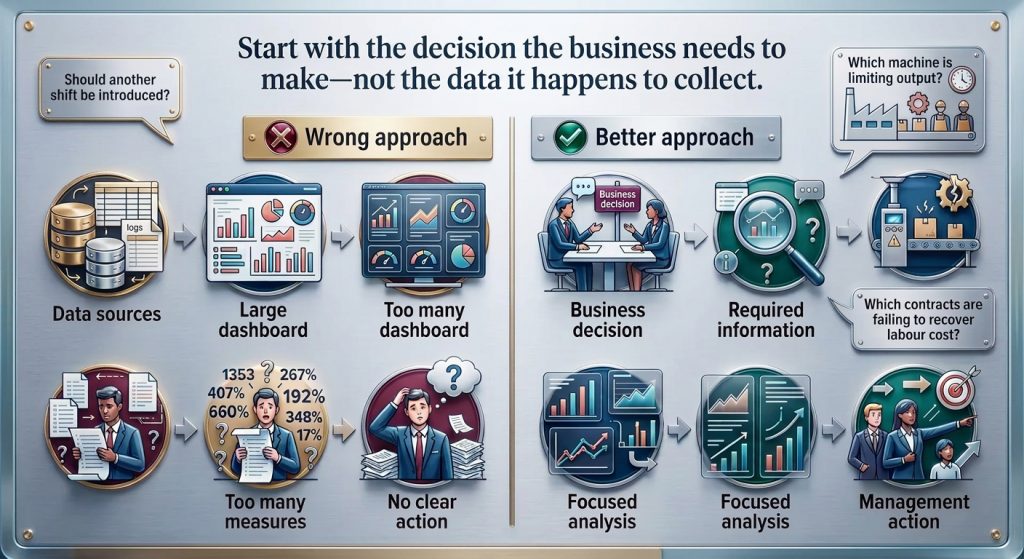
1. Begin with the decision, not the dashboard

A data project should not begin by asking:

What information can we collect?

It should begin by identifying the decisions the organisation needs to improve.

For example:

  • Should another shift be introduced?
  • Is a particular product commercially viable?
  • Which machine is creating the greatest constraint?
  • Why does one production line outperform another?
  • Is overtime increasing output or compensating for inefficiency?
  • Which contracts are failing to recover their true labour cost?

Once the decision is clear, the manufacturer can determine which information is required to support it.

This prevents the business from collecting data simply because it is available.

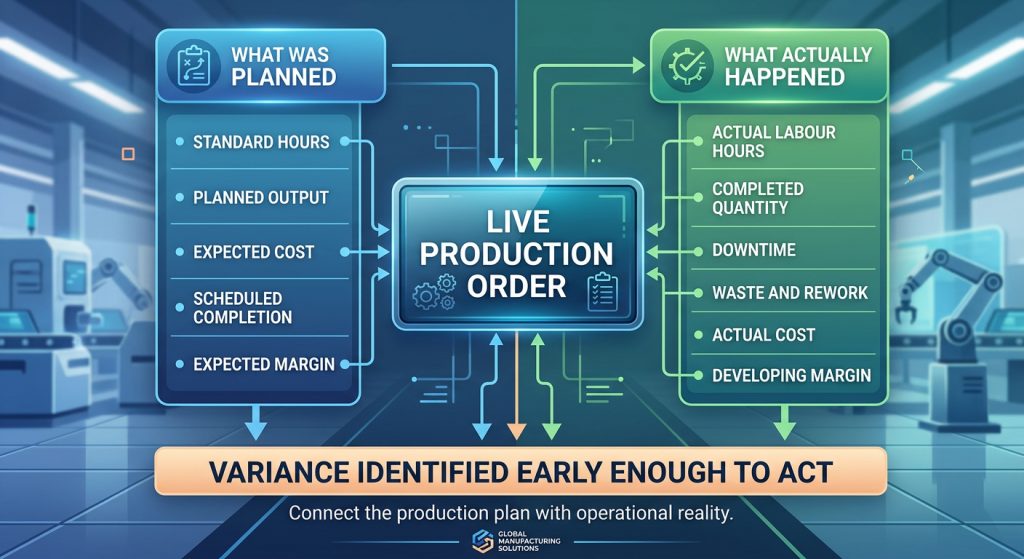
2. Connect planned performance with operational reality

Most manufacturers already hold production plans, estimates, standards and expected costs.

The difficulty lies in comparing them consistently with what actually happened.

A production order should not remain an isolated record within an ERP system.

It should become a live operational entity against which the business can attribute:

  • Labour
  • Activities
  • Machine usage
  • Output
  • Downtime
  • Waste
  • Rework
  • Work in Progress

This enables the manufacturer to compare:

  • Estimated cost with actual cost
  • Standard hours with actual hours
  • Planned output with completed output
  • Expected margin with developing margin
  • Scheduled completion with likely completion

Planning information then becomes a tool for operational control rather than simply a record of what was expected.

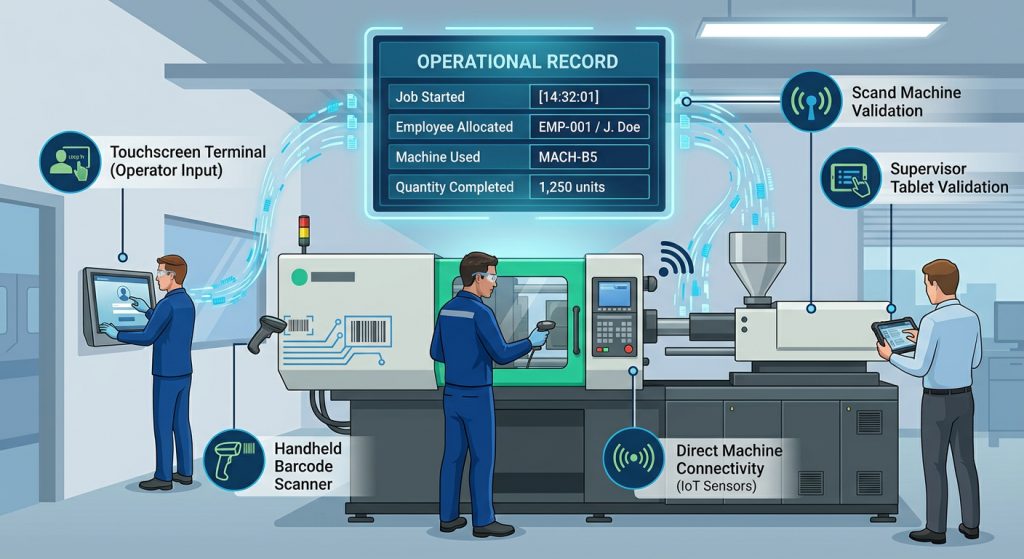
3. Capture information where the activity takes place

Operational data becomes less reliable when it depends on memory or retrospective entry.

Employees may be asked at the end of a shift to remember when a job started, why it stopped or how long they spent on an unplanned activity.

Supervisors may reconstruct events from paper records, spreadsheets and conversations.

Information should instead be captured as close as possible to the activity.

This may involve:

  • Shop-floor touchscreens
  • Barcode scanners
  • Mobile devices
  • Machine and PLC signals
  • Automated data feeds
  • Simple employee declarations
  • Supervisor validation

The objective should not be to create more administration.

It should be to make accurate data capture a natural part of completing the work.

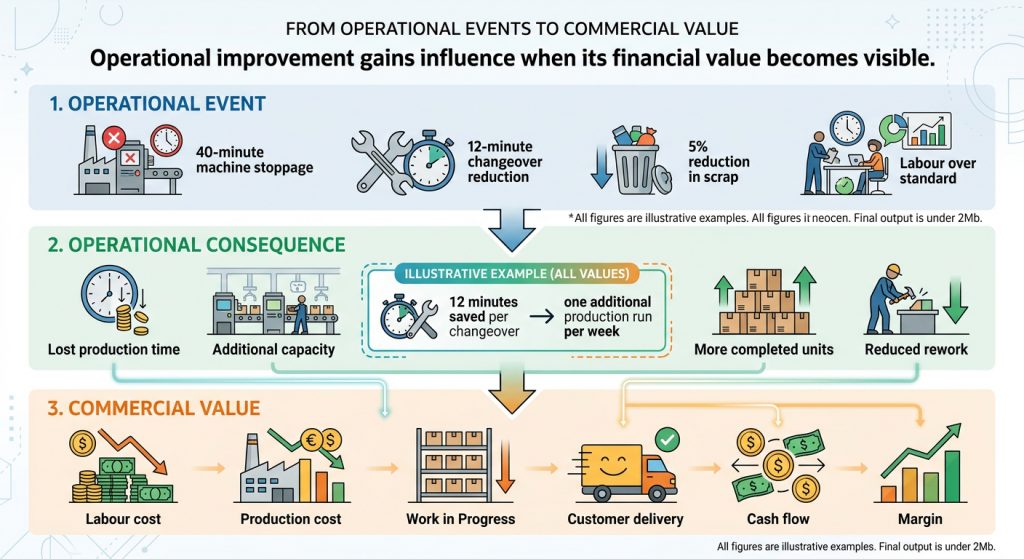
4. Translate operational variance into financial value

Operational measures become more influential when they are expressed commercially.

A reduction in downtime is positive.

An increase in recoverable production capacity creates a business case.

A shorter changeover is useful.

Demonstrating that the reduction creates an additional production run each week gives the improvement strategic relevance.

Manufacturers should therefore connect productivity, downtime, waste and efficiency measures with:

  • Labour cost
  • Production cost
  • Capacity
  • Work in Progress
  • Customer service
  • Cash flow
  • Margin

This creates a common language between operations, finance and senior management.

It also helps improvement teams demonstrate the real commercial value of their work.

5. Close the improvement loop

Continuous Improvement should operate as a complete cycle:

  1. Define the problem
  2. Measure current performance
  3. Identify the causes
  4. Implement the change
  5. Measure the result
  6. Control the improved process

Too many improvement projects reach the implementation stage without establishing how the result will be monitored and sustained.

Reliable operational information allows the manufacturer to determine:

  • What changed
  • Why it changed
  • Whether the improvement has continued
  • What commercial value has been created

This distinguishes a temporary improvement from a permanent change in performance.

Technology is only part of the answer

Advanced technology can support stronger manufacturing performance, but technology alone does not create a data-driven organisation.

Artificial intelligence, robotics and automation all depend on structured management, reliable information and clearly defined operational objectives.

AI cannot compensate for:

  • Inconsistent job codes
  • Unreliable standards
  • Disconnected systems
  • Poor labour attribution
  • Missing downtime reasons
  • Incomplete operational context

Before a manufacturer asks what AI could predict, it must first be able to explain accurately what has already happened.

The foundation of industrial AI is not the algorithm.

It is trusted operational data.

From data collection to operational intelligence

For many manufacturers, the answer is not to replace every existing system.

It is to create a connected operational layer between those systems, the workforce, machinery and the production environment.

That layer should be capable of:

  • Receiving orders, routings, standards and cost information
  • Presenting relevant instructions to employees
  • Capturing activity as work takes place
  • Combining employee, job, process and machine data
  • Applying operational and financial rules
  • Calculating performance at the required level of detail
  • Returning meaningful information to managers and authorised systems

Ceequel® Operational Intelligence has been designed around this principle.

It connects operational activity with information from existing business systems, machinery and the workforce.

The platform can convert job, employee, process and machine information into measures such as:

  • Labour productivity
  • Job cost
  • Work in Progress
  • Actual versus standard performance
  • Downtime
  • Overall Equipment Effectiveness
  • Cost variance
  • Margin performance

The purpose is not simply to produce more reports.

It is to create a consistent operational record that helps manufacturers understand what is happening, why it is happening and what it means commercially.

The next productivity improvement may not require another system producing another isolated set of figures.

It may begin by connecting the information the manufacturer already has—and using it to make better decisions.


Guidance For Preventing The Spread Of COVID-19

You are all now fully aware of the UK Government guidance for preventing the spread of COVID-19.

It is both our duty and social responsibility to ensure that we continue supporting our clients as much as humanly possible during this challenging time, to ensure that companies can continue to pay their staff, efficiently and effectively.

Because of this ELF Productivity Ltd has taken the following measures: –

• We will continue to have a fully-manned Technical Support Desk which has had social distancing protocols applied.
• Those who are able to work remotely from home are doing so.
• We are performing system configuration and training remotely via Skype and Team Viewer.
• Our hardware engineers are continuing to attend client sites where appropriate and have fully comprehensive hygiene procedures to follow.

We have put together a FAQ list, in which ELF Productivity can assist your organisation in maintaining business continuity with the first highlighting the correct way to keep your devices clean.

General advice on frequently touched objects.

Public Health England (PHE) recommends that cleaning and disinfecting frequently touched objects and surfaces will help prevent people from catching and spreading COVID-19.

Clocking machines are interacted with by all staff daily, therefore we recommend that you sanitise your devices regularly throughout the day to help prevent the spread of COVID-19, however please be aware of the following points: –

Avoid the use of very high concentration bleaches as they may discolour the clocking / access control units.

Ensure that cleaning staff do not use abrasive cleaning products on transparent fingerprint scanners or units as they will cloud and could become non-functional.

Depending upon the terminals that you have, you may want to consider the following measures;

1. Facial Recognition – If you already use facial recognition terminals then you will be familiar with clocking without any physical contact. If any staff are using the additional fingerprint reader, we strongly recommend you direct them to use only facial recognition. If any staff report that they are unable to use facial recognition because their biometric template is no longer recognised (e.g their appearance has altered since enrolment, such as the addition of glasses or thick beards) simply re-enrol the staff member. The unit will automatically overwrite their old template with their new one.

2. Fingerprint Recognition – If you have fingerprint terminals and wish to keep using biometric technology, now may be a time to look at changing these for facial recognition units.

3. Proximity Recognition – If you have card / fob terminals then we recommend that you remind staff that the readers will operate without physical contact, no need to “tap” in and out, a wave will suffice.

Many of our clients already use wall mounted sanitisers and ensure frequent cleaning of their readers for general hygiene, please be aware of the points above.

If you have any concerns regarding Ceequel® software or any of your Time & Attendance devices, please do not hesitate to contact us on 01257 256000.

Centralise all your human resource and time management requirements with Ceequel

Here at Elf Productivity Ltd we offer a wide variety of products and services to our clients. Over 30 years of collective experience within the time and attendance market allows us to provide you with unparalleled industry knowledge and expertise. Why not check out this inforgraphic for more information about what is is we do.

Elf infographic

What should you look for in a Time and Attendance Vendor?

When it comes to implementing a new time and attendance system knowing which company to pick can be a daunting task, especially if you’re unsure about what it is you should be looking at going forward. A good quality time and attendance vendor should be able to match your needs to a solution.

So, you have come to realise that your clocking in system is far too outdated to keep up with your business’ growing needs, but you are not really sure what you should be looking for when going forward. A good Time and Attendance vendor should be able to help you find a solution that fits your unique needs by preforming the following duties:

Continue reading “What should you look for in a Time and Attendance Vendor?”

Making Sure Your Access Control System Adapts to the Unexpected

Visitors who are unauthorised and unexpected can often play havoc with your security system and sometime mean your business is in violation of security regulations. Having an access control system in place can prevent any event that would lead to a security breach from happening as they adapt to unexpected circumstances whilst also making sure your businesses security isn’t compromised.

In many ways, the purpose of an access control system is to prevent the unexpected from interfering with your company’s work. Unexpected and unauthorised visitors can play havoc with your operation and mean that your company is in violation of security regulations. However, access control systems can’t prevent every event that could lead to a security breach. Instead, they must adapt to unexpected circumstances without compromising your business’s security.

One extremely common circumstance that will require your access control system to adapt is an employee’s losing an access card. If your access control system can’t adapt to this circumstance, a simple mistake can turn into a time-consuming replacement process or even a security breach. When selecting access control software, make sure it makes it easy for you to cancel lost cards and issue new ones.

Continue reading “Making Sure Your Access Control System Adapts to the Unexpected”

Time and Attendance Issues for Businesses: Increasing Productivity with Time and Attendance Software

Having a non computerised time and attendance solution provides your employees with the ability to take time off here and their as they know you are not able to fully track which employees are working at any one time. A computerised system requires your employees to clock in and out everyday and collects this data within a system all managers have access too.

Time and Attendance is one of the most important aspects of keeping your business productive. Employees can sometimes take advantage of the fact that you may or may not notice when they come to work. Many businesses do have “clocking in” procedures in place but even these can be thwarted by asking a friend to do it for them or other ways.

There are other problems, too, regarding incentives to get people motivated to attend more regularly. Working mothers often call in with sick children. Some workers have health problems or other issues that get in the way of their regular attendance. Those things do happen and people do have problems, lives, and responsibilities outside of the work place.

Continue reading “Time and Attendance Issues for Businesses: Increasing Productivity with Time and Attendance Software”