Replacing Mitrefinch TMS: A Practical Guide for UK Employers

As workforce management requirements continue to evolve, many organisations are reviewing whether their existing Time & Attendance solution remains aligned with their operational, payroll, compliance, and workforce management objectives.

If your organisation currently uses Mitrefinch TMS and is considering its future options, this guide provides a practical framework for assessing whether your current solution continues to meet your needs and, if not, what should be considered when evaluating alternative platforms.

This article is intended as an impartial guide to help employers make informed decisions based on their own business requirements.

Why Organisations Review Their Time & Attendance System

Time & Attendance systems are a critical component of workforce management. As organisations grow, diversify, or modernise their operations, requirements often change.

Common reasons for reviewing an existing solution include:

  • Increasing payroll administration and manual intervention.
  • Expansion across multiple sites or locations.
  • Greater use of remote, mobile, or field-based employees.
  • A requirement to integrate Time & Attendance with HR, Payroll, ERP, Access Control, or Visitor Management systems.
  • The need for improved management visibility and reporting.
  • Changes in working practices, legislation, or compliance requirements.
  • Hardware refresh programmes or software renewal cycles.
  • Business acquisitions, mergers, or organisational restructuring.

A system review does not necessarily mean a replacement is required. However, it provides an opportunity to assess whether the current solution continues to deliver the functionality, efficiency, and return on investment expected by the business.

What a Modern Workforce Management Solution Should Deliver

A Time & Attendance solution should do more than simply record employee attendance. It should provide accurate workforce data that supports operational decision-making, payroll accuracy, compliance, and employee engagement.

When evaluating any solution, organisations should expect:

Accurate Workforce Data

  • Real-time attendance monitoring.
  • Automated calculation of working hours.
  • Accurate overtime and absence management.
  • Reduction in manual payroll adjustments.

Improved Management Visibility

  • Real-time workforce dashboards.
  • Exception reporting.
  • Attendance trend analysis.
  • Labour cost visibility.

Streamlined Payroll Processing

  • Automated payroll preparation.
  • Clear audit trails.
  • Reduced payroll queries.
  • Reliable integration with payroll systems.

Workforce Compliance

  • Working Time Regulations monitoring.
  • Absence tracking.
  • Audit and reporting capabilities.
  • Accurate records for compliance purposes.

Enhanced Employee and Manager Self-Service

  • Electronic holiday requests.
  • Manager approvals.
  • Employee access to attendance records.
  • Mobile workforce capabilities where required.

Key Questions to Ask During a System Review

Whether reviewing your current supplier or considering alternative providers, consistency is essential. Every supplier should be evaluated against the same criteria.

Payroll Management

  • How are exceptions and anomalies identified and managed?
  • How are audit trails maintained?
  • How does the system reduce payroll administration?

Business Rules

  • Can the solution accommodate existing working rules and agreements?
  • How flexible is the configuration?
  • Can future changes be implemented without development work?

Hardware and Data Collection

  • What clocking methods are available?
  • Can existing hardware be retained?
  • What options exist for mobile or remote workers?

Integration

  • What integrations are available with Payroll, HR, ERP, Access Control, and Visitor Management systems?
  • Are integrations proven and supported?

Security and Hosting (for cloud based systems)

  • Where is data hosted?
  • What security standards are maintained?
  • What service levels and support arrangements are provided?

Implementation

  • What does the migration process involve?
  • How is data transferred and validated?
  • What support is available during and after implementation?

Commercial Considerations

  • What are the initial implementation costs?
  • What ongoing support and maintenance costs apply?
  • Are there any additional licensing or usage-based charges?

The Importance of a Structured Migration Process

For most organisations, the greatest risk during a replacement project is not the installation of new software. The primary challenge is ensuring that existing workforce rules, pay calculations, attendance policies, and operational processes are accurately replicated or improved.

A successful migration project should include:

  • Detailed Scope of Works.
  • Documentation of existing rules and processes.
  • Configuration review and approval.
  • Data migration planning – if available.
  • Payroll validation and parallel testing.
  • User and manager training.
  • Post-implementation support.

Organisations should seek clear documentation outlining how each stage of the migration will be managed.

Evaluating Long-Term Value

While software functionality remains important, organisations should also consider the broader value delivered by a workforce management solution.

Areas worth evaluating include:

  • Reduction in payroll administration.
  • Removal of manual calculations.
  • Improved labour cost control.
  • Enhanced workforce visibility.
  • Reduced manual processes.
  • Improved compliance reporting.
  • Increased management efficiency.
  • Scalability for future growth.

A workforce management platform should support operational objectives not only today, but also as the organisation evolves over the coming years.

Making an Informed Decision

Every organisation’s requirements are unique. The most effective procurement decisions are based on clearly documented business objectives, operational requirements, implementation considerations, support arrangements, and long-term value (ROI).

A structured review process allows organisations to assess whether their existing solution remains the best fit or whether alternative platforms may offer additional benefits more aligned with future business goals.

By taking a measured and evidence-based approach, organisations can ensure that any investment in workforce management technology delivers meaningful improvements in productivity, efficiency, accuracy, and visibility.

About Ceequel®

Ceequel® is a UK-developed workforce management platform designed to help organisations manage attendance, absence, labour costs, employee self-service, manager approvals, access control, visitor management, and workforce reporting through a single integrated solution.

Supporting organisations across manufacturing, logistics, food production, distribution, healthcare, engineering, and other sectors, Ceequel® provides flexible deployment options and configurable workforce management capabilities designed to meet the operational requirements of modern UK employers.

For organisations reviewing their current Time & Attendance solution, a structured demonstration and discovery process can help determine whether Ceequel® is aligned with their operational and workforce management objectives.


This article is intended for informational purposes only and does not make any representations regarding the performance, functionality, support, commercial arrangements, or future direction of any third-party software product or supplier. Organisations should undertake their own evaluation based on their individual business requirements and procurement processes.

Replacing Legacy Kronos Systems: A Practical Guide for UK Employers

Many organisations have relied on Kronos workforce management solutions for years, benefiting from robust time recording, scheduling, and workforce management capabilities. However, as technology, workforce expectations, and business requirements evolve, many employers are taking the opportunity to review whether their existing system continues to meet their operational needs and future objectives.

If your organisation is currently using a legacy Kronos solution and is considering its long-term strategy, this guide outlines the key factors that should be considered when evaluating your existing platform and assessing potential alternatives.

This article is intended as an educational resource to support informed decision-making and procurement best practice.

Why Organisations Review Legacy Workforce Management Systems

Workforce management systems often remain in place for many years. During that time, businesses can undergo significant changes that place new demands on technology and operational processes.

Common reasons organisations review their existing workforce management platform include:

  • Changes to payroll processes and compliance requirements.
  • Business growth, acquisitions, or multi-site expansion.
  • Increasing use of mobile, remote, or hybrid working.
  • A desire to improve management visibility and workforce analytics.
  • The need for greater automation and reduced administration.
  • Wider digital transformation programmes.
  • ERP, HR, or payroll system replacement projects.
  • Hardware refresh cycles or infrastructure modernisation initiatives.
  • Evolving employee expectations around self-service and accessibility.

A system review provides an opportunity to assess whether the existing platform remains aligned with current business objectives and future workforce management requirements.

What Modern Workforce Management Should Deliver

Today’s workforce management systems are expected to do far more than simply record attendance.

A modern solution should support strategic decision-making while improving operational efficiency across the organisation.

Accurate Time Recording

Organisations should expect:

  • Real-time attendance visibility.
  • Automated working time calculations.
  • Accurate overtime management.
  • Comprehensive absence monitoring.
  • Clear audit trails for payroll processing.

Improved Operational Visibility

Managers should have access to:

  • Live workforce dashboards.
  • Attendance exception reporting.
  • Labour utilisation data.
  • Departmental and site-level analytics.
  • Real-time workforce status information.

Payroll Efficiency

Effective workforce management should help organisations:

  • Reduce manual payroll administration.
  • Minimise payroll queries and adjustments.
  • Improve payroll accuracy.
  • Streamline payroll preparation processes.
  • Provide clear reporting and audit capabilities.

Employee and Manager Self-Service

Modern solutions increasingly support:

  • Holiday and absence requests.
  • Electronic approvals.
  • Mobile workforce access.
  • Employee attendance visibility.
  • Manager workflow automation.

Workforce Compliance

Employers should be able to monitor and report on:

  • Working Time Regulations.
  • Attendance policies.
  • Absence management.
  • Audit requirements.
  • Workforce governance procedures.

Key Areas to Assess During a System Review

When reviewing any workforce management platform, organisations should evaluate suppliers using consistent criteria.

Workforce Management Functionality

Consider whether the solution supports:

  • Complex shift patterns.
  • Overtime rules.
  • Attendance management.
  • Absence management.
  • Flexible working arrangements.
  • Multi-site operations.

Payroll Integration

Questions to consider include:

  • How is payroll data prepared and transferred?
  • What validation processes exist?
  • How are exceptions managed?
  • What audit capabilities are available?

Data Collection Methods

Review the available options for:

  • Biometric clocking.
  • Facial recognition.
  • Proximity cards and fobs.
  • Mobile workforce applications.
  • Web-based attendance recording.

Integration Capabilities

Organisations should understand how the platform shares data with:

  • Payroll systems.
  • HR software.
  • ERP platforms.
  • Access Control systems.
  • Visitor Management solutions.
  • Business intelligence and reporting tools.

Security and Infrastructure

Areas to evaluate include:

  • Data hosting arrangements.
  • Security standards and certifications.
  • Business continuity provisions.
  • Support and service level agreements.
  • Disaster recovery procedures.

Scalability

A workforce management platform should support:

  • Organisational growth.
  • Additional sites.
  • New departments.
  • Future technology requirements.
  • Evolving workforce practices.

Planning a Successful Migration

Any workforce management replacement project should be approached as a business transformation initiative rather than simply a software installation.

Successful projects typically include:

Discovery and Analysis

  • Review of existing workforce rules.
  • Documentation of attendance policies.
  • Identification of payroll requirements.
  • Review of reporting needs.

Configuration and Validation

  • Comprehensive Scope of Works.
  • Operational validation.
  • Payroll validation.
  • Rule verification.

Data Migration

  • Historical data requirements.
  • Employee information transfer.
  • Validation procedures.

Training and Adoption

  • Manager training.
  • Employee communication.
  • User documentation.
  • Ongoing support arrangements.

Go-Live and Post-Implementation Support

  • Controlled deployment.
  • Parallel payroll testing where appropriate.
  • Dedicated support during transition.
  • Performance monitoring.

Looking Beyond Features

When reviewing any workforce management solution, organisations should consider the wider business outcomes it can deliver.

These may include:

  • Reduced labour administration.
  • Improved payroll accuracy – no payroll leakage.
  • Greater workforce visibility.
  • Better labour cost control.
  • Improved operational efficiency.
  • Enhanced compliance reporting.
  • Increased employee engagement.
  • Better management decision-making.

The objective should be to identify a solution that supports both immediate operational needs and long-term organisational goals.

Future-Proofing Workforce Management

As workforce management technology continues to evolve, organisations increasingly seek platforms that can support a wider range of operational requirements from a single environment.

Areas commonly considered during strategic reviews include:

Bringing these functions together can help reduce administration, improve data accuracy, and provide a more unified view of the workforce.

About Ceequel®

Ceequel® is a UK-developed workforce management platform designed to help organisations manage attendance, absence, labour costs, employee self-service, manager approvals, access control, visitor management, and workforce reporting through a single integrated solution.

Used across manufacturing, food production, logistics, engineering, healthcare, distribution, and other sectors, Ceequel® provides organisations with configurable workforce management capabilities that can be tailored to specific operational requirements.

For organisations reviewing legacy workforce management platforms, a structured discovery and demonstration process can help determine whether Ceequel® aligns with their current and future workforce management objectives.


This article is provided for informational purposes only and does not make any representations regarding the performance, functionality, support arrangements, commercial terms, product lifecycle, or future direction of any third-party software product or supplier. Organisations should undertake their own independent evaluation based on their specific operational requirements, procurement processes, and business objectives.

UK Manufacturing Is Data-Rich – Five Principles for Turning Manufacturing Data into Better Decisions

Part 2 of a 2 Part Series……….

Most manufacturers already hold a significant amount of operational information.

The challenge is converting that information into something managers can use to improve productivity, control cost and sustain Continuous Improvement.

A dashboard containing dozens of measures may look impressive. But if it does not help the organisation make a better decision, its commercial value is limited.

Manufacturers can improve the value of their operational data by applying five practical principles.

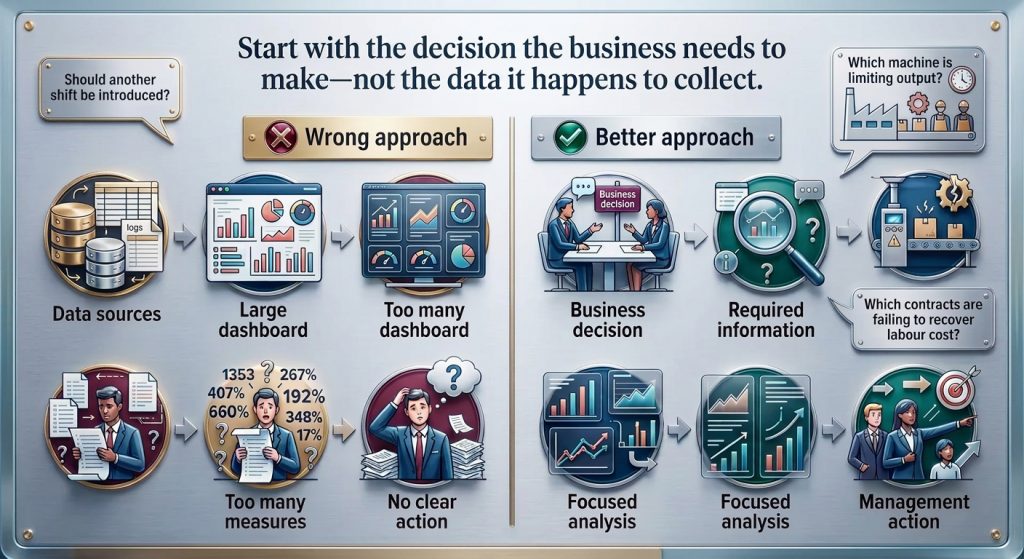
1. Begin with the decision, not the dashboard

A data project should not begin by asking:

What information can we collect?

It should begin by identifying the decisions the organisation needs to improve.

For example:

  • Should another shift be introduced?
  • Is a particular product commercially viable?
  • Which machine is creating the greatest constraint?
  • Why does one production line outperform another?
  • Is overtime increasing output or compensating for inefficiency?
  • Which contracts are failing to recover their true labour cost?

Once the decision is clear, the manufacturer can determine which information is required to support it.

This prevents the business from collecting data simply because it is available.

2. Connect planned performance with operational reality

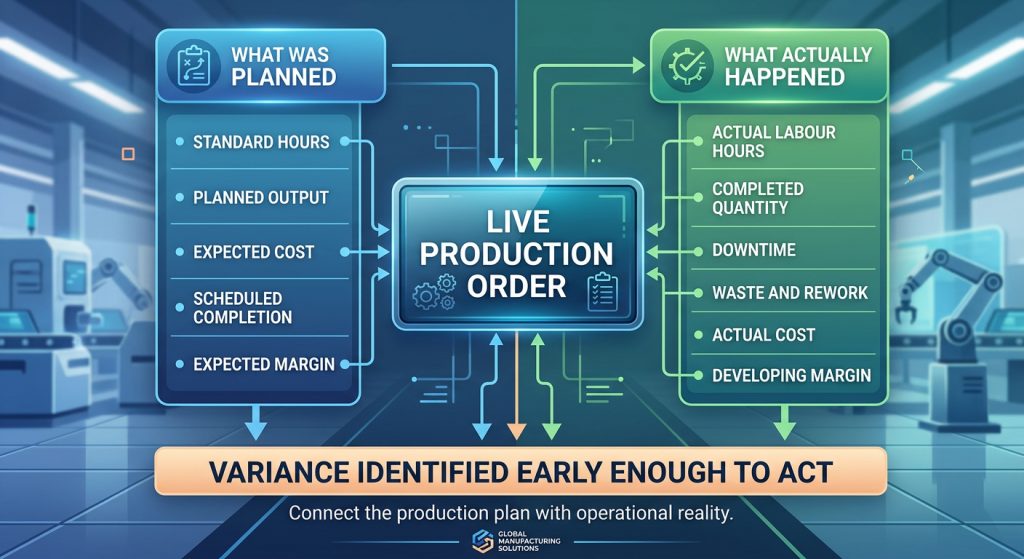
Most manufacturers already hold production plans, estimates, standards and expected costs.

The difficulty lies in comparing them consistently with what actually happened.

A production order should not remain an isolated record within an ERP system.

It should become a live operational entity against which the business can attribute:

  • Labour
  • Activities
  • Machine usage
  • Output
  • Downtime
  • Waste
  • Rework
  • Work in Progress

This enables the manufacturer to compare:

  • Estimated cost with actual cost
  • Standard hours with actual hours
  • Planned output with completed output
  • Expected margin with developing margin
  • Scheduled completion with likely completion

Planning information then becomes a tool for operational control rather than simply a record of what was expected.

3. Capture information where the activity takes place

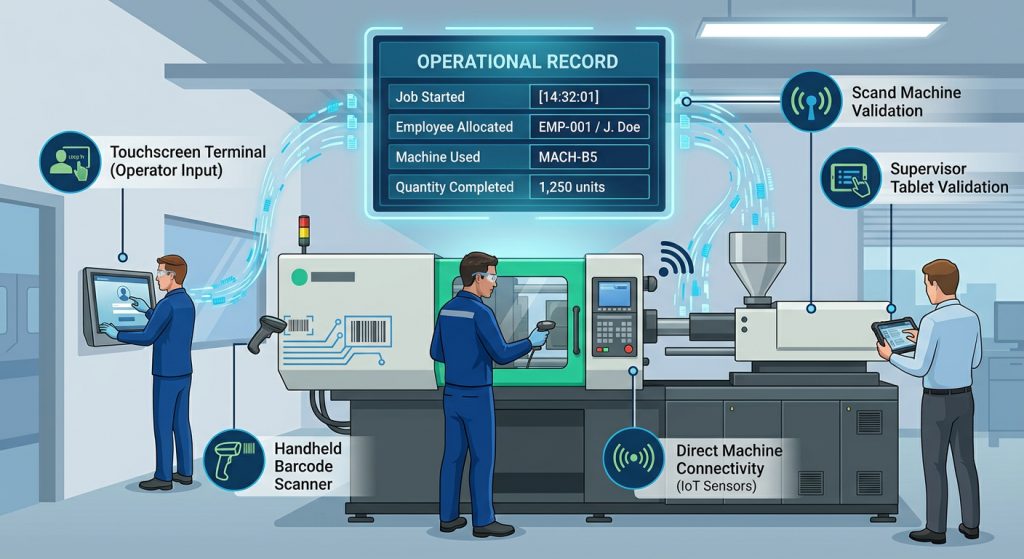
Operational data becomes less reliable when it depends on memory or retrospective entry.

Employees may be asked at the end of a shift to remember when a job started, why it stopped or how long they spent on an unplanned activity.

Supervisors may reconstruct events from paper records, spreadsheets and conversations.

Information should instead be captured as close as possible to the activity.

This may involve:

  • Shop-floor touchscreens
  • Barcode scanners
  • Mobile devices
  • Machine and PLC signals
  • Automated data feeds
  • Simple employee declarations
  • Supervisor validation

The objective should not be to create more administration.

It should be to make accurate data capture a natural part of completing the work.

4. Translate operational variance into financial value

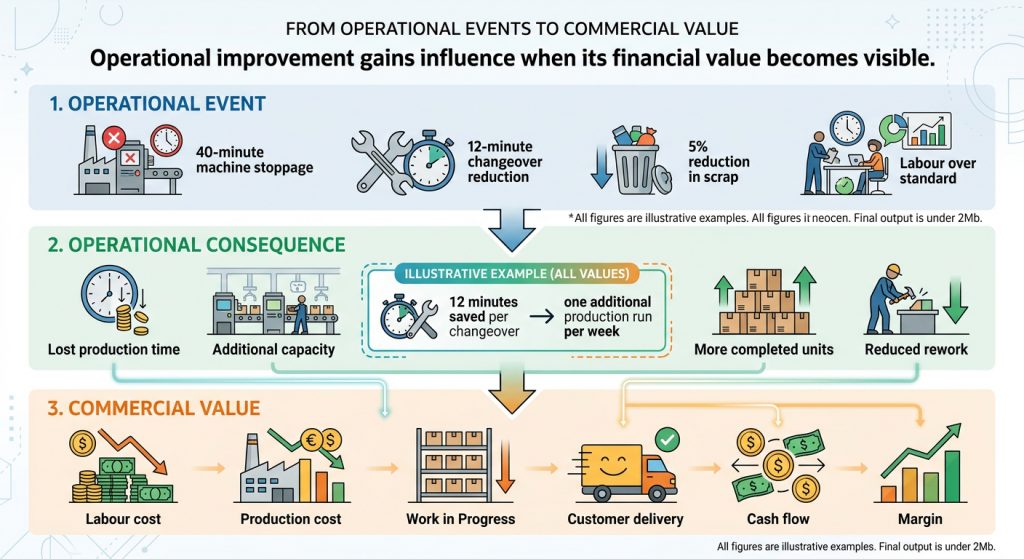
Operational measures become more influential when they are expressed commercially.

A reduction in downtime is positive.

An increase in recoverable production capacity creates a business case.

A shorter changeover is useful.

Demonstrating that the reduction creates an additional production run each week gives the improvement strategic relevance.

Manufacturers should therefore connect productivity, downtime, waste and efficiency measures with:

  • Labour cost
  • Production cost
  • Capacity
  • Work in Progress
  • Customer service
  • Cash flow
  • Margin

This creates a common language between operations, finance and senior management.

It also helps improvement teams demonstrate the real commercial value of their work.

5. Close the improvement loop

Continuous Improvement should operate as a complete cycle:

  1. Define the problem
  2. Measure current performance
  3. Identify the causes
  4. Implement the change
  5. Measure the result
  6. Control the improved process

Too many improvement projects reach the implementation stage without establishing how the result will be monitored and sustained.

Reliable operational information allows the manufacturer to determine:

  • What changed
  • Why it changed
  • Whether the improvement has continued
  • What commercial value has been created

This distinguishes a temporary improvement from a permanent change in performance.

Technology is only part of the answer

Advanced technology can support stronger manufacturing performance, but technology alone does not create a data-driven organisation.

Artificial intelligence, robotics and automation all depend on structured management, reliable information and clearly defined operational objectives.

AI cannot compensate for:

  • Inconsistent job codes
  • Unreliable standards
  • Disconnected systems
  • Poor labour attribution
  • Missing downtime reasons
  • Incomplete operational context

Before a manufacturer asks what AI could predict, it must first be able to explain accurately what has already happened.

The foundation of industrial AI is not the algorithm.

It is trusted operational data.

From data collection to operational intelligence

For many manufacturers, the answer is not to replace every existing system.

It is to create a connected operational layer between those systems, the workforce, machinery and the production environment.

That layer should be capable of:

  • Receiving orders, routings, standards and cost information
  • Presenting relevant instructions to employees
  • Capturing activity as work takes place
  • Combining employee, job, process and machine data
  • Applying operational and financial rules
  • Calculating performance at the required level of detail
  • Returning meaningful information to managers and authorised systems

Ceequel® Operational Intelligence has been designed around this principle.

It connects operational activity with information from existing business systems, machinery and the workforce.

The platform can convert job, employee, process and machine information into measures such as:

  • Labour productivity
  • Job cost
  • Work in Progress
  • Actual versus standard performance
  • Downtime
  • Overall Equipment Effectiveness
  • Cost variance
  • Margin performance

The purpose is not simply to produce more reports.

It is to create a consistent operational record that helps manufacturers understand what is happening, why it is happening and what it means commercially.

The next productivity improvement may not require another system producing another isolated set of figures.

It may begin by connecting the information the manufacturer already has—and using it to make better decisions.


Send Her Victorious, Happy and Glorious

As anniversaries go, two hundred is quite remarkable.

This week the United Kingdom marks a very special day; the 200th Anniversary of the birth of one of its greatest monarchs, HM Queen Victoria.

Alexandrina Victoria was born at Kensington Palace on the 24th May 1819.

After what can only be described as an unconventional and solitary childhood, Victoria ascended to the throne upon the death of her paternal uncle, King William IV.

Victoria was just 18 years of age.

The new teenage Queen wasted no time in heading to her new ‘office’ and after dispatching her mother to the remotest wing she could possibly find, took up residence at the unfinished Buckingham Palace.

Following her Coronation and ensuing marriage to Prince Albert and with the fortitude that would eventually see her clock up 63 years on the throne, Victoria established her reign.

The ‘Grandmother of Europe’ the ‘Empress of India’ as she would eventually become known as, had arrived.

That’s not to say Victoria wasn’t without her testing times or critics. With cholera, death and assassination attempts, Victoria would emerge ‘victorious’ from the numerous challenges that arose during her time on the throne.

The Victorian era is perhaps attributed to be one of the greatest times for the United Kingdom and much of today’s successes and traditions were birthed during Victoria and Albert’s reign.

In 1829, George Stephenson’s steam locomotive, ‘Rocket’ was unveiled. This feat of engineering became the blueprint for modern design for the next 150 years.

Ada Lovelace, the remarkable mathematician who Prince Albert admired greatly, emerged during Victoria’s early reign due to her work on Charles Babbage’s Analytical Engine.

Ada is considered perhaps to be, the first female computer programmer.

But what do we know about her Prince Charming, Albert?

Albert, a serious, dependable, logical thinker was at the forefront when it came to public health. Working alongside the Royal Society, Albert improved the hygiene and sanitation conditions for not only Buckingham Palace but the City of London as a whole. The Palace became one of the first ‘shop floors’ to provide ‘facilities’ for their staff.

With forward thinking, Albert achieved an even greater height with his vision of a ‘grand exhibition’.

The Grand Exhibition of Works and Industry in 1851 became a huge success and was showcased in a vast, flexible, glass construction that was essentially a conservatory.

Albert named the building Crystal Palace.

Victoria and Albert were at the forefront of change and modernisation, the effects of which the United Kingdom can still feel today.

So, all that remains for us to say is ‘Happy Birthday’ your Majesty!

ELF Productivity Ltd and Ceequel® not only Made in the UK but like V&A, progressive, dependable and reliable.

If you are interested in Biometric Time and Attendance software for your business, contact us today for a free, no obligation quotation and demonstration of Ceequel® software.

Explore ELF Productivity Ltd’s Time and Attendance software suite in more detail by downloading the brochure catalogue here.

Human Resources, Shop Floor Data Capture, Employee Self Service, Ceequel® Apps and E-Manager all fall under the Ceequel® umbrella.

Shop floor Data Capture – How lean are your processes?

Constantly hitting production targets is crucial to any company producing products. Having a system in place that records and tracks production numbers at every available stage is key – check out this infographic to discover the impact a shop floor data capture system can have on an organisation.

When it comes to the production of products every company needs to be able to stay on top of their processes. unproductive employees and faulty machinery can prove fatal to any manufacturing organisation. Constantly missing production targets over an extensive period of time can lead to a significant drop in profits which if not corrected can lead to the closure of any organisation. A Shop Floor Data Capture system is designed to help organisations track each stage of their manufacturing process and record accurate data for employers to monitor. The below infographic provides more information on what a shop floor data capture system is and the benefits it can have on organisations who opt to implement one.

The Benefits of a Shop Floor Data Capture system

(click to enlarge image)

shop floor data capture

Share this Image On Your Site


Manufacturing Shop Floor Data Capture (SFDC) with Time & Attendance

Keeping track of your employees productive and unproductive hours is a crucial task for any business who wishes to be successful. Having access to this type of information provides your business with the ability to view all unproductive hours and implement processes which will help improve individual employee productivity levels.

Shop Floor Data Capture

Organisations are always looking for ways to measure and develop the productivity of their employees. It is vitally important if they want to ensure their continued growth and success. To make sure of this, organisations need to have full control over their employees’ working hours – both productive and unproductive. The best way to do this is through the use of time attendance systems.


The use of these systems allows companies to record when their workers start their work and when they stop. They are also able to identify the kind of work as well as the level of productivity. Elf Productivity Limited is a provider of high quality time management and attendance systems that are both reliable and cost effective. We deliver top quality support with our time management software and valuable industry experience.

Shop Floor Data Capture (SFDC)

Our Ceequel® Time and attendance software can help increase companies knowledge of their shop floor.  Companies obtain granular data which ultimately saves on cost through fast and efficient data capture. Since data is captured on the shop floor itself and in real time, accuracy is guaranteed. It leads to a reconciliation of productive and non-productive time. Companies using shop floor data capture are expected to receive the following results.

  • Our state of the art touch screen terminals allow employees to select live jobs often by skill set. It helps increase productivity because all they need to do is simply use the terminal for selecting a job specific to the employee. With the system’s capability to track projects and see the actual time that it takes to complete the job, it is easy to compare actuals to standards or the target/budget time that’s meant for that specific project.
  • It is simpler and easier to select specific activities within a job. The activity tracking module allows for real time information on jobs as it progresses through the manufacturing process. The gradual and step by step progress of any project is visible by both management and employees.
  • It will capture quantities produced, waste and any reworks. This allows companies to measure the actual productivity and efficiency of their employees. Measures can then be taken on how efficiencies can be maximized.
  • Ability to restrict employees by their skill type. This means that the software will help organisations in making sure that only employees who have relevant skill sets are allowed on certain jobs. This makes the work more efficient and ensures that results will almost always be satisfactory.
  • There are certain jobs that need to be prioritised over others. With the use of our shop floor data software, companies are enabled to selectively place the jobs that need to be completed (in order of importance) in their proper order.

Combining the systems that we offer – with our unparalleled industry knowledge and expertise – allows us to provide organisations with a bridge between productive and non-productive time. Productivity is maximised while other non-productive activities including employees become clearer and more defined.

With the quality and capabilities of Ceequel® and our deep commitment to quality customer service, it is easy to see why we have managed to become one of the leading time management companies not just in the UK but in the whole of Europe. Please contact us or take a tour of our website to see how we can assist your organisation.