Why a Dedicated Time & Attendance Platform with Integrated HR Functionality Often Delivers Better Workforce Management Than an HR System with Embedded Time & Attendance

In recent years, many organisations have sought to consolidate software platforms wherever possible. As a result, numerous HR systems now include embedded Time & Attendance functionality as part of a broader Human Resources offering.

While the concept of managing everything from a single platform may appear attractive, organisations whose workforce management requirements extend beyond basic absence recording often discover that there is a significant difference between a system that was designed around workforce management and later enhanced with HR capabilities, and a system that was designed around HR administration and later expanded to include Time & Attendance features.

The distinction is important because the priorities, complexity, and operational demands of workforce management are fundamentally different from those of HR administration.

Time & Attendance Is an Operational System

At its core, Time & Attendance is not simply about recording when someone arrives at work.

A modern Time & Attendance platform is responsible for:

  • Capturing attendance data in real time.
  • Calculating working hours.
  • Applying overtime rules.
  • Managing shift patterns.
  • Monitoring absence.
  • Supporting payroll preparation.
  • Providing labour cost visibility – including shop floor data.
  • Managing workforce compliance.
  • Delivering real-time operational intelligence.

For many organisations, particularly those operating in manufacturing, logistics, food production, engineering, healthcare, retail, and distribution, workforce management is an operational function that directly impacts productivity, labour costs, and profitability every single day.

An error in attendance processing can affect payroll immediately.

An error allocating labour to the wrong job can affect productivity immediately.

An error in workforce visibility can affect operational decision-making immediately.

HR Systems Are Primarily Employee Administration Platforms

Human Resources systems are typically designed to manage employee information and HR processes.

Common areas of focus include:

  • Employee records.
  • Recruitment.
  • Onboarding.
  • Performance management.
  • Learning and development.
  • Disciplinary procedures.
  • Employee documentation.
  • Policy management.
  • Succession planning.

These are critical business functions, but they are generally administrative rather than operational.

Most HR systems are designed to answer questions such as:

  • Who works for us?
  • What qualifications do they hold?
  • What training have they completed?
  • What policies apply to them?

Time & Attendance systems, by contrast, answer questions such as:

  • Who is currently on site?
  • Who is absent?
  • Who is working overtime?
  • What are today’s labour costs?
  • What exceptions require attention before payroll is processed?

While both disciplines involve employees, they serve very different purposes.

Workforce Management Is Often More Complex Than HR

Many organisations underestimate the complexity involved in accurately managing attendance and payroll-related calculations.

Examples include:

  • Multiple shift patterns.
  • Continental shifts.
  • Rotating rosters.
  • Overtime premiums.
  • Call-out payments.
  • Bank holiday rules.
  • Flexitime arrangements.
  • Annualised Hours.
  • TOIL (Banked Hours)
  • Attendance bonuses.
  • Break deductions.
  • Union agreements.
  • Site-specific working practices.

A dedicated Time & Attendance platform is typically designed from the outset to accommodate these operational requirements, effortlessly.

In contrast, organisations should carefully assess whether an embedded Time & Attendance module can fully support the complexity of their workforce rules both now and in the future.

Payroll Accuracy Depends on Workforce Accuracy

For many organisations, payroll represents one of the largest costs within the business.

The quality of payroll output is heavily dependent on the quality of attendance data entering the process.

A dedicated Time & Attendance platform is often built around:

  • Automated Rules Management.
  • Exception management.
  • Payroll validation.
  • Audit trails.
  • Labour cost reporting.

These functions help ensure that attendance data is accurate before it reaches payroll.

This is why many organisations view Time & Attendance as a critical operational control rather than simply an extension of HR administration.

Real-Time Visibility Matters

Operational managers often need access to information throughout the day, not simply at payroll processing time.

Examples include:

  • Who has not arrived for work?
  • Which departments are understaffed?
  • Who is currently on site and in the fire register?
  • Who is approaching overtime thresholds?
  • Which agency workers are present today – and their cost?

Dedicated workforce management platforms are typically designed to provide this information in real time.

This operational visibility can support:

  • Resource planning.
  • Production management.
  • Shift management.
  • Health and safety procedures.
  • Labour cost control.

Workforce Management Extends Beyond HR

Modern Time & Attendance platforms increasingly support a broader workforce ecosystem.

This may include:

  • Employee Self-Service.
  • Manager Self-Service.
  • Access Control.
  • Visitor Management.
  • Contractor Management.
  • Fire Registers.
  • Labour Analytics.
  • Workforce Reporting – Shop Floor Data Capture

These functions often sit closer to operations, facilities, production, and payroll than they do to traditional HR administration.

As a result, many organisations prefer a workforce management platform that can integrate HR functionality rather than relying solely on an HR platform to manage operational workforce processes.

Flexibility for Operational Change

Businesses rarely remain static.

New sites open.

Departments expand.

Shift patterns change.

Acquisitions occur.

Working practices evolve.

A workforce management platform should be capable of adapting to operational change without requiring extensive redevelopment or manual workarounds.

When evaluating any solution, organisations should consider how easily workforce rules, attendance policies, and operational processes can be modified as business requirements evolve.

The Ideal Approach: Integrated, Not Compromised

The discussion should not be viewed as HR versus Time & Attendance.

Both are essential.

The real question is where the organisation’s primary operational requirements sit.

For many employers, the most effective approach is a dedicated workforce management platform that incorporates HR functionality while maintaining the specialist attendance, payroll, labour management, and operational capabilities required to manage the workforce effectively.

This allows organisations to benefit from:

  • Comprehensive workforce management.
  • Integrated HR processes.
  • Accurate payroll preparation.
  • Real-time operational visibility.
  • Reduced administration.
  • Improved workforce intelligence.

Conclusion

Every organisation has different requirements, and there is no single solution that is right for every business.

However, where workforce management, payroll accuracy, labour cost control, operational visibility, continuous improvement, and complex attendance rules are business-critical, organisations should carefully evaluate whether an embedded Time & Attendance module can provide the same depth of functionality as a platform designed specifically for workforce management.

The most successful workforce management projects are typically those that place operational requirements, payroll accuracy, and workforce visibility at the centre of the decision-making process, while ensuring that HR functionality remains fully integrated and readily accessible across the organisation.


This article is intended for informational purposes only. It does not make claims regarding the capabilities, performance, or suitability of any specific software product. Organisations should assess all solutions against their own operational, payroll, HR, compliance, and workforce management requirements before making a procurement decision.

UK Manufacturing Is Data-Rich – Five Principles for Turning Manufacturing Data into Better Decisions

Part 2 of a 2 Part Series……….

Most manufacturers already hold a significant amount of operational information.

The challenge is converting that information into something managers can use to improve productivity, control cost and sustain Continuous Improvement.

A dashboard containing dozens of measures may look impressive. But if it does not help the organisation make a better decision, its commercial value is limited.

Manufacturers can improve the value of their operational data by applying five practical principles.

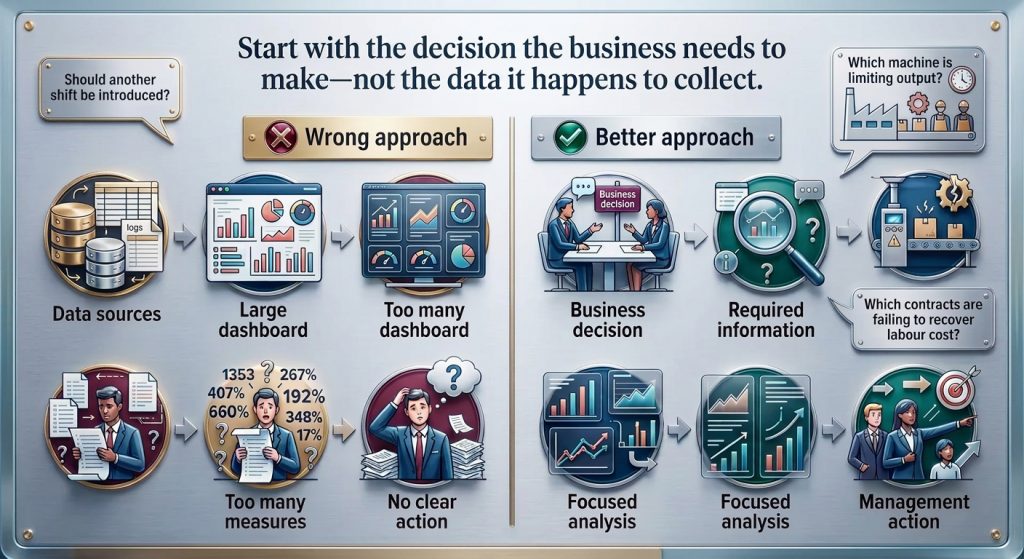
1. Begin with the decision, not the dashboard

A data project should not begin by asking:

What information can we collect?

It should begin by identifying the decisions the organisation needs to improve.

For example:

  • Should another shift be introduced?
  • Is a particular product commercially viable?
  • Which machine is creating the greatest constraint?
  • Why does one production line outperform another?
  • Is overtime increasing output or compensating for inefficiency?
  • Which contracts are failing to recover their true labour cost?

Once the decision is clear, the manufacturer can determine which information is required to support it.

This prevents the business from collecting data simply because it is available.

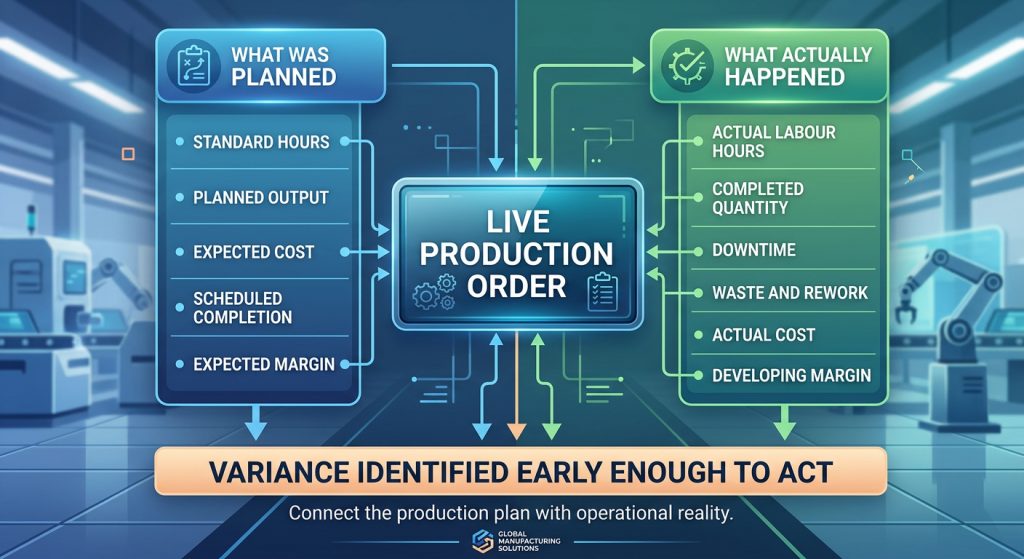
2. Connect planned performance with operational reality

Most manufacturers already hold production plans, estimates, standards and expected costs.

The difficulty lies in comparing them consistently with what actually happened.

A production order should not remain an isolated record within an ERP system.

It should become a live operational entity against which the business can attribute:

  • Labour
  • Activities
  • Machine usage
  • Output
  • Downtime
  • Waste
  • Rework
  • Work in Progress

This enables the manufacturer to compare:

  • Estimated cost with actual cost
  • Standard hours with actual hours
  • Planned output with completed output
  • Expected margin with developing margin
  • Scheduled completion with likely completion

Planning information then becomes a tool for operational control rather than simply a record of what was expected.

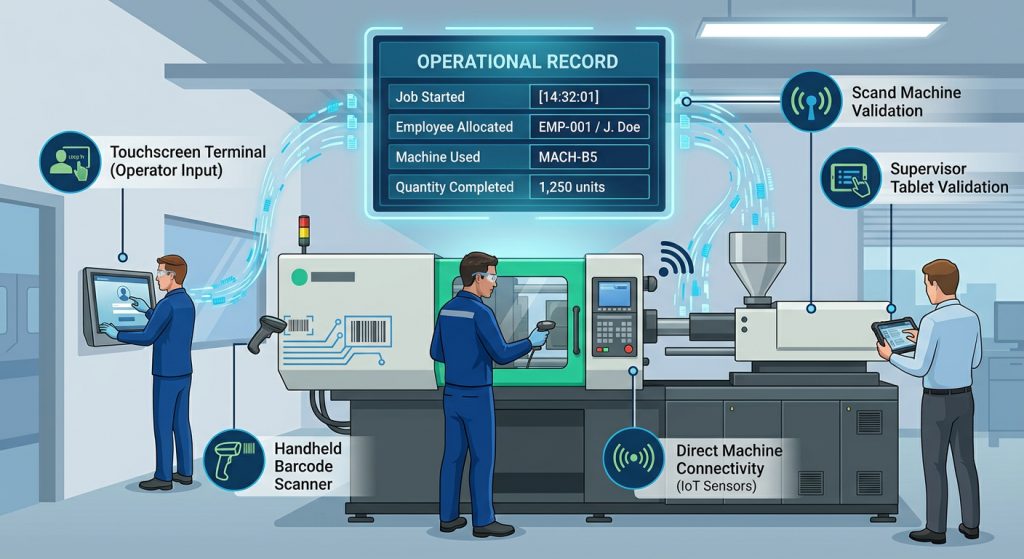
3. Capture information where the activity takes place

Operational data becomes less reliable when it depends on memory or retrospective entry.

Employees may be asked at the end of a shift to remember when a job started, why it stopped or how long they spent on an unplanned activity.

Supervisors may reconstruct events from paper records, spreadsheets and conversations.

Information should instead be captured as close as possible to the activity.

This may involve:

  • Shop-floor touchscreens
  • Barcode scanners
  • Mobile devices
  • Machine and PLC signals
  • Automated data feeds
  • Simple employee declarations
  • Supervisor validation

The objective should not be to create more administration.

It should be to make accurate data capture a natural part of completing the work.

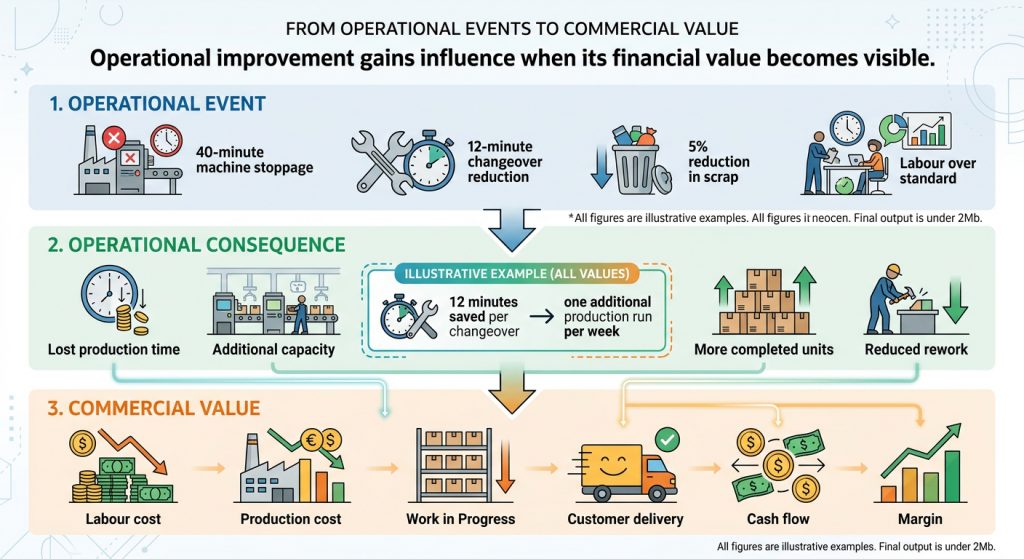
4. Translate operational variance into financial value

Operational measures become more influential when they are expressed commercially.

A reduction in downtime is positive.

An increase in recoverable production capacity creates a business case.

A shorter changeover is useful.

Demonstrating that the reduction creates an additional production run each week gives the improvement strategic relevance.

Manufacturers should therefore connect productivity, downtime, waste and efficiency measures with:

  • Labour cost
  • Production cost
  • Capacity
  • Work in Progress
  • Customer service
  • Cash flow
  • Margin

This creates a common language between operations, finance and senior management.

It also helps improvement teams demonstrate the real commercial value of their work.

5. Close the improvement loop

Continuous Improvement should operate as a complete cycle:

  1. Define the problem
  2. Measure current performance
  3. Identify the causes
  4. Implement the change
  5. Measure the result
  6. Control the improved process

Too many improvement projects reach the implementation stage without establishing how the result will be monitored and sustained.

Reliable operational information allows the manufacturer to determine:

  • What changed
  • Why it changed
  • Whether the improvement has continued
  • What commercial value has been created

This distinguishes a temporary improvement from a permanent change in performance.

Technology is only part of the answer

Advanced technology can support stronger manufacturing performance, but technology alone does not create a data-driven organisation.

Artificial intelligence, robotics and automation all depend on structured management, reliable information and clearly defined operational objectives.

AI cannot compensate for:

  • Inconsistent job codes
  • Unreliable standards
  • Disconnected systems
  • Poor labour attribution
  • Missing downtime reasons
  • Incomplete operational context

Before a manufacturer asks what AI could predict, it must first be able to explain accurately what has already happened.

The foundation of industrial AI is not the algorithm.

It is trusted operational data.

From data collection to operational intelligence

For many manufacturers, the answer is not to replace every existing system.

It is to create a connected operational layer between those systems, the workforce, machinery and the production environment.

That layer should be capable of:

  • Receiving orders, routings, standards and cost information
  • Presenting relevant instructions to employees
  • Capturing activity as work takes place
  • Combining employee, job, process and machine data
  • Applying operational and financial rules
  • Calculating performance at the required level of detail
  • Returning meaningful information to managers and authorised systems

Ceequel® Operational Intelligence has been designed around this principle.

It connects operational activity with information from existing business systems, machinery and the workforce.

The platform can convert job, employee, process and machine information into measures such as:

  • Labour productivity
  • Job cost
  • Work in Progress
  • Actual versus standard performance
  • Downtime
  • Overall Equipment Effectiveness
  • Cost variance
  • Margin performance

The purpose is not simply to produce more reports.

It is to create a consistent operational record that helps manufacturers understand what is happening, why it is happening and what it means commercially.

The next productivity improvement may not require another system producing another isolated set of figures.

It may begin by connecting the information the manufacturer already has—and using it to make better decisions.


Making Sure Your Access Control System Adapts to the Unexpected

Visitors who are unauthorised and unexpected can often play havoc with your security system and sometime mean your business is in violation of security regulations. Having an access control system in place can prevent any event that would lead to a security breach from happening as they adapt to unexpected circumstances whilst also making sure your businesses security isn’t compromised.

In many ways, the purpose of an access control system is to prevent the unexpected from interfering with your company’s work. Unexpected and unauthorised visitors can play havoc with your operation and mean that your company is in violation of security regulations. However, access control systems can’t prevent every event that could lead to a security breach. Instead, they must adapt to unexpected circumstances without compromising your business’s security.

One extremely common circumstance that will require your access control system to adapt is an employee’s losing an access card. If your access control system can’t adapt to this circumstance, a simple mistake can turn into a time-consuming replacement process or even a security breach. When selecting access control software, make sure it makes it easy for you to cancel lost cards and issue new ones.

Continue reading “Making Sure Your Access Control System Adapts to the Unexpected”

Time and Attendance Issues for Businesses: Increasing Productivity with Time and Attendance Software

Having a non computerised time and attendance solution provides your employees with the ability to take time off here and their as they know you are not able to fully track which employees are working at any one time. A computerised system requires your employees to clock in and out everyday and collects this data within a system all managers have access too.

Time and Attendance is one of the most important aspects of keeping your business productive. Employees can sometimes take advantage of the fact that you may or may not notice when they come to work. Many businesses do have “clocking in” procedures in place but even these can be thwarted by asking a friend to do it for them or other ways.

There are other problems, too, regarding incentives to get people motivated to attend more regularly. Working mothers often call in with sick children. Some workers have health problems or other issues that get in the way of their regular attendance. Those things do happen and people do have problems, lives, and responsibilities outside of the work place.

Continue reading “Time and Attendance Issues for Businesses: Increasing Productivity with Time and Attendance Software”