Replacing Mitrefinch TMS: A Practical Guide for UK Employers

As workforce management requirements continue to evolve, many organisations are reviewing whether their existing Time & Attendance solution remains aligned with their operational, payroll, compliance, and workforce management objectives.

If your organisation currently uses Mitrefinch TMS and is considering its future options, this guide provides a practical framework for assessing whether your current solution continues to meet your needs and, if not, what should be considered when evaluating alternative platforms.

This article is intended as an impartial guide to help employers make informed decisions based on their own business requirements.

Why Organisations Review Their Time & Attendance System

Time & Attendance systems are a critical component of workforce management. As organisations grow, diversify, or modernise their operations, requirements often change.

Common reasons for reviewing an existing solution include:

  • Increasing payroll administration and manual intervention.
  • Expansion across multiple sites or locations.
  • Greater use of remote, mobile, or field-based employees.
  • A requirement to integrate Time & Attendance with HR, Payroll, ERP, Access Control, or Visitor Management systems.
  • The need for improved management visibility and reporting.
  • Changes in working practices, legislation, or compliance requirements.
  • Hardware refresh programmes or software renewal cycles.
  • Business acquisitions, mergers, or organisational restructuring.

A system review does not necessarily mean a replacement is required. However, it provides an opportunity to assess whether the current solution continues to deliver the functionality, efficiency, and return on investment expected by the business.

What a Modern Workforce Management Solution Should Deliver

A Time & Attendance solution should do more than simply record employee attendance. It should provide accurate workforce data that supports operational decision-making, payroll accuracy, compliance, and employee engagement.

When evaluating any solution, organisations should expect:

Accurate Workforce Data

  • Real-time attendance monitoring.
  • Automated calculation of working hours.
  • Accurate overtime and absence management.
  • Reduction in manual payroll adjustments.

Improved Management Visibility

  • Real-time workforce dashboards.
  • Exception reporting.
  • Attendance trend analysis.
  • Labour cost visibility.

Streamlined Payroll Processing

  • Automated payroll preparation.
  • Clear audit trails.
  • Reduced payroll queries.
  • Reliable integration with payroll systems.

Workforce Compliance

  • Working Time Regulations monitoring.
  • Absence tracking.
  • Audit and reporting capabilities.
  • Accurate records for compliance purposes.

Enhanced Employee and Manager Self-Service

  • Electronic holiday requests.
  • Manager approvals.
  • Employee access to attendance records.
  • Mobile workforce capabilities where required.

Key Questions to Ask During a System Review

Whether reviewing your current supplier or considering alternative providers, consistency is essential. Every supplier should be evaluated against the same criteria.

Payroll Management

  • How are exceptions and anomalies identified and managed?
  • How are audit trails maintained?
  • How does the system reduce payroll administration?

Business Rules

  • Can the solution accommodate existing working rules and agreements?
  • How flexible is the configuration?
  • Can future changes be implemented without development work?

Hardware and Data Collection

  • What clocking methods are available?
  • Can existing hardware be retained?
  • What options exist for mobile or remote workers?

Integration

  • What integrations are available with Payroll, HR, ERP, Access Control, and Visitor Management systems?
  • Are integrations proven and supported?

Security and Hosting (for cloud based systems)

  • Where is data hosted?
  • What security standards are maintained?
  • What service levels and support arrangements are provided?

Implementation

  • What does the migration process involve?
  • How is data transferred and validated?
  • What support is available during and after implementation?

Commercial Considerations

  • What are the initial implementation costs?
  • What ongoing support and maintenance costs apply?
  • Are there any additional licensing or usage-based charges?

The Importance of a Structured Migration Process

For most organisations, the greatest risk during a replacement project is not the installation of new software. The primary challenge is ensuring that existing workforce rules, pay calculations, attendance policies, and operational processes are accurately replicated or improved.

A successful migration project should include:

  • Detailed Scope of Works.
  • Documentation of existing rules and processes.
  • Configuration review and approval.
  • Data migration planning – if available.
  • Payroll validation and parallel testing.
  • User and manager training.
  • Post-implementation support.

Organisations should seek clear documentation outlining how each stage of the migration will be managed.

Evaluating Long-Term Value

While software functionality remains important, organisations should also consider the broader value delivered by a workforce management solution.

Areas worth evaluating include:

  • Reduction in payroll administration.
  • Removal of manual calculations.
  • Improved labour cost control.
  • Enhanced workforce visibility.
  • Reduced manual processes.
  • Improved compliance reporting.
  • Increased management efficiency.
  • Scalability for future growth.

A workforce management platform should support operational objectives not only today, but also as the organisation evolves over the coming years.

Making an Informed Decision

Every organisation’s requirements are unique. The most effective procurement decisions are based on clearly documented business objectives, operational requirements, implementation considerations, support arrangements, and long-term value (ROI).

A structured review process allows organisations to assess whether their existing solution remains the best fit or whether alternative platforms may offer additional benefits more aligned with future business goals.

By taking a measured and evidence-based approach, organisations can ensure that any investment in workforce management technology delivers meaningful improvements in productivity, efficiency, accuracy, and visibility.

About Ceequel®

Ceequel® is a UK-developed workforce management platform designed to help organisations manage attendance, absence, labour costs, employee self-service, manager approvals, access control, visitor management, and workforce reporting through a single integrated solution.

Supporting organisations across manufacturing, logistics, food production, distribution, healthcare, engineering, and other sectors, Ceequel® provides flexible deployment options and configurable workforce management capabilities designed to meet the operational requirements of modern UK employers.

For organisations reviewing their current Time & Attendance solution, a structured demonstration and discovery process can help determine whether Ceequel® is aligned with their operational and workforce management objectives.


This article is intended for informational purposes only and does not make any representations regarding the performance, functionality, support, commercial arrangements, or future direction of any third-party software product or supplier. Organisations should undertake their own evaluation based on their individual business requirements and procurement processes.

Replacing Legacy Kronos Systems: A Practical Guide for UK Employers

Many organisations have relied on Kronos workforce management solutions for years, benefiting from robust time recording, scheduling, and workforce management capabilities. However, as technology, workforce expectations, and business requirements evolve, many employers are taking the opportunity to review whether their existing system continues to meet their operational needs and future objectives.

If your organisation is currently using a legacy Kronos solution and is considering its long-term strategy, this guide outlines the key factors that should be considered when evaluating your existing platform and assessing potential alternatives.

This article is intended as an educational resource to support informed decision-making and procurement best practice.

Why Organisations Review Legacy Workforce Management Systems

Workforce management systems often remain in place for many years. During that time, businesses can undergo significant changes that place new demands on technology and operational processes.

Common reasons organisations review their existing workforce management platform include:

  • Changes to payroll processes and compliance requirements.
  • Business growth, acquisitions, or multi-site expansion.
  • Increasing use of mobile, remote, or hybrid working.
  • A desire to improve management visibility and workforce analytics.
  • The need for greater automation and reduced administration.
  • Wider digital transformation programmes.
  • ERP, HR, or payroll system replacement projects.
  • Hardware refresh cycles or infrastructure modernisation initiatives.
  • Evolving employee expectations around self-service and accessibility.

A system review provides an opportunity to assess whether the existing platform remains aligned with current business objectives and future workforce management requirements.

What Modern Workforce Management Should Deliver

Today’s workforce management systems are expected to do far more than simply record attendance.

A modern solution should support strategic decision-making while improving operational efficiency across the organisation.

Accurate Time Recording

Organisations should expect:

  • Real-time attendance visibility.
  • Automated working time calculations.
  • Accurate overtime management.
  • Comprehensive absence monitoring.
  • Clear audit trails for payroll processing.

Improved Operational Visibility

Managers should have access to:

  • Live workforce dashboards.
  • Attendance exception reporting.
  • Labour utilisation data.
  • Departmental and site-level analytics.
  • Real-time workforce status information.

Payroll Efficiency

Effective workforce management should help organisations:

  • Reduce manual payroll administration.
  • Minimise payroll queries and adjustments.
  • Improve payroll accuracy.
  • Streamline payroll preparation processes.
  • Provide clear reporting and audit capabilities.

Employee and Manager Self-Service

Modern solutions increasingly support:

  • Holiday and absence requests.
  • Electronic approvals.
  • Mobile workforce access.
  • Employee attendance visibility.
  • Manager workflow automation.

Workforce Compliance

Employers should be able to monitor and report on:

  • Working Time Regulations.
  • Attendance policies.
  • Absence management.
  • Audit requirements.
  • Workforce governance procedures.

Key Areas to Assess During a System Review

When reviewing any workforce management platform, organisations should evaluate suppliers using consistent criteria.

Workforce Management Functionality

Consider whether the solution supports:

  • Complex shift patterns.
  • Overtime rules.
  • Attendance management.
  • Absence management.
  • Flexible working arrangements.
  • Multi-site operations.

Payroll Integration

Questions to consider include:

  • How is payroll data prepared and transferred?
  • What validation processes exist?
  • How are exceptions managed?
  • What audit capabilities are available?

Data Collection Methods

Review the available options for:

  • Biometric clocking.
  • Facial recognition.
  • Proximity cards and fobs.
  • Mobile workforce applications.
  • Web-based attendance recording.

Integration Capabilities

Organisations should understand how the platform shares data with:

  • Payroll systems.
  • HR software.
  • ERP platforms.
  • Access Control systems.
  • Visitor Management solutions.
  • Business intelligence and reporting tools.

Security and Infrastructure

Areas to evaluate include:

  • Data hosting arrangements.
  • Security standards and certifications.
  • Business continuity provisions.
  • Support and service level agreements.
  • Disaster recovery procedures.

Scalability

A workforce management platform should support:

  • Organisational growth.
  • Additional sites.
  • New departments.
  • Future technology requirements.
  • Evolving workforce practices.

Planning a Successful Migration

Any workforce management replacement project should be approached as a business transformation initiative rather than simply a software installation.

Successful projects typically include:

Discovery and Analysis

  • Review of existing workforce rules.
  • Documentation of attendance policies.
  • Identification of payroll requirements.
  • Review of reporting needs.

Configuration and Validation

  • Comprehensive Scope of Works.
  • Operational validation.
  • Payroll validation.
  • Rule verification.

Data Migration

  • Historical data requirements.
  • Employee information transfer.
  • Validation procedures.

Training and Adoption

  • Manager training.
  • Employee communication.
  • User documentation.
  • Ongoing support arrangements.

Go-Live and Post-Implementation Support

  • Controlled deployment.
  • Parallel payroll testing where appropriate.
  • Dedicated support during transition.
  • Performance monitoring.

Looking Beyond Features

When reviewing any workforce management solution, organisations should consider the wider business outcomes it can deliver.

These may include:

  • Reduced labour administration.
  • Improved payroll accuracy – no payroll leakage.
  • Greater workforce visibility.
  • Better labour cost control.
  • Improved operational efficiency.
  • Enhanced compliance reporting.
  • Increased employee engagement.
  • Better management decision-making.

The objective should be to identify a solution that supports both immediate operational needs and long-term organisational goals.

Future-Proofing Workforce Management

As workforce management technology continues to evolve, organisations increasingly seek platforms that can support a wider range of operational requirements from a single environment.

Areas commonly considered during strategic reviews include:

Bringing these functions together can help reduce administration, improve data accuracy, and provide a more unified view of the workforce.

About Ceequel®

Ceequel® is a UK-developed workforce management platform designed to help organisations manage attendance, absence, labour costs, employee self-service, manager approvals, access control, visitor management, and workforce reporting through a single integrated solution.

Used across manufacturing, food production, logistics, engineering, healthcare, distribution, and other sectors, Ceequel® provides organisations with configurable workforce management capabilities that can be tailored to specific operational requirements.

For organisations reviewing legacy workforce management platforms, a structured discovery and demonstration process can help determine whether Ceequel® aligns with their current and future workforce management objectives.


This article is provided for informational purposes only and does not make any representations regarding the performance, functionality, support arrangements, commercial terms, product lifecycle, or future direction of any third-party software product or supplier. Organisations should undertake their own independent evaluation based on their specific operational requirements, procurement processes, and business objectives.

UK Manufacturing Is Data-Rich – Five Principles for Turning Manufacturing Data into Better Decisions

Part 2 of a 2 Part Series……….

Most manufacturers already hold a significant amount of operational information.

The challenge is converting that information into something managers can use to improve productivity, control cost and sustain Continuous Improvement.

A dashboard containing dozens of measures may look impressive. But if it does not help the organisation make a better decision, its commercial value is limited.

Manufacturers can improve the value of their operational data by applying five practical principles.

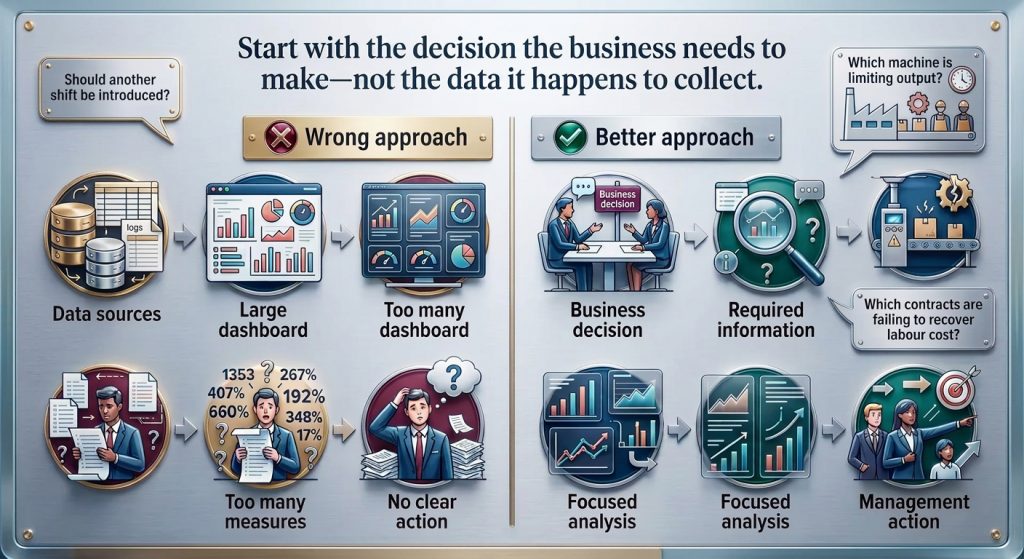
1. Begin with the decision, not the dashboard

A data project should not begin by asking:

What information can we collect?

It should begin by identifying the decisions the organisation needs to improve.

For example:

  • Should another shift be introduced?
  • Is a particular product commercially viable?
  • Which machine is creating the greatest constraint?
  • Why does one production line outperform another?
  • Is overtime increasing output or compensating for inefficiency?
  • Which contracts are failing to recover their true labour cost?

Once the decision is clear, the manufacturer can determine which information is required to support it.

This prevents the business from collecting data simply because it is available.

2. Connect planned performance with operational reality

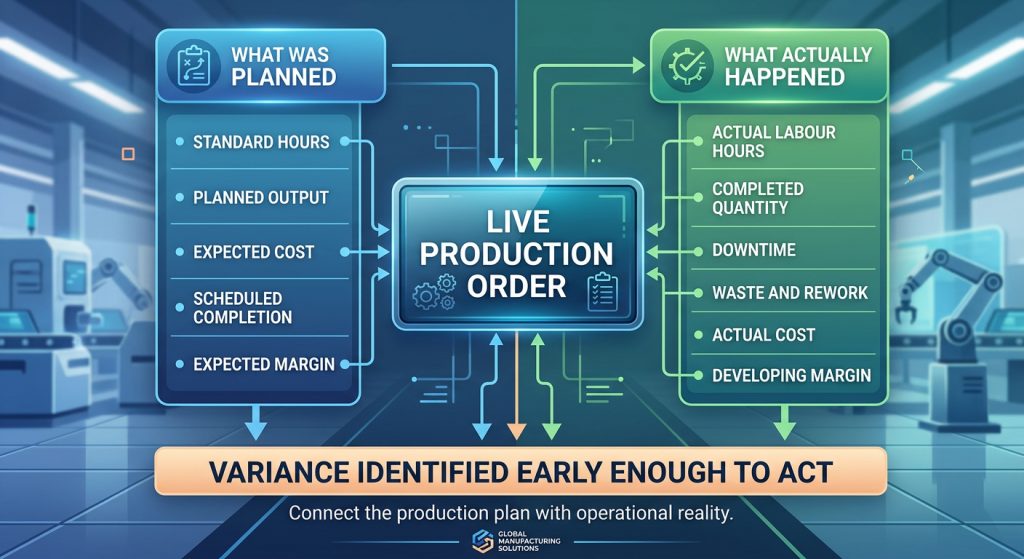
Most manufacturers already hold production plans, estimates, standards and expected costs.

The difficulty lies in comparing them consistently with what actually happened.

A production order should not remain an isolated record within an ERP system.

It should become a live operational entity against which the business can attribute:

  • Labour
  • Activities
  • Machine usage
  • Output
  • Downtime
  • Waste
  • Rework
  • Work in Progress

This enables the manufacturer to compare:

  • Estimated cost with actual cost
  • Standard hours with actual hours
  • Planned output with completed output
  • Expected margin with developing margin
  • Scheduled completion with likely completion

Planning information then becomes a tool for operational control rather than simply a record of what was expected.

3. Capture information where the activity takes place

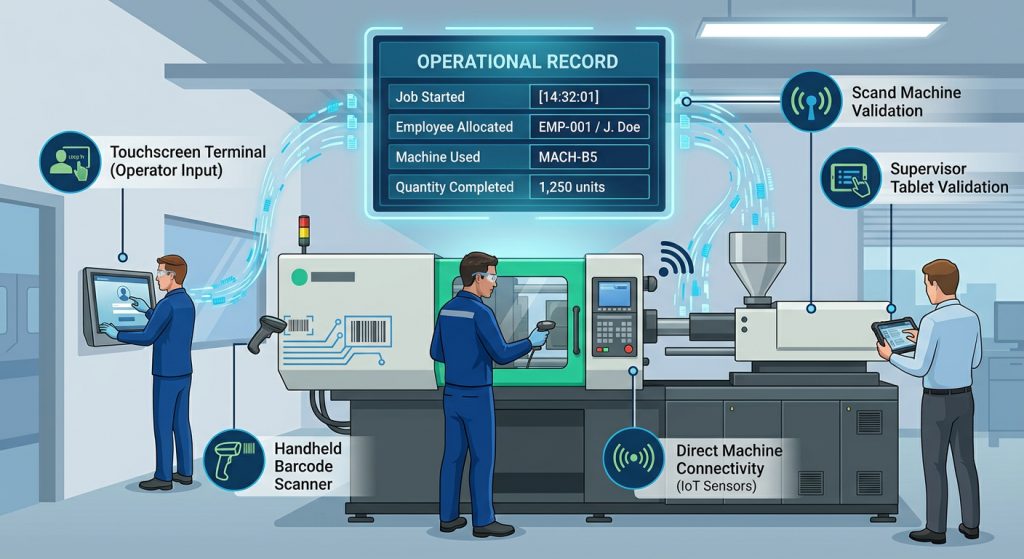
Operational data becomes less reliable when it depends on memory or retrospective entry.

Employees may be asked at the end of a shift to remember when a job started, why it stopped or how long they spent on an unplanned activity.

Supervisors may reconstruct events from paper records, spreadsheets and conversations.

Information should instead be captured as close as possible to the activity.

This may involve:

  • Shop-floor touchscreens
  • Barcode scanners
  • Mobile devices
  • Machine and PLC signals
  • Automated data feeds
  • Simple employee declarations
  • Supervisor validation

The objective should not be to create more administration.

It should be to make accurate data capture a natural part of completing the work.

4. Translate operational variance into financial value

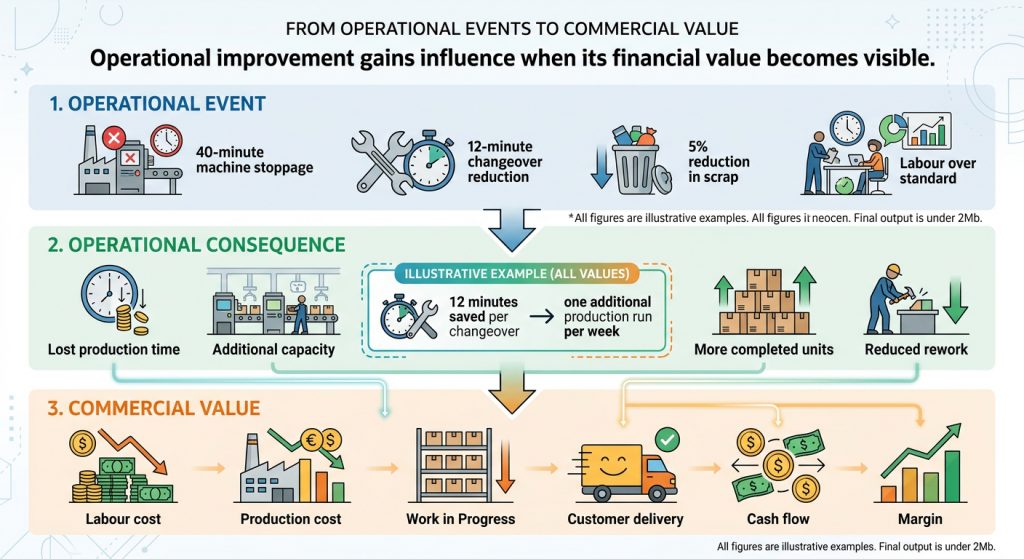
Operational measures become more influential when they are expressed commercially.

A reduction in downtime is positive.

An increase in recoverable production capacity creates a business case.

A shorter changeover is useful.

Demonstrating that the reduction creates an additional production run each week gives the improvement strategic relevance.

Manufacturers should therefore connect productivity, downtime, waste and efficiency measures with:

  • Labour cost
  • Production cost
  • Capacity
  • Work in Progress
  • Customer service
  • Cash flow
  • Margin

This creates a common language between operations, finance and senior management.

It also helps improvement teams demonstrate the real commercial value of their work.

5. Close the improvement loop

Continuous Improvement should operate as a complete cycle:

  1. Define the problem
  2. Measure current performance
  3. Identify the causes
  4. Implement the change
  5. Measure the result
  6. Control the improved process

Too many improvement projects reach the implementation stage without establishing how the result will be monitored and sustained.

Reliable operational information allows the manufacturer to determine:

  • What changed
  • Why it changed
  • Whether the improvement has continued
  • What commercial value has been created

This distinguishes a temporary improvement from a permanent change in performance.

Technology is only part of the answer

Advanced technology can support stronger manufacturing performance, but technology alone does not create a data-driven organisation.

Artificial intelligence, robotics and automation all depend on structured management, reliable information and clearly defined operational objectives.

AI cannot compensate for:

  • Inconsistent job codes
  • Unreliable standards
  • Disconnected systems
  • Poor labour attribution
  • Missing downtime reasons
  • Incomplete operational context

Before a manufacturer asks what AI could predict, it must first be able to explain accurately what has already happened.

The foundation of industrial AI is not the algorithm.

It is trusted operational data.

From data collection to operational intelligence

For many manufacturers, the answer is not to replace every existing system.

It is to create a connected operational layer between those systems, the workforce, machinery and the production environment.

That layer should be capable of:

  • Receiving orders, routings, standards and cost information
  • Presenting relevant instructions to employees
  • Capturing activity as work takes place
  • Combining employee, job, process and machine data
  • Applying operational and financial rules
  • Calculating performance at the required level of detail
  • Returning meaningful information to managers and authorised systems

Ceequel® Operational Intelligence has been designed around this principle.

It connects operational activity with information from existing business systems, machinery and the workforce.

The platform can convert job, employee, process and machine information into measures such as:

  • Labour productivity
  • Job cost
  • Work in Progress
  • Actual versus standard performance
  • Downtime
  • Overall Equipment Effectiveness
  • Cost variance
  • Margin performance

The purpose is not simply to produce more reports.

It is to create a consistent operational record that helps manufacturers understand what is happening, why it is happening and what it means commercially.

The next productivity improvement may not require another system producing another isolated set of figures.

It may begin by connecting the information the manufacturer already has—and using it to make better decisions.


There’s No Place Like Home

Education both remotely and at school is finally over until September and that means only one thing……summer is officially here!

Holidays can begin or as the UK travel industry have re-branded it, let the ‘staycation’ commence!

#Staycation. With holidays already reserved to spend via ‘Costa del Decking’ this summer, when was the last time any of us chose to take our annual leave in Blighty?

As we emerge from one of the most traumatic times in UK work history, a ‘staycation’ could just be what the doctor if not the Government ordered for UK workers. Coastal, countryside and city destinations all filled with businesses that need a helping hand at this time.

Not convinced and still prefer to jet off?

Given the current climate, is anyone particularly enamoured with the thought of sharing a tin can with 200 + strangers, on a flight loaded with masks and hand sanitiser, accompanied by the type of nervy eye-swivels that only appear when someone is brave enough to clear their throat?

Surely the option to holiday at home this year for that reason alone is more attractive.

Remember when you were a child and the only things that mattered on holiday were candy floss, building sandcastles on the beach and fish and chips, usually in that order. Children don’t particularly care where they holiday, as long as they get to have an adventure.

With UK hotels and hospitality still able to accommodate bookings, supporting local businesses is crucial at this stage of our recovery to provide the country with a much-needed economic boost and to help workers enjoy some welcome R&R time-off.

Perhaps you have always wanted to scale the dizzy heights of Ben Nevis – Bear Grylls style obviously! Maybe now is the time to accomplish that dream. Spending hours outdoors is a proven medicine for a good night’s sleep, as well as being beneficial for both mental health and physical wellbeing.

Given the current climate that’s something we could all profit from once we are back on the shop floor.

Great Britain is an amazing place so why not enjoy a ‘staycation’ this summer? Is holidaying in the UK really so bad?

After all, as Dorothy often reminds us “There’s no place like home.”

If you are interested in implementing a Human Resources Time and Attendance Management system to assist in planning your employees own summer #staycation, contact ELF Productivity Ltd today on 01257 256000 for a free, no obligation demonstration and quotation of Ceequel® software suite.

Or alternatively, our brochure catalogue can be downloaded here.

ELF Productivity Ltd and Ceequel® software, assisting, advising and supporting all our clients both remotely and office-based during the ongoing Coronavirus outbreak.

It’s A Jungle Out There

Despite the negativity surrounding the introduction of Artificial Intelligence into the workplace, there has never been a more opportune or favourable time to upskill your workforce.

As with any investment that HR make into the domain of digital transformation the prosperity of staff must be at the forefront. With the current privacy law set-up and with yet ‘another’ delayed Brexit departure, there has never been a more fundamental need for a workforce Time and Attendance software that not only supports British businesses but delivers on the promised ‘real deal’.

Over the last two decades the workplace landscape has altered enormously with vast emphasis placed not only on development but digital and social media roles. ‘Tech’ individuals dominating in positions that at one time were considered a hobby or a side-line to a person’s real job.

Jobs that are now mainstream career choices.

Generation X were the first to experience Atari, Excel, Microsoft Windows and essentially the World Wide Web, Millennials have not only embraced the digital revolution but have taken it to the next level.

The soft skills that were considered just that, i.e. ‘soft’, were effectively shelved and ultimately made redundant.

But, as everyone of a ‘certain age’ understands, ALL things come around again in their own good time. The onset of the AI revolution has brought with it a revitalisation. Soft skills are having what can only be described as a revival, a rebirth. Soft skills are ‘hip’ again, soft skills have made it back onto the job spec!

When you think of this unique skill set, what image do they convey to you? Do you instantly think of Time Management, Empathy, Compassion, Timekeeping, Communication and Teamwork?

Through no fault of their own, many ‘tech’ individuals are lacking in the ‘soft’ department and unfortunately their predicament only comes to light during employment.

During the interview process, many candidates appear to be all-singing and all-dancing but once entrenched in the workplace, you discover that in some areas they are in fact more Peter Crouch than Fred Astaire.

With AI now a very real presence and role reversals and training required in order to survive and compete in the metropolis ‘work jungle’, soft skills can be ‘fired up’ again for Generation X and for the younger, ‘techy’ generation, developed.

With Time Management systems now a key priority for the majority of businesses, the good news is that no matter how digital they become, robots will always require a helping ‘human’ hand.

If you are interested in a Biometric Time Management system for your business, contact ELF Productivity Ltd today for a no obligation quotation and demonstration of Ceequel® software.

Alternatively, our brochure catalogue can be downloaded here.

Clocking On

The academic year is now in full swing and this week for most, observes the first half-term break of the year.

Christmas is hovering just on the horizon but so is a long overdue Au Revoir! But let’s not dwell or even mention the ‘B’ word that is due to manifest ‘sometime’ this century!

So, heading swiftly ‘back to school’, have you ever contemplated why most pupils are eager to return after their Autumn break, whilst teachers and supporting staff are less than, how shall we say, ‘enthusiastic’ about clocking on.

Hmm, the world of work, sometimes it’s about as attractive an option as meeting Jeremy Corbyn at the First Dates restaurant! Stuffy, tedious, regimented routines to look forward to, the same old, same old. A titanic effort is often obligatory in order to muster up the ‘zing’ required to take you through to the welcome sound of the 5.00pm klaxon!

Somewhere in between “school’s out” for good and the real graft begins, a dissatisfied worker appears…… and that’s just the boss!

All jokes aside, shouldn’t we expect to welcome ‘clocking on’, after all, we spend more time on the shop floor than we do anywhere else. This leads us to the question “who exactly is responsible for our workplace bliss” the Line Manager, the ‘Big Boss’, HR, ourselves or something else?

Maybe the ‘something else’ is what is missing from many shop floors.

The HR crew are traditionally the main port-of-call for all worker gripes but as with everything, having the appropriate processes in-situ in the first place, not only helps but makes an enormous difference.

Employees that are granted more responsibility and freedom of choice regarding shifts, flexible/remote working options, training and progression are, in the main, likely to be more content.

Happy workforce = increased productivity

Just maybe, the crucial element to true workplace happiness doesn’t lie primarily in the salary that’s earned but, in the opportunities available, opportunities to learn and grow.

School’s out doesn’t = learning stops

Whatever the workforce age there is always something new to be mastered. By observing the eagerness displayed by school children, who like sponges, happily soak up fresh ideas and new learning, we understand that different ventures should be embraced and not feared within the workplace.

With the times that now lie ahead and with the imminent onset of AI and digital transformation this has never been more crucial.

ELF Productivity Ltd and Ceequel® software suite, the only Biometric Time and Attendance system that you will ever need in order to facilitate all your Time Management requirements for your own ‘classroom’.

If you are interested in a Biometric Time Management solution for your workforce, contact ELF Productivity Ltd today and take advantage of a free no obligation quotation and demonstration of Ceequel® software.

Alternatively, please feel free to download our brochure catalogue here.

Keep Calm and Carry On

On the 1st September 2019, the world will stand and remember the 80th Anniversary of the outbreak of World War 2.

A war that plunged Britain into a period of desolation with ‘Britannia’ once again ‘in the trenches’. A war that raged until 2nd September 1945.

After 6 long years of conflict, how much of what transpired during that period, fashioned the contemporary nation that we occupy today?

From Alan Turing and his ground-breaking work on the complex Enigma code, work that paved the way for modern Computer Science and Artificial Intelligence, to the Keep Calm and Carry On brigade of the Home Guard and the ‘Jam and Jerusalem’ steadfast ladies of the WI, WW2 produced some of our finest moments.

After all, you only really discover what’s under the surface when you are squeezed!

The PM in-situ at No 10 on that historic day was Neville Chamberlain; perhaps not the best day to be the ‘Boss’! But has history judged Neville kindly? After suddenly becoming terminally ill in 1940, we will never comprehend the manner of leadership he would’ve gone on to display.

But in all honesty, given the choice, would YOU have wanted the responsibility?

Despite his flaws, Sir Winston Churchill was perhaps the only person during that time, considered proficient enough for the ‘top job’.

Strategic planning, key decision-making, focus, dedication, commitment and loyalty, leadership qualities already in place, honed by Churchill’s many years in the military. Leadership qualities crucial to steering a nation through rationing, bombing raids, the Battle of Britain and the Blitz.

The steely British backbone the advancements in Computer Science and the birth of modern-day management as the United Kingdom re-built itself; all are by-products of the war years.

We may not be facing the same battles today, but workplaces can still be a ‘war zone’. From personality clashes to motivating staff, from business foresight to projection and ‘staying ahead of the competition’ they all require tactical planning, excellent negotiating skills and solid, dependable leadership.

So, after 80 years what have we learned? Have we learned to side-step and avoid confrontation, or have we learned to ‘step-up’ and meet our challenges head on?

One thing is certain, we have discovered that for every dedicated leader there is also an ally, an ally all too ready, willing and able to embark on that same challenge with them.

ELF Productivity Ltd and Ceequel® software the only allies you will ever need to facilitate a competent business strategy for your entire workforce.

If you are looking to introduce a Biometric Time and Attendance system into your company, contact ELF Productivity Ltd today for a free no obligation quotation and demonstration of Ceequel® software suite.

Alternatively, please feel free to download our brochure catalogue here.

Productivity Gains from Flexible Working

Every company strives to improve employee productivity. After all a productive workforce is a happy workforce and happy people often produce a higher standard of work. Reliable working is just one of many options to boost employee productivity.

Flexiable Working

Since the twentieth century UK employees have been expected to work a total of forty hours a week. Working eight hours a day, five days a week is considered natural to most people and a vast improvement on the 12 hour, 6 day week prior to that.  However as times change so do companies thoughts on how many hours an employee should work per week.

Many companies are opting to allow their employees to work a four day week – instead of the now considered – traditional five.  These companies believe that a shorter working week increases productivity levels in the workplace and therefore leads to an improved working environment.

However there are still some companies who remain unconvinced.  Detailed below are three reasons why a four day working week would be beneficial to both employers and employees.

Improved work-life balance

In today’s world, employees can struggle with finding an acceptable work-life balance.  Working long hours, five days a week, often impacts on the quality time parents spend with their children. Employees who don’t have parental commitments can also experience time intrusions on their out of work activities and social commitments.

Allowing your employees to work a four day week provides them with more personal time, giving them the chance to be more focused and productive.

Parents can spend more time with their children and family life. Employers, who are flexible on which day an employee takes off, allow both parents the opportunity to spend equal amounts of time with their children, as alternate days can be had away from the workplace.

Employees without children can also use extended weekends to participate in out of work activates such as hobbies.  A longer weekend gives staff more time to relax, meaning employees are more likely to come into work on a Monday feeling refreshed and enthusiastic.

More Productive Employees

Companies often assume that having a four day week will significantly impact the amount of productive work from employees.  This however is not known to be correct.  Employees are more aware they have less time to complete their weekly tasks and therefore they become more focused and productive.  Most employees will no longer waste time checking emails or interacting on social-sites and re-direct their attention on to completing the essential tasks in the given time.

A longer weekend also provides employees with the ability to completely switch off from work and concentrate on relaxing and revitalising.

Ultimately this leads to happier more productive employees.

Increase employee retention

Employee retention is vital to running a successful organisation. Every company wants to retain their best employees, their skills and knowledge.  Losing essential members of the workforce can not only impact businesses negatively but is often costly.  Attracting replacements can be a long, tedious and costly process and will generally have an effect on productivity and quality whilst new employees are up-skilled.

Ultimately – providing your employees with a four day week option is a positive way to incentive your employees to stay with the company.  It makes your organisation more appealing over your competitors when it comes to recruiting for new employees.   A four day working week can also act as an alternative to pay-increases or staff bonuses – improving your businesses bottom line.


12.5 working hours a week are being wasted on these 10 tasks

High productivity levels within a business are a key aspect to the survival of any organisation. So it’s surprising to find that on average 12.5 working hours a week are being wasted by UK employees on unproductive tasks. A survey carried out by vouchercodespro found that employees who worked seven and a half hours a day were only using 5 of those hours to complete their given tasks.

According to a recent survey carried out by VoucherCodesPro.co.uk’s, employees spend 12.5 working hours on average each week ‘dilly-dallying’ with tasks that have nothing to do with their current workload.   The survey was carried out on full time employees within the UK, who should be working approximately seven and a half hours a day.   However only five hours of that time was being spent productively.  The other two and a half hours were most commonly being wasted on the same 10 tasks.  Can you guess what these are?

Out of the employees surveyed 89% of them admitted to overly checking social media channels such as LinkedIn, Facebook and twitter in work time. This was then closely followed by internet shopping/ paying of bills which 84% of employees admitted to doing.

Working Hour Distractions Chart

Of the employees surveyed 58% of them admitted they weren’t scared of the repercussions as they didn’t believe they would get caught. 22% of employees admitted they were careful not to be caught off duties.  Surprisingly 20% of people revealed that their boss didn’t actually mind them taking time out from their supposed tasks as long as all work was completed on time.

Amazingly some 39% even admitted to viewing adult websites during working hours.

Do you know what your employees are doing during working hours and do you have a method of recording employee productivity?  Why not consider Ceequel® Employee Tracking?


Do you know the most productive day of the week?

Every wondered what the most productive day of a business week is?. well now we know, a recent study done by Accountemps has shown that Tuesdays are the most productive day off the week, with 33% of HR managers saying they seen a rise in there staffs productivity. Wednesday was the next productive day with 23% followed by Monday on a surprisingly high 14% as many employees are often still tired from there busy weekends.

productivity

When it comes to completing a big project or making a start on the little tasks you’ve been putting off, it has been analysed by Accountemps on 300 HR Managers, that Tuesday’s are apparently the most productive day of the week.  After all no one likes Mondays.   While Fridays signal the start of the weekend with many employees choosing to finish early meaning little work is actually being completed.

The survey showed that 33% percent of Human Resource managers noticed a rise in productivity levels on a Tuesday compared to Thursdays and Fridays which both scored below 10%. Wednesday was the next most productive day with 23% and Monday surprisingly scored higher than the last two days of the week with 14%.

Giving your employees projects that require the most focus on a Tuesdays is therefore a suggestion that many employers have probably never even considered.

The goal of course should be to attempt to replicate the improvements found on a Tuesday.  To assist in making this happen, we have four tips:

–          Prioritise

Each day make a list of your key tasks and ensure you focus on these and try not to get side tracked

–          Limit distractions

When working on key projects or tasks, turn off likely distractions such as mobile phones.  Sign out of social media sites and even close Outlook.

–          Quality is paramount

While many employees will try to rush certain tasks, it is often the case where time has not been allocated accordingly that the quality diminishes and results in the task either having to be repeated or improved.

–          Consider technology

Utilising Elf Productivity’s Employee Tracking software, employees can be set standards to complete tasks and these can be compared to actual times.  Quality can be improved as management can assess the works completed and allocate a score for quality or monitor any waste.   As this module links directly to Time and Attendance a reconciliation of productive and non-productive time can be produced at the touch of a button.

For more information about Elf’s employee tracking software contact us today!