Part 2 of a 2 Part Series……….
Most manufacturers already hold a significant amount of operational information.
The challenge is converting that information into something managers can use to improve productivity, control cost and sustain Continuous Improvement.
A dashboard containing dozens of measures may look impressive. But if it does not help the organisation make a better decision, its commercial value is limited.
Manufacturers can improve the value of their operational data by applying five practical principles.
1. Begin with the decision, not the dashboard
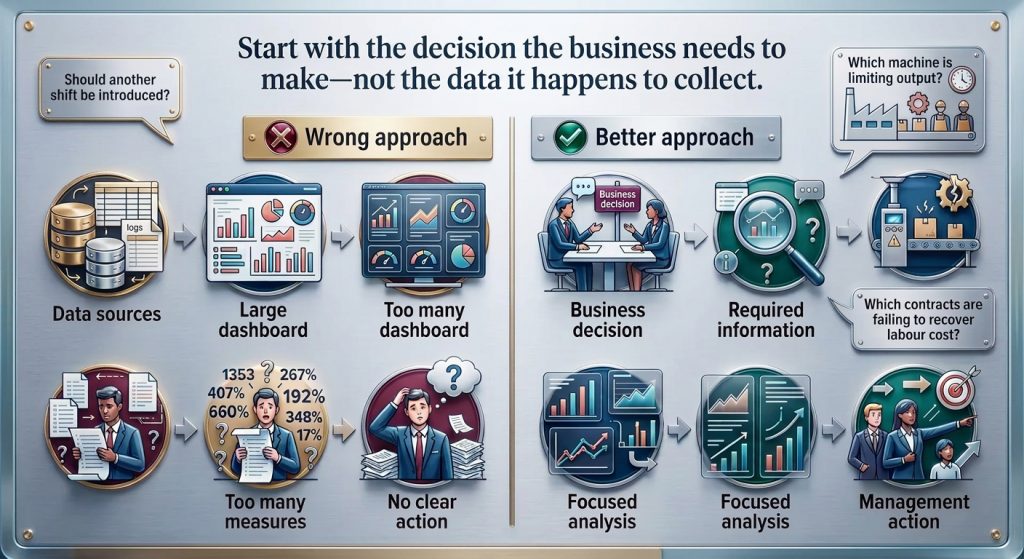
A data project should not begin by asking:
What information can we collect?
It should begin by identifying the decisions the organisation needs to improve.
For example:
- Should another shift be introduced?
- Is a particular product commercially viable?
- Which machine is creating the greatest constraint?
- Why does one production line outperform another?
- Is overtime increasing output or compensating for inefficiency?
- Which contracts are failing to recover their true labour cost?
Once the decision is clear, the manufacturer can determine which information is required to support it.
This prevents the business from collecting data simply because it is available.
2. Connect planned performance with operational reality
Most manufacturers already hold production plans, estimates, standards and expected costs.
The difficulty lies in comparing them consistently with what actually happened.
A production order should not remain an isolated record within an ERP system.
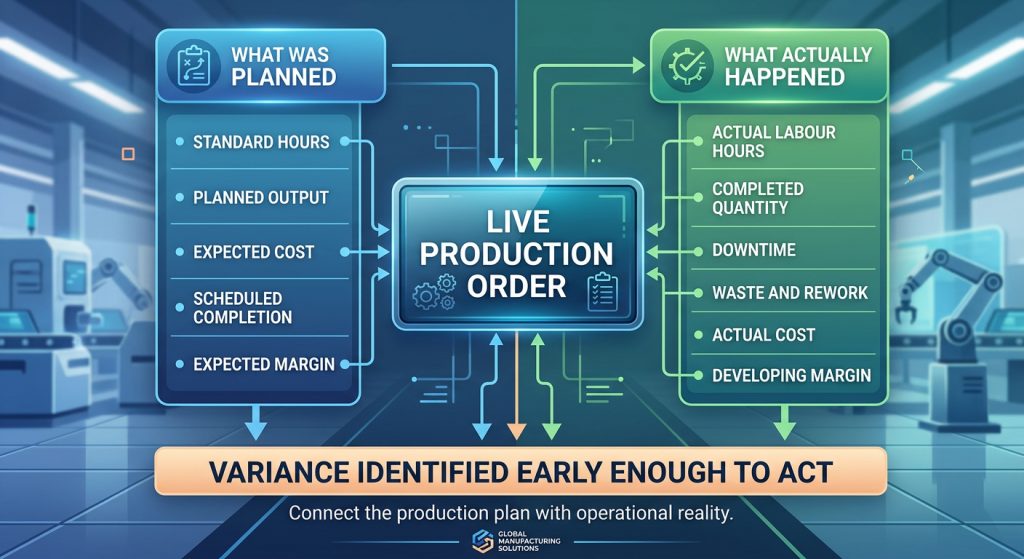
It should become a live operational entity against which the business can attribute:
- Labour
- Activities
- Machine usage
- Output
- Downtime
- Waste
- Rework
- Work in Progress
This enables the manufacturer to compare:
- Estimated cost with actual cost
- Standard hours with actual hours
- Planned output with completed output
- Expected margin with developing margin
- Scheduled completion with likely completion
Planning information then becomes a tool for operational control rather than simply a record of what was expected.
3. Capture information where the activity takes place
Operational data becomes less reliable when it depends on memory or retrospective entry.
Employees may be asked at the end of a shift to remember when a job started, why it stopped or how long they spent on an unplanned activity.
Supervisors may reconstruct events from paper records, spreadsheets and conversations.
Information should instead be captured as close as possible to the activity.
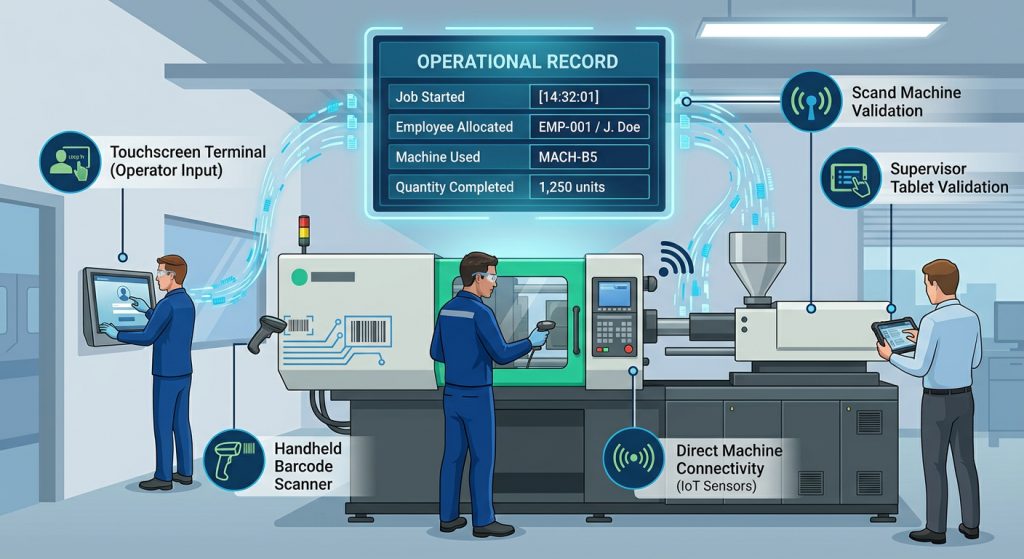
This may involve:
- Shop-floor touchscreens
- Barcode scanners
- Mobile devices
- Machine and PLC signals
- Automated data feeds
- Simple employee declarations
- Supervisor validation
The objective should not be to create more administration.
It should be to make accurate data capture a natural part of completing the work.
4. Translate operational variance into financial value
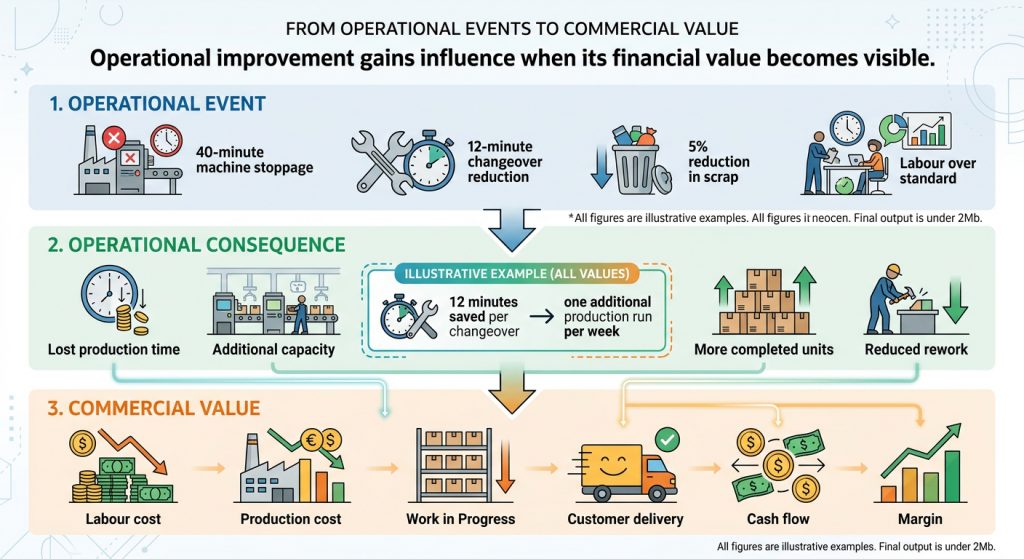
Operational measures become more influential when they are expressed commercially.
A reduction in downtime is positive.
An increase in recoverable production capacity creates a business case.
A shorter changeover is useful.
Demonstrating that the reduction creates an additional production run each week gives the improvement strategic relevance.
Manufacturers should therefore connect productivity, downtime, waste and efficiency measures with:
- Labour cost
- Production cost
- Capacity
- Work in Progress
- Customer service
- Cash flow
- Margin
This creates a common language between operations, finance and senior management.
It also helps improvement teams demonstrate the real commercial value of their work.
5. Close the improvement loop
Continuous Improvement should operate as a complete cycle:
- Define the problem
- Measure current performance
- Identify the causes
- Implement the change
- Measure the result
- Control the improved process
Too many improvement projects reach the implementation stage without establishing how the result will be monitored and sustained.
Reliable operational information allows the manufacturer to determine:
- What changed
- Why it changed
- Whether the improvement has continued
- What commercial value has been created
This distinguishes a temporary improvement from a permanent change in performance.
Technology is only part of the answer
Advanced technology can support stronger manufacturing performance, but technology alone does not create a data-driven organisation.
Artificial intelligence, robotics and automation all depend on structured management, reliable information and clearly defined operational objectives.
AI cannot compensate for:
- Inconsistent job codes
- Unreliable standards
- Disconnected systems
- Poor labour attribution
- Missing downtime reasons
- Incomplete operational context
Before a manufacturer asks what AI could predict, it must first be able to explain accurately what has already happened.
The foundation of industrial AI is not the algorithm.
It is trusted operational data.
From data collection to operational intelligence
For many manufacturers, the answer is not to replace every existing system.
It is to create a connected operational layer between those systems, the workforce, machinery and the production environment.
That layer should be capable of:
- Receiving orders, routings, standards and cost information
- Presenting relevant instructions to employees
- Capturing activity as work takes place
- Combining employee, job, process and machine data
- Applying operational and financial rules
- Calculating performance at the required level of detail
- Returning meaningful information to managers and authorised systems
Ceequel® Operational Intelligence has been designed around this principle.
It connects operational activity with information from existing business systems, machinery and the workforce.
The platform can convert job, employee, process and machine information into measures such as:
- Labour productivity
- Job cost
- Work in Progress
- Actual versus standard performance
- Downtime
- Overall Equipment Effectiveness
- Cost variance
- Margin performance
The purpose is not simply to produce more reports.
It is to create a consistent operational record that helps manufacturers understand what is happening, why it is happening and what it means commercially.
The next productivity improvement may not require another system producing another isolated set of figures.
It may begin by connecting the information the manufacturer already has—and using it to make better decisions.